New York Quitclaim Deed (Two Grantors)
County Specific Legal Forms Validated as recently as October 14, 2026 by our Forms Development Team
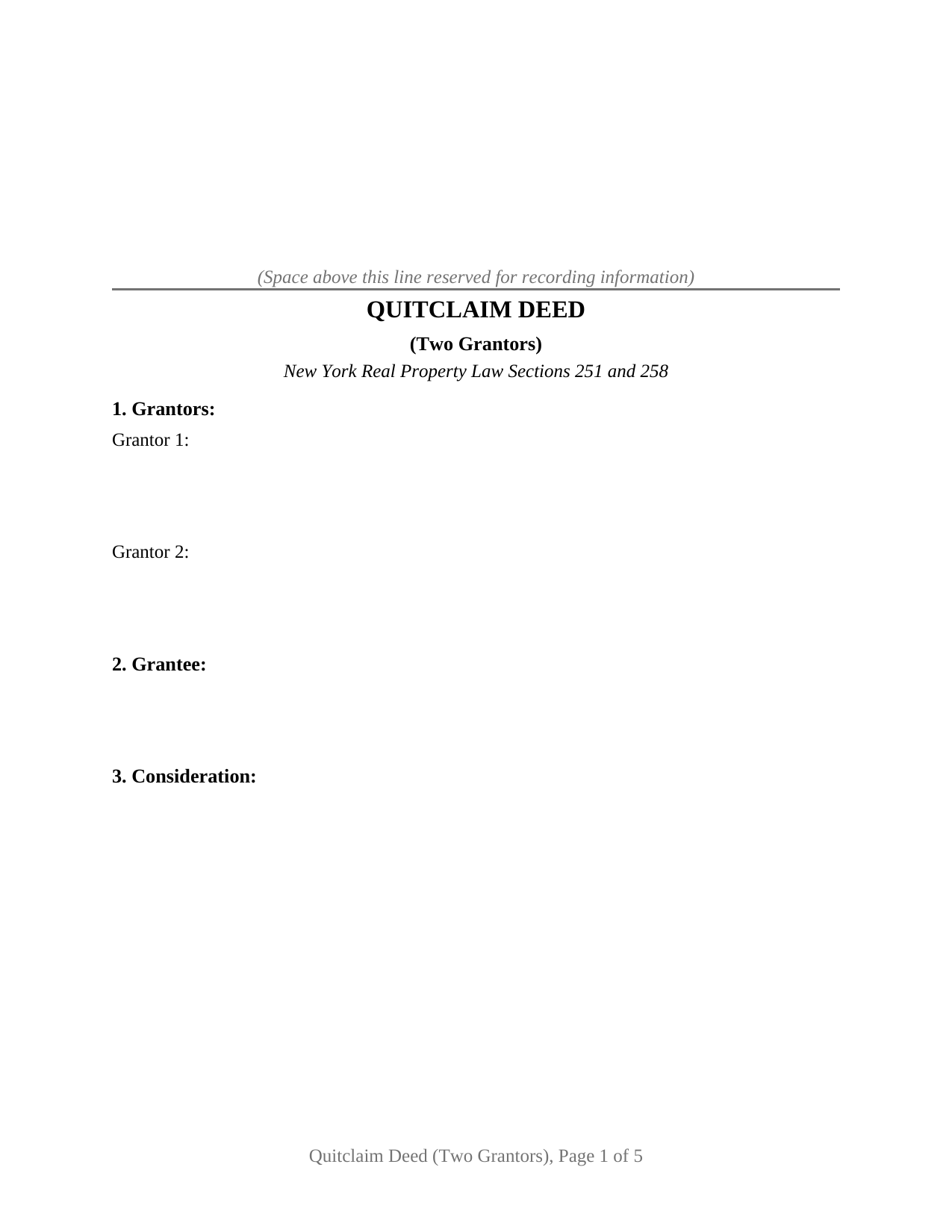
About the New York Quitclaim Deed (Two Grantors)
How to Use This Form
- Select your county from the list
- Download the county-specific form
- Fill in the required information
- Have the document notarized if required
- Record with your county recorder's office
What Others Like You Are Saying
"The process was easy and the Staff was very helpful. Document was recorded quickly."
"good format, helpful instructions"
"A suggestion: Include instructions on how to add your spouse to the deed, rather than transferring c…"
"I used your TOD document to deed my home to my daughter. Your sample document was very helpful. I ha…"
"Quick, easy and reasonably priced."
4.8/5 from 4,828 reviews. Read all
Two record owners, one recorded instrument: this quitclaim deed for New York real property carries a pair of grantor signature blocks and a pair of notary certificates, so both owners release their interests through the same deed rather than through two separate filings. Whatever right, title, and interest the two named grantors hold passes to the grantee together, and the grantee ends up holding exactly the combined interest the signers actually owned.
Two grantors, two acknowledgment certificates
The form recites exactly two grantors, each an individual signing personally. Section 1 collects both names with their residence addresses, the signature section carries a separate line, printed name, and date for each signer, and the notary pages carry one acknowledgment certificate per grantor in the substance of the Real Property Law Section 309-a uniform form. Because each certificate stands alone, the two grantors may sign on different days, in different counties, or before different officers; the completed example shows one grantor acknowledging on July 10 and the other four days later before a different notary. New York law does not demand a certificate per signer, since the statutory form is written in plural-inclusive terms; the two-certificate layout is what lets a pair of owners finish the deed without coordinating a single notary appointment.
Ownership patterns that present two grantors in the record include a married couple conveying property titled in both names, two co-tenants consolidating a shared title in a single name, and co-owners jointly passing their combined interests to one recipient. Where the two grantors are spouses holding as tenants by the entirety, the second signature is the load-bearing one: New York case law treats a deed by one spouse alone as reaching only that spouse's own interest, while a conveyance in which both spouses join passes the entire estate. The form is not set up as a single-owner release, an entity conveyance, or a deed for three or more grantors; those configurations recite different signature and capacity patterns.
A conveyance without promises
The operative section performs the release in the words of the statutory short form: the grantors remise, release, and quitclaim to the grantee. Real Property Law Section 251 provides that no covenant is implied in a New York conveyance, and this deed adds none, so the instrument transfers the grantors' interests, if any, with no warranty of title behind them. The deed also prints the trust fund covenant of Lien Law Section 13, the clause that preserves a conveyance's priority where a building improvement recently commenced, and a matters-of-record section whose listing is expressly informational, creating no covenant of its own.
Face-of-the-deed details New York collects
Real Property Law Section 333 drives several of the blanks: residence addresses with street numbers for the parties, the city, town, or village where the land lies, and, in county practice, the parcel's tax map identifier, whether a section, block, and lot or a Monroe-style tax account number. The form also gathers the source of title, the street address, and the legal description carried forward from the deed by which the two grantors took title, and it reserves the top of its first page for the clerk's recording stamp.
Recording the finished deed
The signed and acknowledged deed is recorded with the county clerk of the county where the property is located, through ACRIS in the four City Register boroughs. Companion filings, prepared separately at recording time, complete the package: the joint TP-584 transfer tax return, due whether or not any tax is owed, and the RP-5217 transfer report with its filing fee. State transfer tax runs two dollars per five hundred dollars once consideration passes five hundred dollars, and the statute exempts bona fide gifts. Under the recording act, a deed left unrecorded is void against a later good faith purchaser from the same grantors who records first, so a finished two-grantor deed heads to the clerk promptly.
The package delivers three items: the quitclaim deed, often searched as a quit claim deed, as a fillable blank; a completed example showing the form finished for a two-grantor Monroe County transfer; and a plain-language guide covering every numbered section, both acknowledgment certificates, and the recording package. The materials are informational and are not legal advice; a New York attorney can speak to how a two-grantor release operates on a particular title.
Important: County-Specific Forms
Our quitclaim deed (two grantors) forms are specifically formatted for each of the 62 counties in New York.
After selecting your county, you'll receive forms that meet all local recording requirements, ensuring your documents will be accepted without delays or rejection fees.