New York Quitclaim Deed (Individual Grantor by Attorney-in-Fact)
County Specific Legal Forms Validated as recently as October 13, 2026 by our Forms Development Team
About the New York Quitclaim Deed (Individual Grantor by Attorney-in-Fact)
How to Use This Form
- Select your county from the list
- Download the county-specific form
- Fill in the required information
- Have the document notarized if required
- Record with your county recorder's office
What Others Like You Are Saying
"Great service! fast turnaround! I’ve used Deeds.com multiple times, and the software interface is ea…"
"Thank You, Job well done. So nice not to have to leave house and drive all over to record these docu…"
"Got the legal forms, they worked. Nothing exciting but that probably a good thing."
"The site worked well for me."
"Couldnt have been easier. Docs recorded the next day!"
4.8/5 from 4,829 reviews. Read all
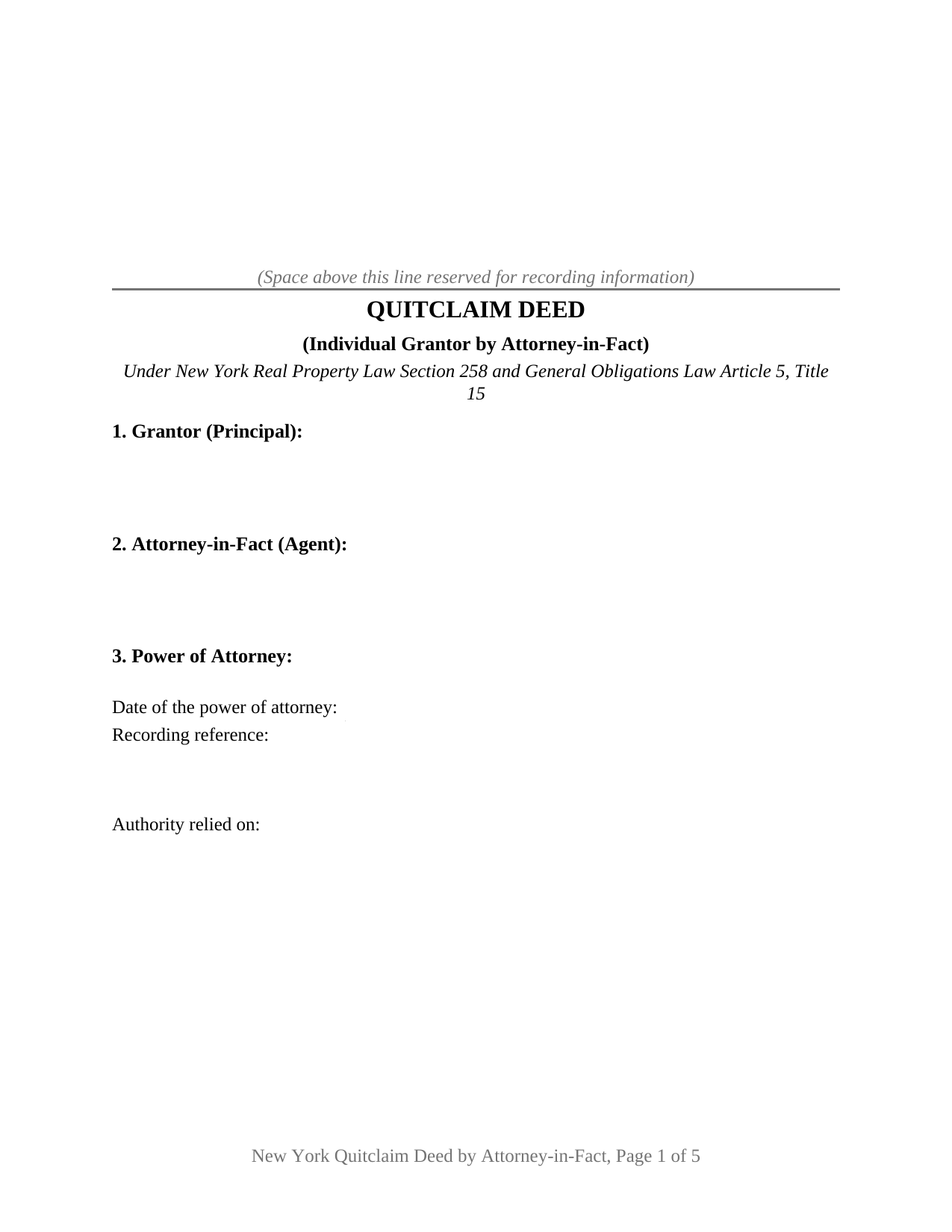
The owner named as Grantor on this New York quitclaim deed never signs it. An attorney-in-fact signs in that owner's name, and a numbered section identifies the power of attorney behind the signature by its date, by its recording reference, and by the authority relied on. This form prepares that instrument, often typed as a quit claim deed, for New York real property released through an agent rather than by the record owner in person.
The section an owner's own deed never needs
Section 3 exists because the authority here is a document the recorded deed identifies. General Obligations Law Section 5-1502A construes the words real estate transactions in a statutory short form power of attorney, and its second subdivision names this deed's act outright, among them to convey either with or without covenants, to quit-claim, and to release any estate or interest in land. The ninth subdivision reaches execution itself, the power to execute, acknowledge, seal and deliver a deed, and the section makes those powers exercisable as to land the principal held when the power was given or acquired later.
A signature that names two people
Section 5-1507 governs how the relationship appears in a handwritten signature: the agent's name as agent for the principal, or the principal's name by the agent as agent, or any similar written disclosure of it. New York's uniform certificate accommodates that arrangement in its own words, the Real Property Law Section 309-a closing clause recording that the individual, or the person upon behalf of which the individual acted, executed the instrument. The printed name line carries the fiduciary capacity, and one signer means one certificate.
Where authority stops being routine
Conveying the principal's property without consideration operates as a gift of it, and the statutory short form treats gifts apart from real estate transactions. Section 5-1502I reaches customary gifts capped at five thousand dollars in the aggregate per calendar year. The certain gift transactions provision of the Section 5-1513 form calls for express authorization in the Modifications section for gifts beyond that total and for changes to interests in the principal's property, and Section 5-1505 makes the agent a fiduciary who may not gift the principal's property to the agent's own self without specific authorization.
The attorney-in-fact configuration
The form recites exactly one Grantor, an individual record owner, and exactly one attorney-in-fact who signs for that owner and not individually, with one signature block and one Section 309-a certificate. Conveyances presenting this configuration appear in the record where the owner lives far from the parcel or outside the country, where a durable power of attorney is in use after a loss of capacity, and where an unavailable owner's fractional interest is released in a family settlement. The form is not arranged for a record owner signing in person, for two record owners, for a company acting through a member or officer, or for a fiduciary drawing authority from a trust instrument or from letters.
A release with nothing promised
The operative words are the Section 258 statutory short form words, remise, release and quitclaim, and Section 251 leaves them bare, since a covenant is not implied in a New York conveyance. Two printed clauses hold their place beside them: the Lien Law Section 13 trust fund covenant, which keeps a conveyance recorded during a building improvement ahead of mechanics liens filed afterward, and a listing of recorded matters printed with a line stating that it grants no warranty.
Two instruments at the counter
The deed goes to the clerk of the county where the land lies, or through ACRIS in four boroughs, and Section 291 rewards the conveyance that reaches the record first. The power travels with it, since Real Property Law Section 294 allows an instrument containing a power to convey real property as agent for the owner to be recorded in a county where the property sits. Prepared separately at filing are the joint TP-584 return, due whether or not tax is payable, and the RP-5217 transfer report on legal paper with its fee.
Three items make up the download: the blank deed as a fillable PDF, a completed example prepared for an Oneida County release signed by an agent, and a plain language guide that works through the twelve numbered sections, the acknowledgment certificate, and the returns filed alongside the deed. The materials are informational and are not legal advice. What a particular power of attorney authorizes, and what an agent's release reaches on a given title, are questions for a New York attorney.
Important: County-Specific Forms
Our quitclaim deed (individual grantor by attorney-in-fact) forms are specifically formatted for each of the 62 counties in New York.
After selecting your county, you'll receive forms that meet all local recording requirements, ensuring your documents will be accepted without delays or rejection fees.