New York Quitclaim Deed (Trustee Grantor)
County Specific Legal Forms Validated as recently as October 12, 2026 by our Forms Development Team
About the New York Quitclaim Deed (Trustee Grantor)
How to Use This Form
- Select your county from the list
- Download the county-specific form
- Fill in the required information
- Have the document notarized if required
- Record with your county recorder's office
What Others Like You Are Saying
"Wonderful service, forms were great. Completed and ready for recording. Will check back in after rec…"
"Thank you for making my life easier!!"
"I got what I was looking for! Turned out well and like I thought it would."
"what do you do with it once filled out. doesn't tell you"
"It was very easy to use the website. I wish there was an option to pay for multiple documents at onc…"
4.8/5 from 4,828 reviews. Read all
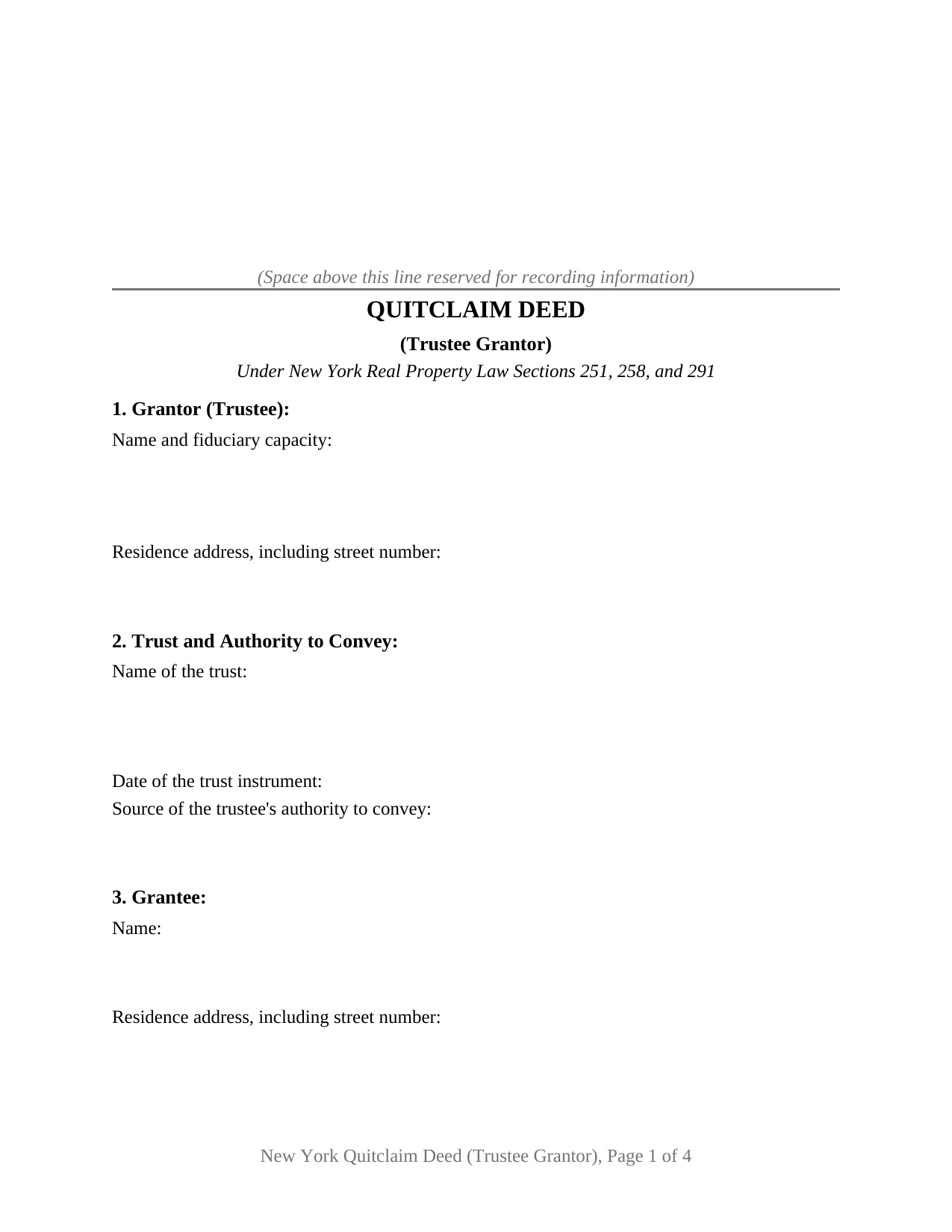
Property leaves a trust the way it entered one, through a recorded deed, and on this New York form the grantor is the trustee who holds the legal estate. Section 1 gives the trustee's name together with the fiduciary capacity in which that person signs; Section 2 gives the trust, the date of its trust instrument, and the power being exercised. This form prepares a quitclaim deed, also typed as quit claim deed, for New York real property passing out of a trusteeship to a named grantee.
Why the trustee is the grantor
Under Estates, Powers and Trusts Law Section 7-2.1(a), an express trust vests the legal estate in whoever is serving as trustee, and it does so subject to the execution of the trust; the beneficiary receives no legal estate at all and holds a right to enforce instead. Only the serving trustee, then, can sign away trust real property, which is why the fiduciary capacity belongs on the grantor side of this instrument.
The blanks a fiduciary grantor adds
Section 2 is the section an ordinary owner's deed has no use for. It collects the name of the trust, the date of the trust instrument, and the source of the trustee's authority to convey, which is an article of the trust agreement, a court order, or the statutory power to sell that Estates, Powers and Trusts Law Section 11-1.1 supplies where the instrument says nothing. That entry matters outside the deed too, because Section 7-2.4 makes a trustee's conveyance in contravention of an expressed trust void except as Article 7 and other law authorize, while Section 7-3.2 protects a purchaser for value without notice of an undeclared trust.
The trustee-grantor configuration
The form recites exactly one grantor, an individual signing as trustee of one named trust and not individually, with one signature block whose printed name line carries the capacity, and one acknowledgment certificate in the substance of the Real Property Law Section 309-a uniform form. That certificate reaches a fiduciary signature on its own terms, since its wording covers execution in the signer's capacity and by the person on whose behalf the signer acted, and subdivision 4 defines person to include a trust and any entity in a representative capacity. Conveyances out of trust appearing in the record with this configuration include a trustee distributing property to a beneficiary as a trust winds up, a successor trustee conveying under powers the trust agreement grants, a trustee deeding property back to the person who created the trust, and a trustee releasing an interest of uncertain extent. The form recites one individual trustee; co-trustees executing together, a bank or trust company acting through an authorized officer, an executor drawing authority from letters, and a trustee taking title rather than giving it each present a different party and signature section than this deed carries.
A release with nothing promised behind it
The operative words are the statutory short form words of Real Property Law Section 258, remise, release and quitclaim, and Section 251 leaves them unaccompanied: a covenant is not implied in a New York conveyance, so the deed passes the estate the trustee holds and vouches for none of it. Section 10 adds the Lien Law Section 13 trust fund covenant that customary New York printed deeds carry, and Section 9's listing of matters of record says in print that it creates none.
Tax and the trip to the clerk
A deed out of trust often moves for no money, and Tax Law Section 1405(b) reaches that case twice: paragraph 4 covers a conveyance without consideration and otherwise than in connection with a sale, and paragraph 6 covers a mere change of identity or form of ownership with no change in beneficial ownership. Section 1404 still presumes the conveyance taxable, and no exemption excuses the joint TP-584 return or the RP-5217 report on legal paper. The finished deed goes to the clerk of the county where the land lies, or through ACRIS in four of the boroughs, and Section 291 rewards getting there first.
Three items arrive in the download: the trustee quitclaim deed as a blank fillable PDF, a completed example prepared for a Saratoga County distribution out of a revocable trust, and a plain language guide walking through all eleven numbered sections, the certificate, and the companion filings. The materials are informational and are not legal advice. Whether a particular trust agreement carries the power a given conveyance exercises is a question for a New York attorney.
Important: County-Specific Forms
Our quitclaim deed (trustee grantor) forms are specifically formatted for each of the 62 counties in New York.
After selecting your county, you'll receive forms that meet all local recording requirements, ensuring your documents will be accepted without delays or rejection fees.