New York Quitclaim Deed (Married Grantor with Non-Owner Spouse Joinder)
County Specific Legal Forms Validated as recently as October 5, 2026 by our Forms Development Team
About the New York Quitclaim Deed (Married Grantor with Non-Owner Spouse Joinder)
How to Use This Form
- Select your county from the list
- Download the county-specific form
- Fill in the required information
- Have the document notarized if required
- Record with your county recorder's office
What Others Like You Are Saying
"This was super easy and fast!"
"Worked well."
"I needed a Missouri Notice of Intent to Sell without a named designated buyer. Mo Statutes require n…"
"Perfect timing. Everything was consistent and timely."
"Excellent Service! Quick and easy! Will definitely be using again!"
4.8/5 from 4,829 reviews. Read all
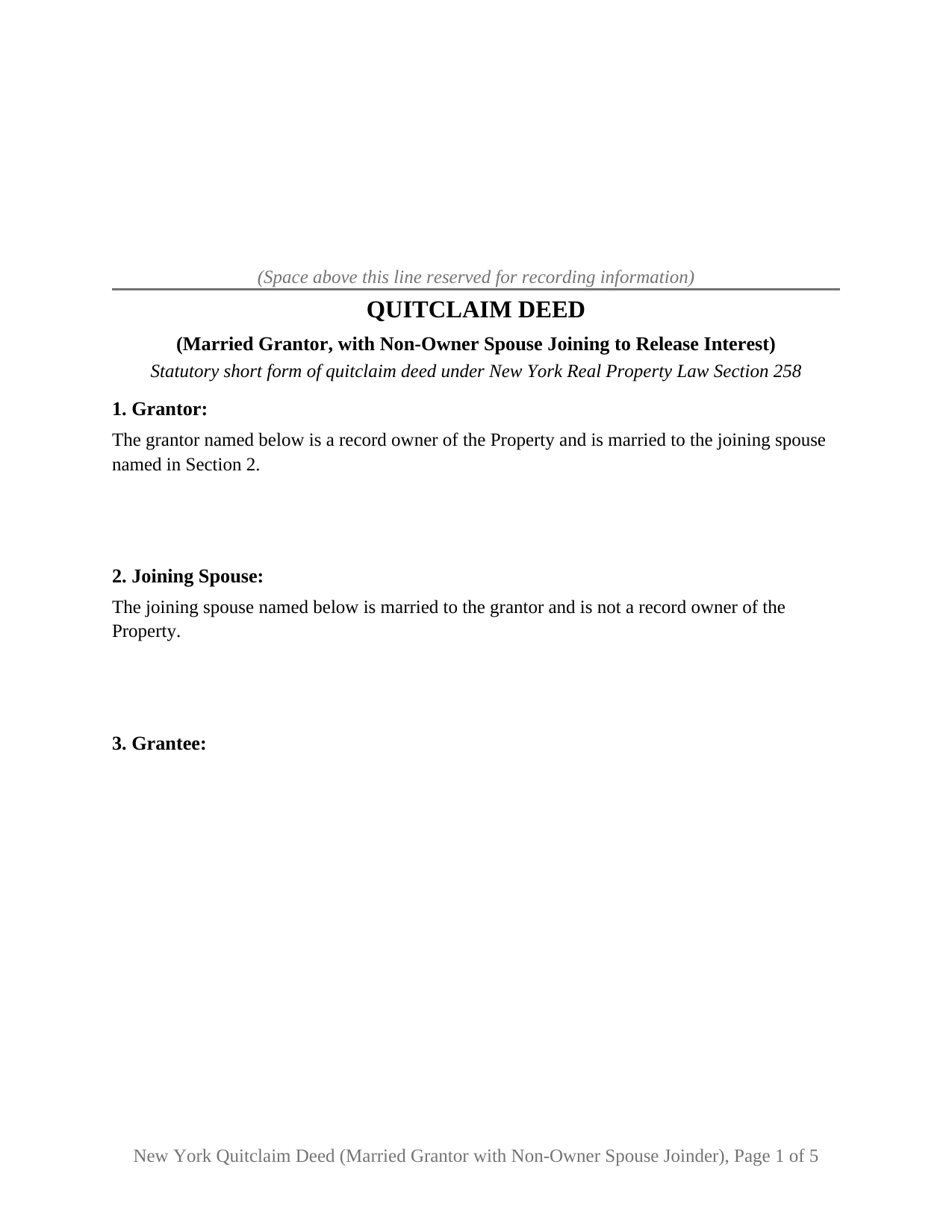
Two people sign this New York quitclaim deed and only one of them owns the property. The grantor named in Section 1 holds title in his or her own name and states that he or she is married; the spouse named in Section 2 holds no record interest and signs to release rather than to convey. This form prepares that deed, sometimes typed as a quit claim deed, for a married record owner whose spouse is not on the title.
A signature that releases instead of conveying
The deed performs two acts in two numbered sections. Section 8 is the owner's quitclaim, in the operative words of the Real Property Law Section 258 statutory short form: the grantor remises, releases, and quitclaims all estate, right, title, interest, claim, and demand in the property. Section 9 is narrower by design. It states in print that the joining spouse is not a record owner and conveys no fee, then releases to the grantee whatever interest that spouse has or may claim, whether arising by reason of the marriage or otherwise, for that purpose only. Section 251 provides that no covenant is implied in a New York conveyance, so neither signature carries a warranty of title.
Why a spouse who is not on the title signs at all
New York asks for no such signature. No homestead joinder statute conditions a deed of property titled in one spouse's name alone on the other spouse's signature, and the old marital interests are gone from modern titles: Real Property Law Section 190 confines dower to marriages contracted before September 1, 1930, and Section 189 abolished curtesy for a wife dying after August 31, 1930. The joinder answers a title question rather than a statutory one. Where the chain leaves open whether a spouse holds or claims an interest, a release recorded with the deed puts the answer where the next examiner reads it.
The joinder configuration
Section 1 recites one grantor who is a record owner and married; Section 2 recites the spouse who is not. Each signer has a signature block with a printed name and date, and the notary pages carry one certificate per signer in the substance of the Real Property Law Section 309-a uniform form. Sole title in one spouse's name commonly arises where the property was acquired before the marriage, where it came to one spouse by gift or inheritance, or where the vesting deed named one spouse alone, and a title examiner's requisition for a spousal release presents the same pattern from the other side. The form recites exactly one record owner and one non-owner spouse; a deed in which the record shows both spouses as owners recites both of them as grantors of the fee, and a signer holding title in a fiduciary or entity capacity recites that capacity and its authority.
What the deed collects on its face
Real Property Law Section 333 shapes several blanks: residence addresses with street numbers for the parties, the city, town, or village where the land lies, and the county's tax map identifier. The property sections also carry the street address, the source of title, and the legal description carried forward from the grantor's vesting deed. Section 10 prints the trust fund covenant of Lien Law Section 13, the clause New York printed forms carry so that a conveyance recorded during a building improvement keeps its position against mechanics' liens filed afterward.
Notary, clerk, and the filings that ride along
Both signers acknowledge before a notarial officer. The Section 309-a form is written in plural inclusive terms, so one certificate can cover signers who appear together, and New York law does not require a certificate per signer; the two printed certificates let the owner and the spouse acknowledge on different days or before different officers. The completed example shows both before the same Dutchess County notary. The deed then goes to the clerk of the county where the land lies, or to the City Register in the four boroughs it serves, with the TP-584 transfer tax return and the RP-5217 transfer report prepared separately at filing.
The download holds the deed as a blank fillable PDF, a completed example prepared for a Dutchess County transfer, and a plain language guide covering the eleven numbered sections, both certificates, and the recording package. The materials are informational and are not legal advice. What interest a particular spouse holds, and what a release reaches, are questions for a New York attorney.
Important: County-Specific Forms
Our quitclaim deed (married grantor with non-owner spouse joinder) forms are specifically formatted for each of the 62 counties in New York.
After selecting your county, you'll receive forms that meet all local recording requirements, ensuring your documents will be accepted without delays or rejection fees.