New York Quitclaim Deed (Trustee Grantee)
County Specific Legal Forms Validated as recently as October 2, 2026 by our Forms Development Team
About the New York Quitclaim Deed (Trustee Grantee)
How to Use This Form
- Select your county from the list
- Download the county-specific form
- Fill in the required information
- Have the document notarized if required
- Record with your county recorder's office
What Others Like You Are Saying
"So far, it's been a very seamless experience! Easy way to get documents recorded. Worth the money"
"GREAT STUFF TKS"
"I am so happy that I was able to get these forms. So simple to get and seems like will be easy to fi…"
"Found just the form I was looking for. It was an easy download process. Now just have to complete th…"
"Outstanding forms, thanks for making this easy."
4.8/5 from 4,832 reviews. Read all
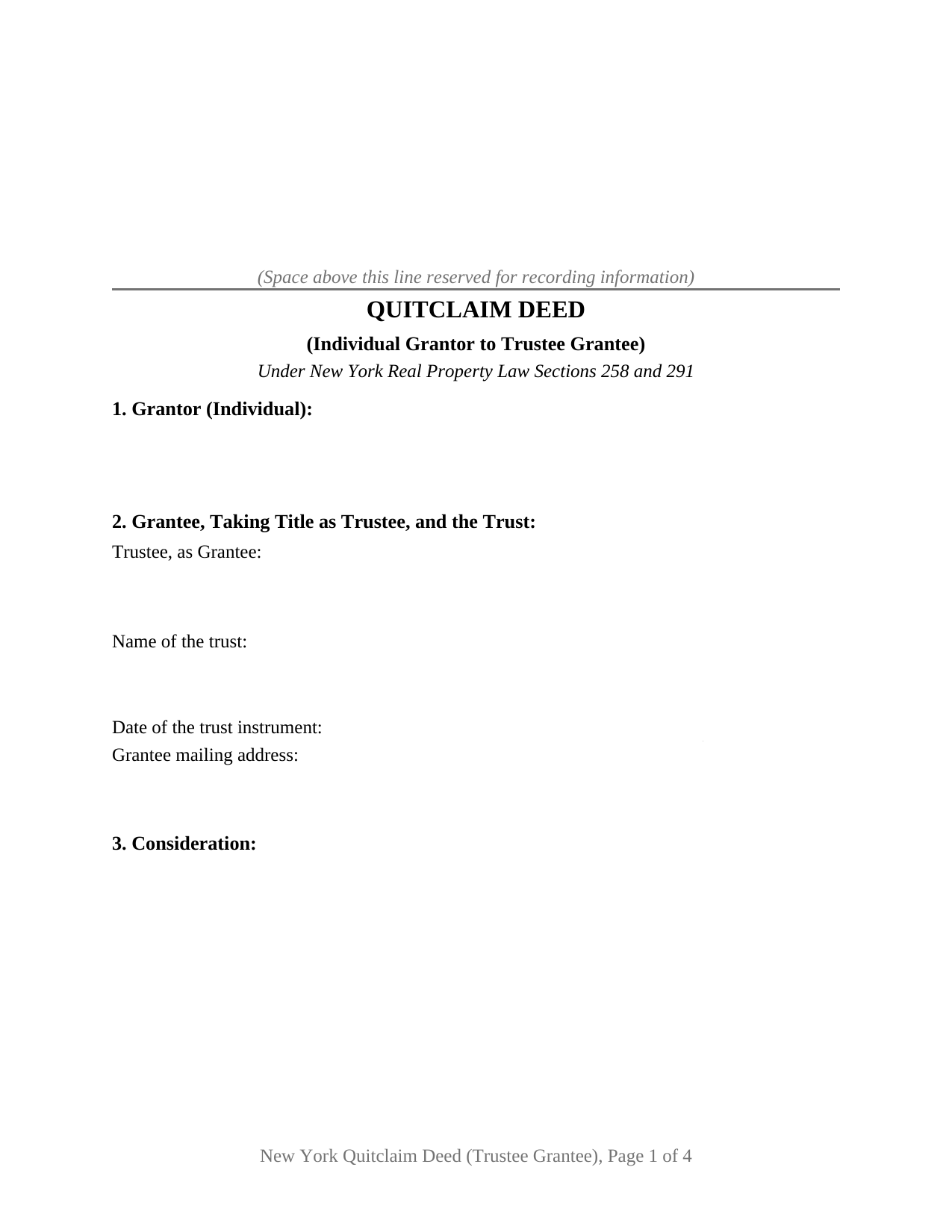
The blank that defines this New York quitclaim deed sits on the receiving side. Section 2 names a trustee, the trust that trustee serves, and the date of the trust instrument, so the land records show not only who takes the property but in what capacity. This form prepares a quitclaim deed, also typed as a quit claim deed, for New York real property moving out of one individual owner's name and into the hands of a trustee.
Why the trustee is the grantee, and not the trust
Estates, Powers and Trusts Law Section 7-2.1(a) puts the legal estate of an express trust in the trustee, subject only to the execution of the trust, and leaves the beneficiary with no legal estate and a right to enforce. An ordinary lifetime trust therefore takes title through the person serving as its trustee, which is how the grantee is described on this deed. A narrow exception in Section 7-2.1(c) lets the trusts named in Sections 9-1.5, 9-1.6, and 9-1.7, business trusts among them, acquire property in the trust's own name.
Recording as the act that funds the trust
Section 7-1.18 measures a lifetime trust by what has actually been transferred into it, and states that a transfer is not accomplished by a recital of assignment, holding, or receipt in the trust instrument. Where the person who set up the trust is also its sole trustee, the same section defines transfer of a registrable asset such as real estate as the recording of the deed in the name of the trust or trustee. In that common arrangement the trip to the clerk is not merely a priority step, it is the funding step.
The trustee-grantee configuration
The form recites one individual grantor signing personally, and one grantee taking as trustee of one named trust, with separate blanks for the trustee, the trust name, the date of the trust instrument, and the grantee mailing address. A single signature block and a single acknowledgment certificate follow, in the substance of the Real Property Law Section 309-a uniform form; the trustee signs nothing, since a New York deed is executed by the grantor alone. Where two or more people take as trustees, Estates, Powers and Trusts Law Section 6-2.2(e) makes them joint tenants unless the instrument provides otherwise, and Section 9 of this deed leaves that fiduciary default in place. Patterns appearing in the record with this configuration include an owner placing a home into a revocable lifetime trust and a parent moving a family parcel to the trustee of a trust set up for children. Deeds executed by two record owners, by spouses together, or by a business entity present different party and signature sections than this form carries.
A release with no promise behind it
The operative words come from the statutory short form of Real Property Law Section 258: remise, release, and quitclaim. Nothing is said about the state of the title, and Section 251 keeps it that way by refusing to imply covenants into a New York conveyance. Section 10 prints the short trust fund statement that Lien Law Section 13(5) accepts in place of the full covenant, which protects a recorded conveyance against mechanics' liens filed after a building improvement has begun.
The tax forms that ride along
Transfers into a trust are usually made for no money, and Tax Law Section 1405(b) carries two exemptions that reach them: paragraph 4 for a conveyance without consideration and otherwise than in connection with a sale, and paragraph 6 for a mere change of identity or form of ownership where beneficial ownership does not change. Neither exemption removes the paperwork. A joint TP-584 return accompanies the conveyance, TP-584-NYC where the parcel sits in the five boroughs, and the RP-5217 transfer report goes in on legal size paper with its filing fee. A mortgage left on the parcel counts toward consideration under Section 1401(d), which is where a transfer made as a gift can still meet the tax.
The download holds three items: the blank deed as a fillable PDF, a completed example prepared for an Ulster County transfer into a revocable lifetime trust, and a plain language guide covering the eleven numbered sections, the certificate, and the filings that travel with the deed. The materials are informational and are not legal advice; a New York attorney can address how a conveyance to a trustee lands on a particular title.
Important: County-Specific Forms
Our quitclaim deed (trustee grantee) forms are specifically formatted for each of the 62 counties in New York.
After selecting your county, you'll receive forms that meet all local recording requirements, ensuring your documents will be accepted without delays or rejection fees.