New York Quitclaim Deed (Married Couple as Grantors)
County Specific Legal Forms Validated as recently as October 13, 2026 by our Forms Development Team
About the New York Quitclaim Deed (Married Couple as Grantors)
How to Use This Form
- Select your county from the list
- Download the county-specific form
- Fill in the required information
- Have the document notarized if required
- Record with your county recorder's office
What Others Like You Are Saying
"Quick and easy. I will definitely use this services again."
"Great communication, this was my first e-recording."
"I requested a property report and it was completed fast and accurately. I would highly recommend thi…"
"I was very pleased. It was the form I needed. I was getting discouraged by companies that wanted me …"
"Very helpful. The Register office is closed in Detroit due to covid, but after using it, I would do …"
4.8/5 from 4,828 reviews. Read all
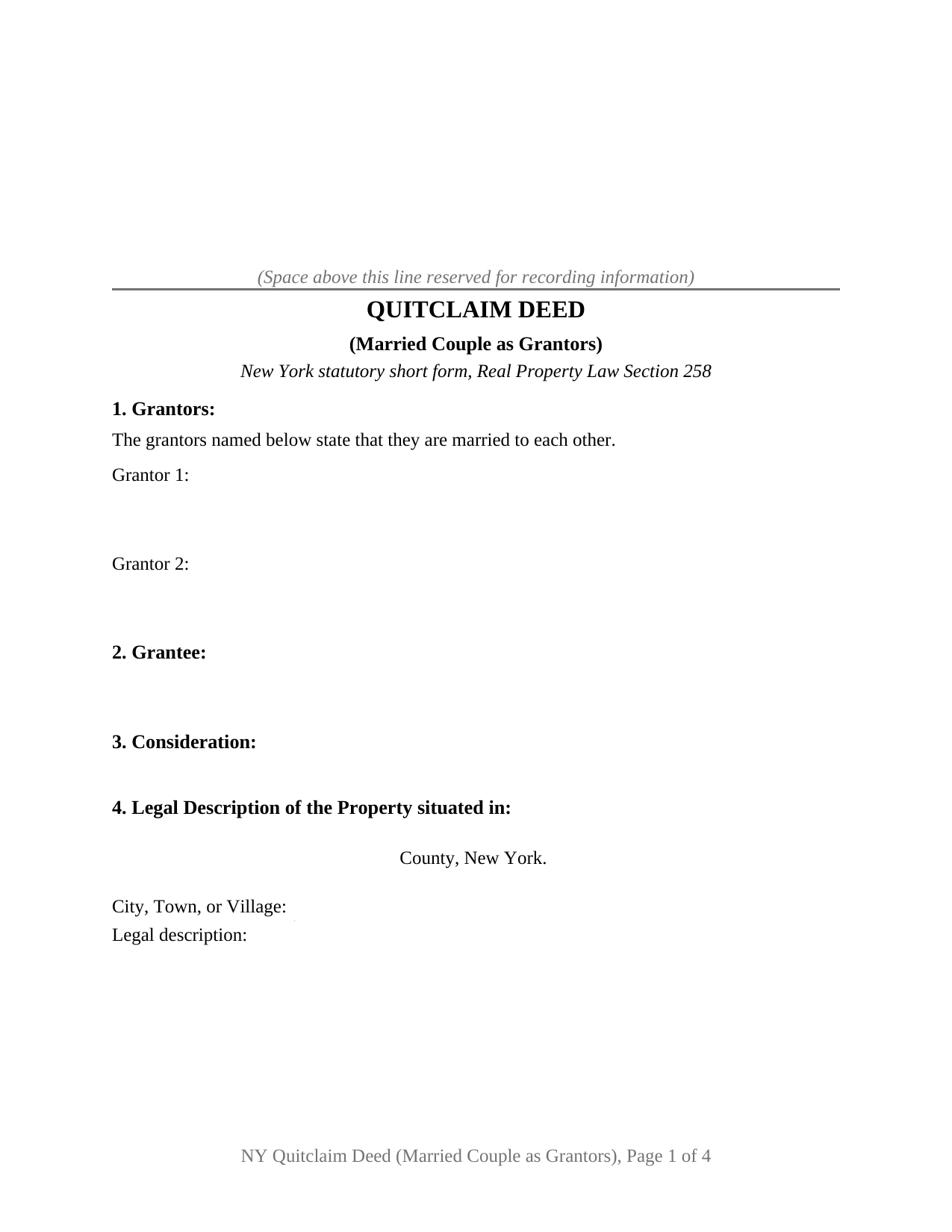
A quitclaim deed whose defining entry is a marriage: Section 1 of this New York form names two grantors and states, on the face of the deed, that they are married to each other. Both spouses execute, and their combined estate, right, title, and interest passes to the grantee through a single recorded instrument. This form prepares the deed, often typed as quit claim deed, for spouses conveying New York real property together.
One estate, two signatures
When a New York deed conveys real property to a legally married couple, EPTL 6-2.2(b) makes them tenants by the entirety by default, an ownership form in which each spouse holds the undivided whole with a built-in right of survivorship. That estate shapes how it leaves the record. A release signed by one spouse alone reaches only that spouse's alienable interest and cannot cut off the other spouse's survivorship; the couple executing together is what carries the entire fee out of their names during life. This form is arranged around that joint execution: the marital recital in Section 1, a signature block for each spouse, and operative language in which the grantors, and each of them, remise, release, and quitclaim to the grantee.
The married-grantor configuration
Section 1 collects each spouse's name and residence address under the printed statement of marriage, and the notary pages carry a Real Property Law Section 309-a certificate for each spouse. The statutory certificate is written in plural inclusive terms, so a couple appearing together may share one certificate under the statute; the printed layout keeps one per spouse, which also lets the two acknowledge at different times or places when signing together is impractical. Record patterns that present married grantors include spouses deeding a jointly titled house or vacation parcel to an adult child, spouses moving a property into one spouse's sole name, and spouses clearing both of their interests from a title in a single filing. The form recites exactly two grantors who state they are married to each other; a sole owner's release, co-owners with no marital statement, an entity, and a fiduciary each present a different first section than this deed carries.
A release with no promises attached
The deed's warranty posture is the quitclaim posture of Real Property Law Sections 258 and 251: the operative words convey all the grantors' estate and rights, no covenant of title stands behind them, and New York implies none. Two printed clauses do additional work. The Lien Law Section 13 trust fund covenant preserves the conveyance's priority against mechanics' liens filed after a recent building improvement, and the matters-of-record section states in print that its listing is informational and creates no covenant or warranty.
Taxes and the county clerk
Because married-grantor quitclaims are so often family gifts, the transfer tax mechanics deserve their own reading. Tax Law Article 31 presumes a conveyance taxable and makes the grantors primarily liable, at two dollars per five hundred dollars of consideration above five hundred dollars, but a bona fide gift without consideration is a listed exemption, claimed on the joint TP-584 return that accompanies every deed whether or not tax is owed. The RP-5217 transfer report rides along on legal size paper with its filing fee, and the package goes to the clerk of the county where the land lies, through ACRIS in the City Register boroughs. Recording promptly matters here as everywhere in New York: an unrecorded deed loses to a later good faith purchaser from the same grantors who records first.
The download contains the blank deed as a fillable PDF, a completed example prepared for a married couple's Onondaga County transfer, and a plain language guide that walks through the ten numbered sections, both certificates, and the recording package. The materials are informational and are not legal advice; a New York attorney can address how a conveyance by spouses operates on a particular title.
Important: County-Specific Forms
Our quitclaim deed (married couple as grantors) forms are specifically formatted for each of the 62 counties in New York.
After selecting your county, you'll receive forms that meet all local recording requirements, ensuring your documents will be accepted without delays or rejection fees.