Ohio Mineral Deed (Heirs as Grantors)
County Specific Legal Forms Validated as recently as October 27, 2026 by our Forms Development Team
About the Ohio Mineral Deed (Heirs as Grantors)
How to Use This Form
- Select your county from the list
- Download the county-specific form
- Fill in the required information
- Have the document notarized if required
- Record with your county recorder's office
What Others Like You Are Saying
"Really nice deed form and guide the whole process was super easy."
"Awesome service! This took care of my needs 10x faster than I thought possible. I even bought an ext…"
"This was extremely helpful!"
"Great resource and everything went smoothly except email was performed through autofill prompted by …"
"Great service that saved me a lot of time for under 30 bucks."
4.8/5 from 4,836 reviews. Read all
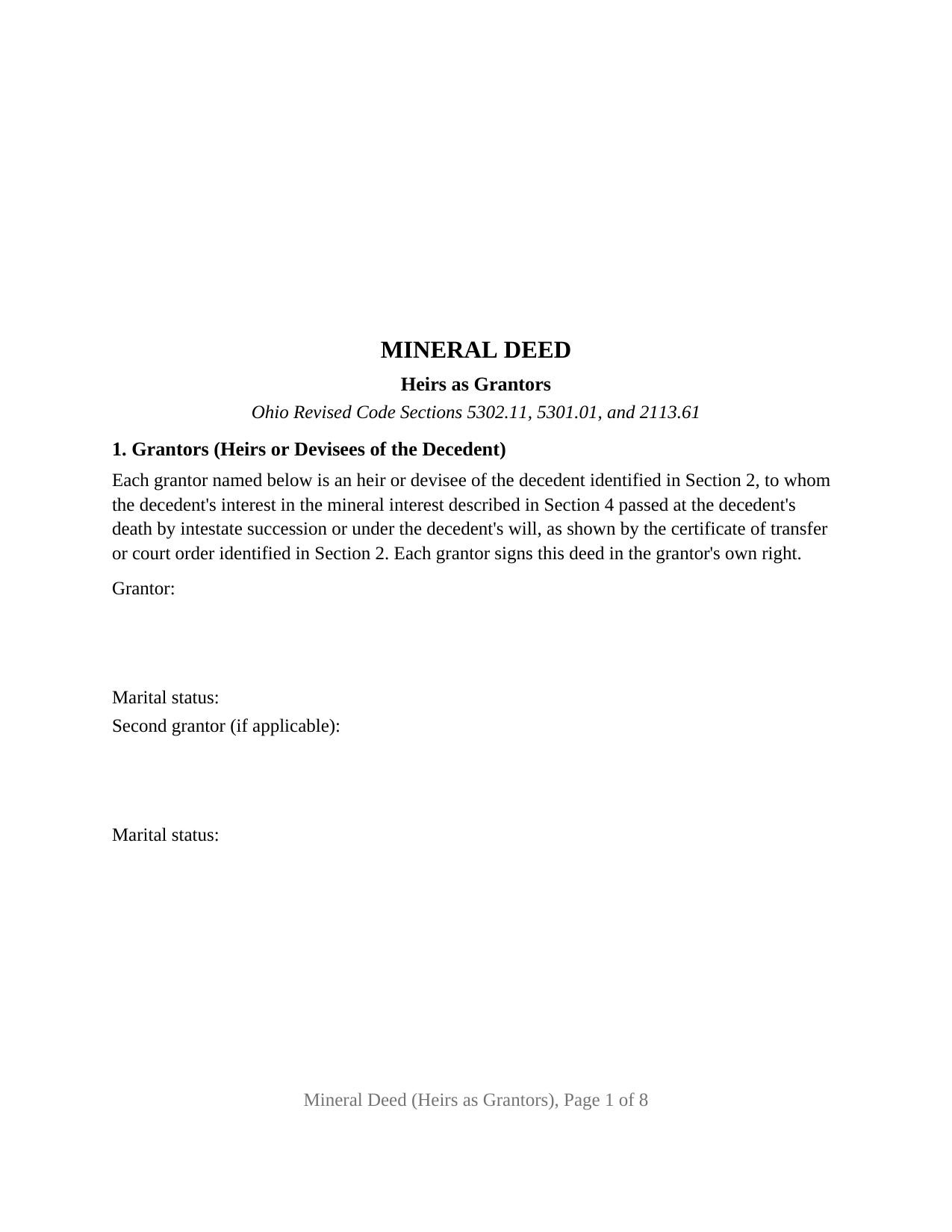
When the owner of Ohio mineral rights dies, the minerals pass at death to the heirs or devisees, and the probate court's certificate of transfer puts their names of record; the sale that follows is the heirs' own deed. This Ohio Mineral Deed (Heirs as Grantors) is that deed: one or two heirs or devisees of a named decedent convey the oil, gas, coal, and other minerals that passed to them, in the quitclaim form of Section 5302.11 of the Ohio Revised Code, with the probate record stated on the face of the instrument.
A deed that recites the probate record
Section 2113.61 of the Revised Code has the executor or administrator apply to the probate court for a certificate of transfer when real property passes by intestate succession or under a will. The certificate recites the decedent, the date of death, the case number, the heirs or devisees with the interest passing to each, and the parcel; Section 2113.62 has the county recorder record it. An order under Section 2113.03 relieving a small estate from administration stands in for the certificate, and where no administration was had, Section 2113.61(D) lets an heir or devisee apply directly. The deed's second section carries the decedent, the date of death, the probate case, the certificate or order with its recording reference, and the decedent's own source of title; the certificate is also the deed's prior instrument reference under Section 319.20.
What passes, and in what shares
Heirs who take one parcel under one certificate hold it in undivided shares as tenants in common under Section 5302.19, and the deed conveys the share or shares its signing grantors hold; the legal description states the fraction where the inherited interest is less than the whole. Fixed text defines the interest conveyed as all of the grantors' right, title, and interest in the oil, gas, coal, and other minerals under the described land, with their interest under any oil and gas lease covering it. A deed in substance following Section 5302.11 operates in fee simple but without covenants of any kind; the grantors convey what they hold and warrant nothing about the chain before them.
Two grantors, two spouses, four certificates
The form carries a signature block headed GRANTOR (HEIR OR DEVISEE), a second grantor block, and a spouse block after each, with a Section 147.55(A) acknowledgment certificate following every block. Dower under Section 2103.02 reaches real property of which a spouse was seized as an estate of inheritance during the marriage, which an inherited mineral interest held in fee is, so a married grantor's spouse signs the spouse block to release dower, a release the deed carries as fixed text. The fixed recital above the grantor blocks states the configuration: each grantor is an heir or devisee of the decedent identified in the deed, taking at death as the certificate of transfer shows, and signing in the grantor's own right. A sole devisee conveying the entire inherited interest, two devisees named in one certificate joining to convey the whole, and an heir conveying only the share that passed to that heir present the pattern this deed recites. An executor conveying in a fiduciary capacity follows the fiduciary deed form of Section 5302.09, a different instrument; an interest that passed through two estates, a trustee or attorney-in-fact signer, an entity grantor, and three or more grantors each present a pattern outside the single-decedent recital.
Auditor first, then the recorder
A conveyance of minerals goes to the county auditor first. Section 319.202 calls for the conveyance fee statement, form DTE 100, or the DTE 100EX exemption statement under Section 319.54(G)(3); a transfer among heirs of a common decedent without monetary consideration is a listed exemption, while a sale pays ten cents per one hundred dollars of value plus any county permissive tax. Section 317.22 bars the recorder from recording the deed until the auditor's stamp and transfer endorsement appear. Once recorded, the deed is a title transaction within Section 5301.47(F), one of the events Section 5301.56 counts in the twenty years before any Dormant Mineral Act notice. With all four certificates in use the deed runs eight pages.
The package includes the fillable deed, a completed example prepared for a Guernsey County estate in which two heirs and their spouses sign, and the guide that walks through each section, the dower release, and recording. The description and the guide describe the form and the governing statutes in general terms; they are not legal advice.
Important: County-Specific Forms
Our mineral deed (heirs as grantors) forms are specifically formatted for each of the 88 counties in Ohio.
After selecting your county, you'll receive forms that meet all local recording requirements, ensuring your documents will be accepted without delays or rejection fees.