Ohio Mineral Deed (Husband and Wife to Trust)
County Specific Legal Forms Validated as recently as October 27, 2026 by our Forms Development Team
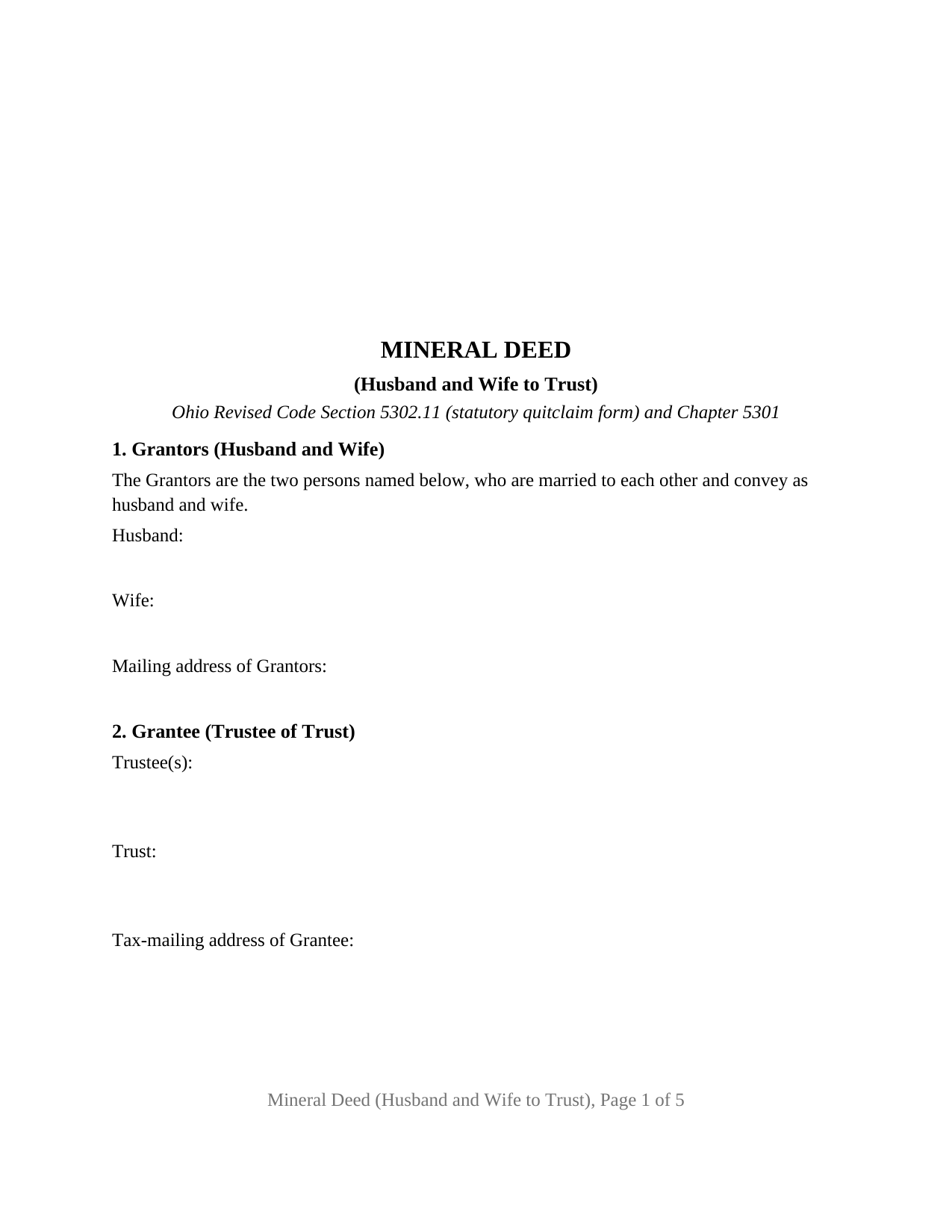
About the Ohio Mineral Deed (Husband and Wife to Trust)
How to Use This Form
- Select your county from the list
- Download the county-specific form
- Fill in the required information
- Have the document notarized if required
- Record with your county recorder's office
What Others Like You Are Saying
"Form was the one I needed and the instructions along with a sample form was all I needed."
"Nice an easy. Just wondered if I can come back and still have my order (forms) available to get agai…"
"Was quick and easy compared to visiting downtown where the recorders office is closed or just the th…"
"I was looking for realty transfer or deed in the name of ***** **** and could never find the list of…"
"good place to get documents and it seems like a sound place to get forms. Self explainitory and help…"
4.8/5 from 4,836 reviews. Read all
This Ohio mineral deed conveys, to the trustee of a trust, two spouses' interest in the minerals beneath a described Ohio tract. It is built for one transfer: two grantors who are married to each other, and one grantee who takes title as trustee of a named trust and not individually. The deed follows in substance the quitclaim form of Section 5302.11 of the Ohio Revised Code, so it passes the interest the spouses hold in the oil, gas, coal, and other minerals without covenants, and both spouses sign it.
A grantee who holds as trustee
Ohio deeds to trusts name the trustee rather than the trust, and Section 2 of this deed asks for both: the person or persons taking title, and the trust by name and date. The operative clause grants the mineral interest to the Grantee as trustee of that trust and not individually, to the Grantee and the Grantee's successors in trust. Under Section 5301.03, the word trustee after a grantee's name, without other recorded language showing the trust and its terms, does not by itself give notice that a trust exists or that the trustee's powers are limited. Section 5301.255, as amended effective June 16, 2026, requires a memorandum of trust to be of record when the trustee later conveys any interest in the property; that memorandum is prepared and recorded separately and is not included in this package.
Both spouses grant, and each releases dower
This configuration carries a fixed recital that the two grantors are married to each other and convey as husband and wife, two signature blocks headed GRANTOR (Husband) and GRANTOR (Wife), and a separate acknowledgment certificate for each spouse in the Section 147.55(A) short form. Each spouse conveys whatever interest that spouse holds in the minerals, and each, as the spouse of the other, releases all rights of dower under Section 2103.02 in the other's interest. The two certificates are the form's architecture, so the spouses may acknowledge on different dates or before different officers; Ohio law also accepts one certificate naming both. Spouses funding their revocable living trust with the minerals under the family farm, and spouses placing a leased mineral interest in trust so that the trustee receives the royalties, present the pattern this deed recites. The form recites exactly two grantors who are married to each other and one trustee grantee; a single grantor, co-owners who are not spouses, an entity, an attorney-in-fact, and a grantee taking individually each follow a different pattern.
Minerals only, without covenants
The deed defines the interest conveyed in fixed text: all of the grantors' right, title, and interest in the oil, gas, coal, and other minerals in, on, and under the described land, with the appurtenant rights and the grantors' interest as lessor under any oil and gas lease covering it. The surface is not conveyed; where the spouses own land and minerals together, the deed moves the minerals into the trust and leaves the surface where it was. The trustee takes the interest subject to the lease, reservations, and encumbrances stated in Section 6, and without covenants of any kind on the part of the grantors. A recorded deed of a severed mineral interest is also a title transaction under Section 5301.47(F), a saving event under the Dormant Mineral Act, Section 5301.56.
The conveyance fee and the trust exemption
A conveyance of minerals or mineral rights passes through the county auditor before the recorder will accept it, under Section 317.22. The auditor collects the state conveyance fee under Section 319.54(G)(3) and any county transfer tax under Chapter 322 unless an exemption applies, and two listed exemptions describe transfers of the kind this form carries: Section 319.54(G)(3)(t), a transfer to the trustee of a trust whose grantor has reserved an unlimited power to revoke it, and Section 319.54(G)(3)(d), a gift in trust between husband and wife. The deed carries the grantee's tax-mailing address and prior instrument reference under Section 319.20, is laid out to the Section 317.114 format standard, and is executed under Section 5301.01 by signature and acknowledgment, with no witnesses.
The package contains the fillable mineral deed, a completed example on a Guernsey County fact pattern in which the spouses convey to themselves as co-trustees of their revocable living trust, and the guide covering every section, the dower release, the auditor's step, and recording. Both the description and the guide explain the form and the Ohio statutes behind it in general terms and are not legal advice.
Important: County-Specific Forms
Our mineral deed (husband and wife to trust) forms are specifically formatted for each of the 88 counties in Ohio.
After selecting your county, you'll receive forms that meet all local recording requirements, ensuring your documents will be accepted without delays or rejection fees.