Ohio Mineral Deed (Individual Grantor)
County Specific Legal Forms Validated as recently as October 27, 2026 by our Forms Development Team
About the Ohio Mineral Deed (Individual Grantor)
How to Use This Form
- Select your county from the list
- Download the county-specific form
- Fill in the required information
- Have the document notarized if required
- Record with your county recorder's office
What Others Like You Are Saying
"Deeds.com is helpful to help me finish my forms and submit my forms to the County successfully. Very…"
"This service is WONDERUL. I spent 14 years trying to get a deed recorded properly. Deeds.com kept su…"
"Great service that saved me a lot of time for under 30 bucks."
"Love Deeds.com! I was a little confused as to how to go about Quitclaiming, but you made it very eas…"
"Great site makes this procedure easy to do,thanks"
4.8/5 from 4,836 reviews. Read all
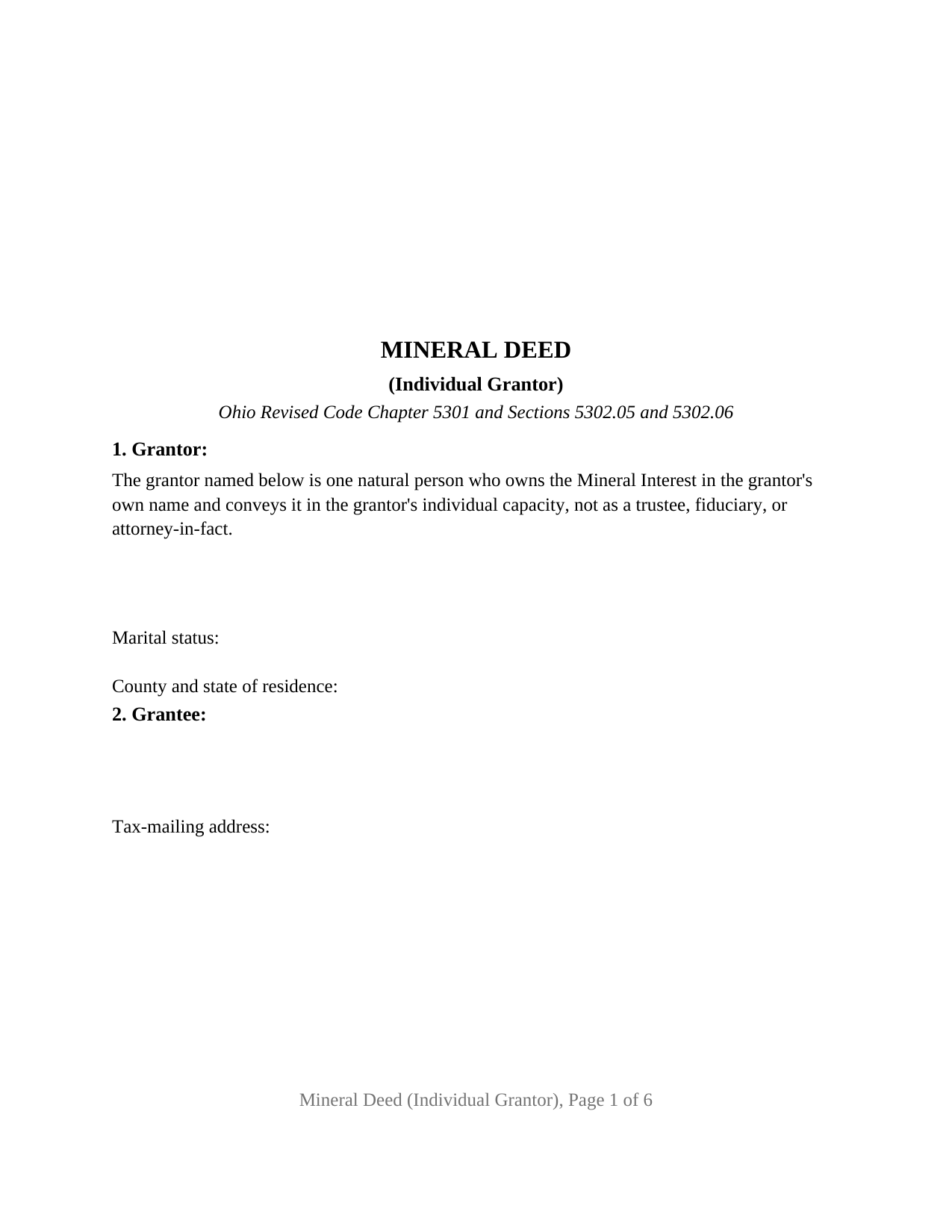
This Ohio mineral deed is drawn for one grantor: a natural person who holds oil, gas, and mineral rights in the grantor's own name and conveys them, or an undivided fraction of them, with general warranty covenants. One signature line carries the conveyance, and a second signature block lets the spouse of a married grantor release dower.
One grantor, one mineral interest, warranted
Ohio writes no separate statute for a mineral deed; a conveyance of severed minerals is a conveyance of an interest in real property under Ohio Revised Code Chapter 5301, built on the statutory deed forms of Chapter 5302. This form follows the general warranty deed of Section 5302.05 in substance, adapted to the minerals rather than the fee of the land: the grantor grants, with general warranty covenants, the Mineral Interest the deed describes, together with the right of ingress and egress to explore, drill, produce, and market what is conveyed. Section 5302.06 gives those words their statutory meaning in a conveyance of any interest in real estate: seisin, freedom from encumbrances, good right to convey, and warranty against the lawful claims of all persons, the covenant that distinguishes a warranted mineral deed from a mineral quitclaim. The deed carries all of the grantor's minerals or an undivided fraction of them, subject to any valid oil and gas lease of record, and it is a transfer of ownership, not a lease.
The spouse's signature and Ohio dower
Section 2103.02 gives a spouse a life estate in one third of the real property of which the other spouse was seized during the marriage, and Section 5301.04 requires a married person's deed of an interest in real property to be signed, acknowledged, and certified under Section 5301.01. The statutory deed forms end with a line in which the grantor's spouse releases all rights of dower, and this deed carries that release with the spouse's name as the blank, a SPOUSE OF GRANTOR signature block, and the spouse's own acknowledgment certificate; an unmarried grantor leaves those blank.
The individual grantor configuration
The form recites exactly one grantor conveying in the grantor's individual capacity, not as a trustee, fiduciary, or attorney-in-fact, printed as deed text rather than left to a blank. A single mineral owner selling an undivided interest to a mineral buyer, a parent conveying inherited minerals to one child, and a landowner severing the minerals from a farm before a surface sale each present the one-grantor pattern this deed recites. It is not set up as a conveyance by two or more co-owners, by a trustee, by an executor or administrator, or by an entity. The grantee side is open: one grantee, or two or more with a co-ownership designation the guide describes.
Through the auditor before the recorder
An Ohio mineral deed travels first to the county auditor, with the conveyance fee statement Section 319.202 requires (form DTE 100, or DTE 100EX where an exemption applies) and the conveyance fee of ten cents per one hundred dollars of value under Section 319.54(G)(3), plus any county transfer tax under Chapter 322. Section 319.20 requires the grantee's tax-mailing address and the prior instrument reference on the deed, and Section 5713.04 lists a mineral interest held apart from the surface in its own tax entry. Section 317.22 then bars the recorder from recording a conveyance of minerals until the auditor's stamp and transfer endorsement are on it; the deed keeps the margins of Section 317.114 and names its preparer under Section 317.111.
Severed minerals and the twenty year clock
Ohio's Dormant Mineral Act, Section 5301.56, deems a severed mineral interest abandoned and vested in the surface owner when the surface owner completes the statutory notice and affidavit procedure and no saving event occurred in the preceding twenty years. A recorded title transaction concerning the mineral interest is the first saving event, and Section 5301.47(F) defines a title transaction to include a warranty deed. Recording this deed places a fresh title transaction of record for the interest conveyed; nothing in it restores an interest already extinguished under the Marketable Title Act or already vested in the surface owner.
The package includes the fillable form, a completed example filled in for a Belmont County fact pattern, and the guide that walks through every numbered section and the two-office recording path. This description and the guide describe the form and the governing Ohio statutes in general terms; they are not legal advice.
Important: County-Specific Forms
Our mineral deed (individual grantor) forms are specifically formatted for each of the 88 counties in Ohio.
After selecting your county, you'll receive forms that meet all local recording requirements, ensuring your documents will be accepted without delays or rejection fees.