Ohio Mineral Deed
County Specific Legal Forms Validated as recently as October 27, 2026 by our Forms Development Team
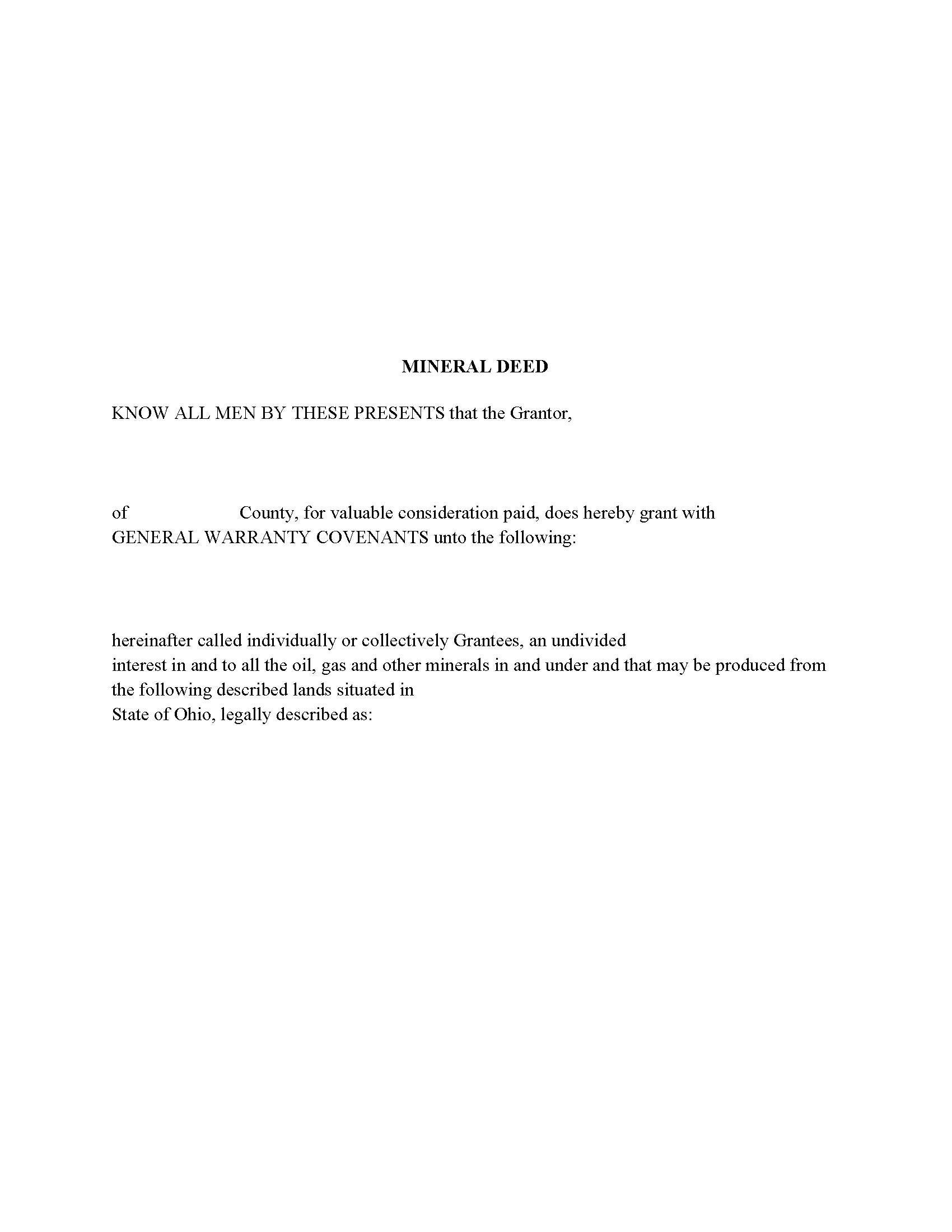
About the Ohio Mineral Deed
How to Use This Form
- Select your county from the list
- Download the county-specific form
- Fill in the required information
- Have the document notarized if required
- Record with your county recorder's office
What Others Like You Are Saying
"Very nice!"
"Found the forms I needed with no problem and easy to fill out thanks to the guide that is with it. B…"
"I'm not too bright and I made a mess of things when I tried to create my own deed. It was lucky that…"
"I thought the process was fairly easy. The price was reasonable. I had a slight problem, some of the…"
"Very quick and gave me exactly what I needed! I would have had to go down to the courts and take off…"
4.8/5 from 4,847 reviews. Read all
An Ohio mineral deed moves ownership of the oil, gas, coal, or other minerals under a tract of land from one owner to another, with the general warranty covenants that Ohio Revised Code Sections 5302.05 and 5302.06 define. This package prepares that deed for one or two individual grantors conveying a mineral interest to one or two grantees, for recording in any Ohio county.
A warranty that reaches the whole chain
Ohio compresses its strongest title promise into one statutory phrase. A deed that grants, with general warranty covenants, carries the covenants Section 5302.06 spells out: that the grantor is lawfully seized in fee simple, that the premises are free from all encumbrances, that the grantor has good right to sell and convey, and that the grantor will warrant and defend the title forever against the lawful claims of all persons. The section applies those words to any interest in real estate, a severed mineral interest included, and the deed carries the phrase verbatim, so the warranty reaches every link in the chain of title.
Separating the minerals from the surface
Section 4 of the form states which minerals and what share pass, in the style all of the oil, gas, and other minerals, or an undivided one-half interest, and identifies any existing lease whose royalties pass with the interest. Section 5 carries the legal description of the tract. The operative section conveys the mineral interest with the right of ingress and egress and reasonable surface use for developing and removing the minerals, and it states that the deed does not convey the surface itself. Once minerals and surface are in different hands, Section 5713.04 directs the county auditor to list and tax them in separate entries, which is why the grantee's tax-mailing address appears on the deed under Section 319.20.
Twenty years on the recorder's clock
Under Ohio's Dormant Mineral Act, Section 5301.56, a severed mineral interest can be deemed abandoned and vested in the surface owner when no savings event occurred in the twenty years before the surface owner's statutory notice. The first savings event listed is a title transaction recorded in the county recorder's office concerning the interest, and Section 5301.47(F) defines a title transaction to include a warranty deed. Recording this deed is itself an event the Act counts, and the guide describes the Act's definitions and its other savings events.
One or two grantors, and the dower release
The form is the base configuration of the Ohio mineral deed. Its grantor and grantee blocks are open: one or two natural persons are named as grantors with their marital status, one or two grantees are named with any designation of how they hold title, and nothing about status or vesting is preprinted. Two signature blocks, GRANTOR and SECOND GRANTOR (if applicable), each carry their own acknowledgment certificate in the Section 147.55(A) short form; on a one-grantor conveyance the second block is left blank. Spouses conveying inherited minerals, a sole owner selling a royalty-bearing half interest in the Utica shale counties, and two siblings consolidating a family mineral interest present the patterns this deed recites. A married grantor's spouse signs the second block to release the dower interest Section 2103.02 gives a spouse in real property of which the other spouse was seized during the marriage, and the operative section states the release. The form is not set up as a conveyance by a corporation, limited liability company, trustee, or attorney-in-fact, nor for three or more grantors or grantees.
From the auditor's counter to the recorder's
Section 317.22 provides that a conveyance of minerals or mineral rights is not admitted to record until it bears the county auditor's stamp and transfer endorsement, so the deed travels first to the auditor with the conveyance fee statement, DTE 100, or the exemption statement, DTE 100EX, where the grantor pays the state conveyance fee of ten cents per hundred dollars of value and any county permissive tax. The deed is built to the format standard of Section 317.114 and runs four recorded pages at the statutory fee of thirty-four dollars for the first two pages and eight dollars for each additional page.
The package includes the fillable mineral deed, a completed example filled in for a Belmont County fact pattern, and the guide that walks through every numbered section and the recording process. This description and the guide describe the form and the governing Ohio statutes in general terms; they are not legal advice.
Important: County-Specific Forms
Our mineral deed forms are specifically formatted for each of the 88 counties in Ohio.
After selecting your county, you'll receive forms that meet all local recording requirements, ensuring your documents will be accepted without delays or rejection fees.