Ohio Mineral Deed (Individual with Spousal Dower Release)
County Specific Legal Forms Validated as recently as October 27, 2026 by our Forms Development Team
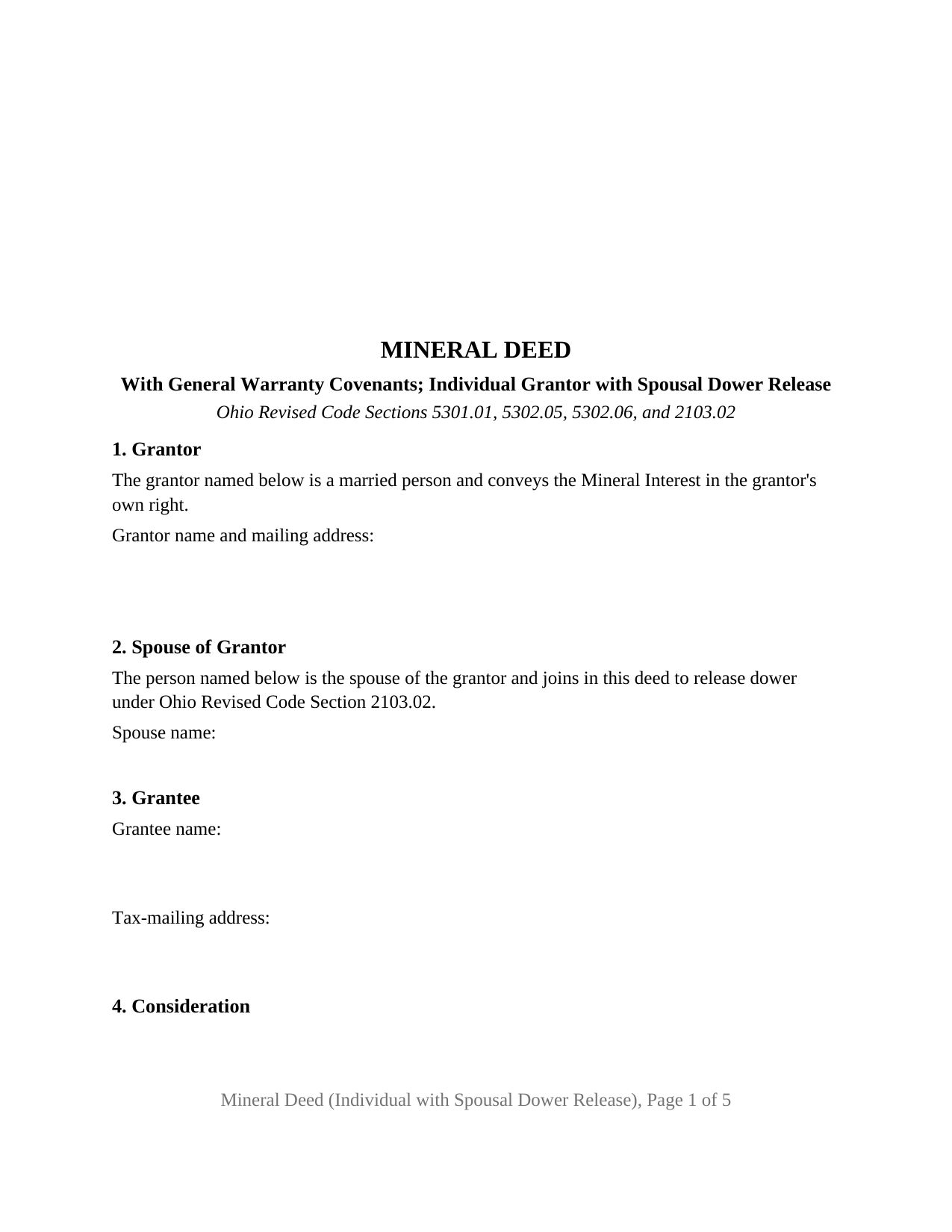
About the Ohio Mineral Deed (Individual with Spousal Dower Release)
How to Use This Form
- Select your county from the list
- Download the county-specific form
- Fill in the required information
- Have the document notarized if required
- Record with your county recorder's office
What Others Like You Are Saying
"Helpful and informative."
"Easy to use, fast and reliable. love deeds.com"
"Hopefully, I am on the correct site to transfer ownership of a time share to my son. I am a senior, …"
"Found documents I needed quickly and at a reasonable price. MH"
"I love this recording service! They are so fast and let me know in advance if they think something i…"
4.8/5 from 4,836 reviews. Read all
This Ohio mineral deed recites one married grantor conveying an interest in the oil, gas, coal, and other minerals under a described tract, with the grantor's spouse signing alongside to release dower. It conveys with general warranty covenants in the statutory words of Ohio Revised Code Section 5302.05 and carries two signature blocks and two acknowledgment certificates: one pair for the grantor, one pair for the releasing spouse.
Why the spouse signs a deed of minerals held in one name
Section 2103.02 gives a spouse a life estate in one third of the real property of which the other spouse was seized as an estate of inheritance during the marriage. A severed mineral interest is real property, defined in Section 5301.56(A)(3) as a fee interest in at least one mineral, so dower attaches to minerals exactly as it attaches to a farm. The statutory deed forms print a line on which the wife or husband of the grantor releases all rights of dower therein, and this form carries that release with the spouse's own signature block and acknowledgment. The spouse's signature releases dower only and conveys no title of the spouse's own.
What a mineral interest carries with it
The deed defines the Mineral Interest as the interest stated in a blank, whether the grantor's entire interest, an undivided fraction, or an interest limited to particular minerals. With it go the right of ingress and egress and reasonable surface use to explore for, develop, produce, and remove the minerals, and the grantor's share of royalties, bonuses, and rentals under any mineral lease of record, to the extent of the interest conveyed. A separate section lists what the conveyance is subject to, which is where an existing lease is identified and where the warranty stops: a deed that grants, with general warranty covenants, carries the Section 5302.06 promises of seisin, freedom from encumbrances, right to convey, and defense of title against all persons, except as to the matters the deed excepts.
The Dormant Mineral Act and the value of recording
Severed minerals in Ohio live under Section 5301.56, the Dormant Mineral Act. A mineral interest held by someone other than the surface owner is deemed abandoned and vests in the surface owner if the surface owner completes the statutory notice and affidavit procedure and no saving event occurred in the preceding twenty years. The saving events include a recorded title transaction concerning the mineral interest, actual production, a recorded claim to preserve, and a separately listed tax parcel. A recorded mineral deed is a title transaction, and Section 5713.04 directs the county auditor to list a severed mineral right in a separate entry taxed to its owner, so recording and auditor transfer place the grantee's interest on the record in two ways the Act counts.
Auditor transfer before recording
Section 317.22 provides that a conveyance of minerals or mineral rights is not admitted to record until it carries the county auditor's conveyance fee stamp under Section 319.202 and the endorsement that it has been transferred or that transfer is not necessary. The grantee presents the DTE 100 conveyance fee statement, or the DTE 100EX exemption statement where Section 319.54(G)(3) applies, and the deed carries the tax-mailing address and prior instrument reference Section 319.20 requires, the preparer's name Section 317.111 requires, and the Section 317.114 format.
The configuration this form recites
The form fixes the grantor as a married person conveying in the grantor's own right and fixes the second signer as the spouse of the grantor joining to release dower; the names are blanks, the roles are deed text. The grantee side is open to one or more grantees, with any survivorship designation under Section 5302.17 following the names. A mineral owner who inherited the minerals before marriage, and a landowner who kept the minerals when the surface was sold and now sells an undivided fraction while married, each present the pattern this deed recites. The form is not set up as a deed by two record owners, by an unmarried grantor, by a trustee, by an entity, or by an attorney-in-fact, each of which carries a different recital and a different acknowledgment short form under Section 147.55.
The package includes the fillable mineral deed form, a completed example filled in for a Belmont County fact pattern, and the guide that walks through every numbered section and the recording steps. This description and the guide describe the form and the governing Ohio statutes in general terms; they are not legal advice.
Important: County-Specific Forms
Our mineral deed (individual with spousal dower release) forms are specifically formatted for each of the 88 counties in Ohio.
After selecting your county, you'll receive forms that meet all local recording requirements, ensuring your documents will be accepted without delays or rejection fees.