Ohio Mineral Deed (Individual to Trust)
County Specific Legal Forms Validated as recently as October 27, 2026 by our Forms Development Team
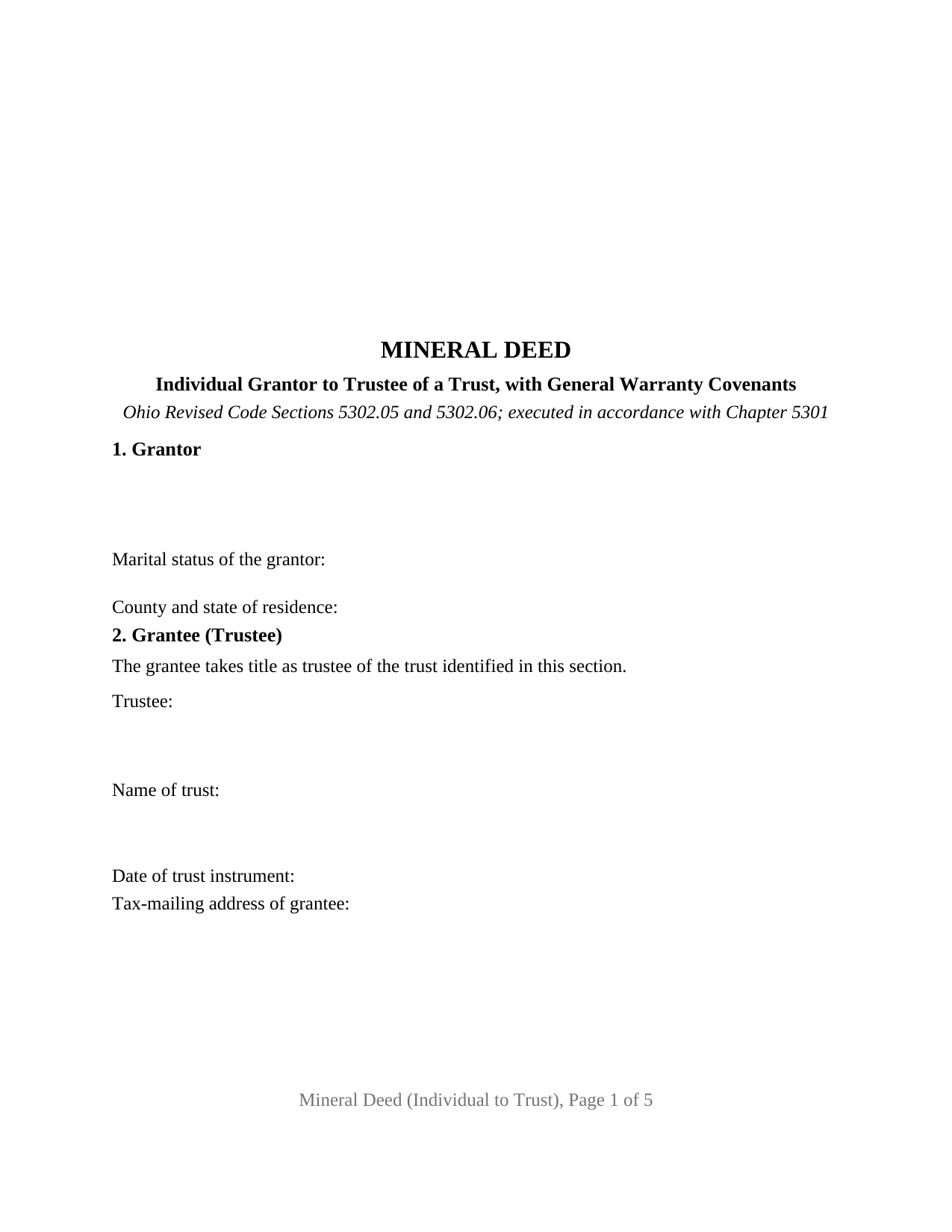
About the Ohio Mineral Deed (Individual to Trust)
How to Use This Form
- Select your county from the list
- Download the county-specific form
- Fill in the required information
- Have the document notarized if required
- Record with your county recorder's office
What Others Like You Are Saying
"Very easy to use and with all the documents that I needed."
"Good Work!"
"On multiple tries, I could not get validation mail through my Yahoo email address. I tried Gmail, wo…"
"Easy to pay for, hard to download. A zip file containing all the forms would be a great addition. Yo…"
"amazing customer service. thank you deeds.com. I just wish I knew about this company earlier. Kevin"
4.8/5 from 4,836 reviews. Read all
This Ohio mineral deed moves an interest in oil, gas, coal, and other minerals from one individual owner into a trust. One grantor conveys, the trustee of a named trust takes title, and the deed carries the general warranty covenants of Ohio Revised Code Section 5302.05, formatted for recording in any Ohio county. A spouse signs only to release dower, and each signer has a separate certificate.
A deed that names the trustee, the trust, and its date
Ohio title to trust property is held by the trustee, so the grantee clause identifies the trustee by name, the trust by its full name, and the date of the trust instrument, with the tax-mailing address the county auditor enters under Section 319.20. Those identifiers match the ones a memorandum of trust states under Section 5301.255, the recorded notice of the trustee's powers that, under the amendment effective June 16, 2026, must be of record before a trustee conveys Ohio real property. The memorandum is a separate instrument the trustee signs; it is not included in this package.
Why a recorded mineral deed matters in Ohio
Severed mineral rights in Ohio live under two title statutes at once. The Dormant Mineral Act, Section 5301.56, lets a surface owner have a severed mineral interest deemed abandoned when no saving event has occurred in the preceding twenty years, and the Marketable Title Act can extinguish an old interest after forty years; West v. Bode, 2020-Ohio-5473, holds that both apply independently. A title transaction concerning the mineral interest, recorded in the county where the land lies, is a saving event under Section 5301.56(B)(3)(a), and a separately listed mineral tax parcel is another under division (B)(3)(f). Recording this deed places a current title transaction of record for the trust. The deed describes the interest conveyed in its own section, so an undivided fraction, the whole mineral estate, or a stated subset of the minerals is set out beside the land description, with ingress, egress, and the other appurtenant rights carried by fixed text.
Six statutory words and what they promise
Ohio compresses the general warranty into the phrase grant(s), with general warranty covenants. Section 5302.06 gives those words the force of covenants that the grantor is lawfully seized in fee simple, that the premises are free from all encumbrances, that the grantor has good right to sell and convey them, and that the grantor warrants and will defend them against the lawful claims of all persons. The statutory form's description blank reads land or interest therein, which is how a mineral interest fits the form. The encumbrances section lists the lease, easements, and prior reservations the conveyance is subject to, which the covenant against encumbrances then excepts.
The individual to trust configuration
The form recites exactly one grantor, a natural person conveying in the grantor's own right, and one grantee, the trustee of a trust. The grantor's marital status is a factual entry, and the dower release of Section 2103.02 appears as a named line and a SPOUSE OF GRANTOR signature block, left blank when the grantor is unmarried. An owner placing inherited Utica shale minerals into a revocable living trust, and a parent conveying a fractional mineral interest to an irrevocable trust, present the pattern this deed recites. The form is not set up as a conveyance by co-owners, by a company, by an attorney-in-fact, or by a trustee out of a trust, and it does not convey the surface.
Auditor first, then recorder
Section 317.22 bars an Ohio recorder from recording a conveyance of minerals until the county auditor has stamped and endorsed it. The grantee files the conveyance fee statement, DTE 100, or the exemption statement, DTE 100EX; Section 319.54(G)(3)(t) exempts a transfer to a trustee when the grantor of the trust has reserved an unlimited power to revoke it, and other transfers pay the fee on value plus any county permissive tax. The deed then records under the format rules of Section 317.114, which this form meets: a three inch blank margin atop the first page, one and one half inches atop each later page, one inch sides and bottom, and twelve point type.
The package includes the fillable mineral deed, a completed example for a Belmont County fact pattern, and a guide that walks through every numbered section and the auditor and recorder steps. This description and the guide describe the form and the governing Ohio statutes in general terms; they are not legal advice.
Important: County-Specific Forms
Our mineral deed (individual to trust) forms are specifically formatted for each of the 88 counties in Ohio.
After selecting your county, you'll receive forms that meet all local recording requirements, ensuring your documents will be accepted without delays or rejection fees.