Ohio Mineral Deed (Two Individuals)
County Specific Legal Forms Validated as recently as October 27, 2026 by our Forms Development Team
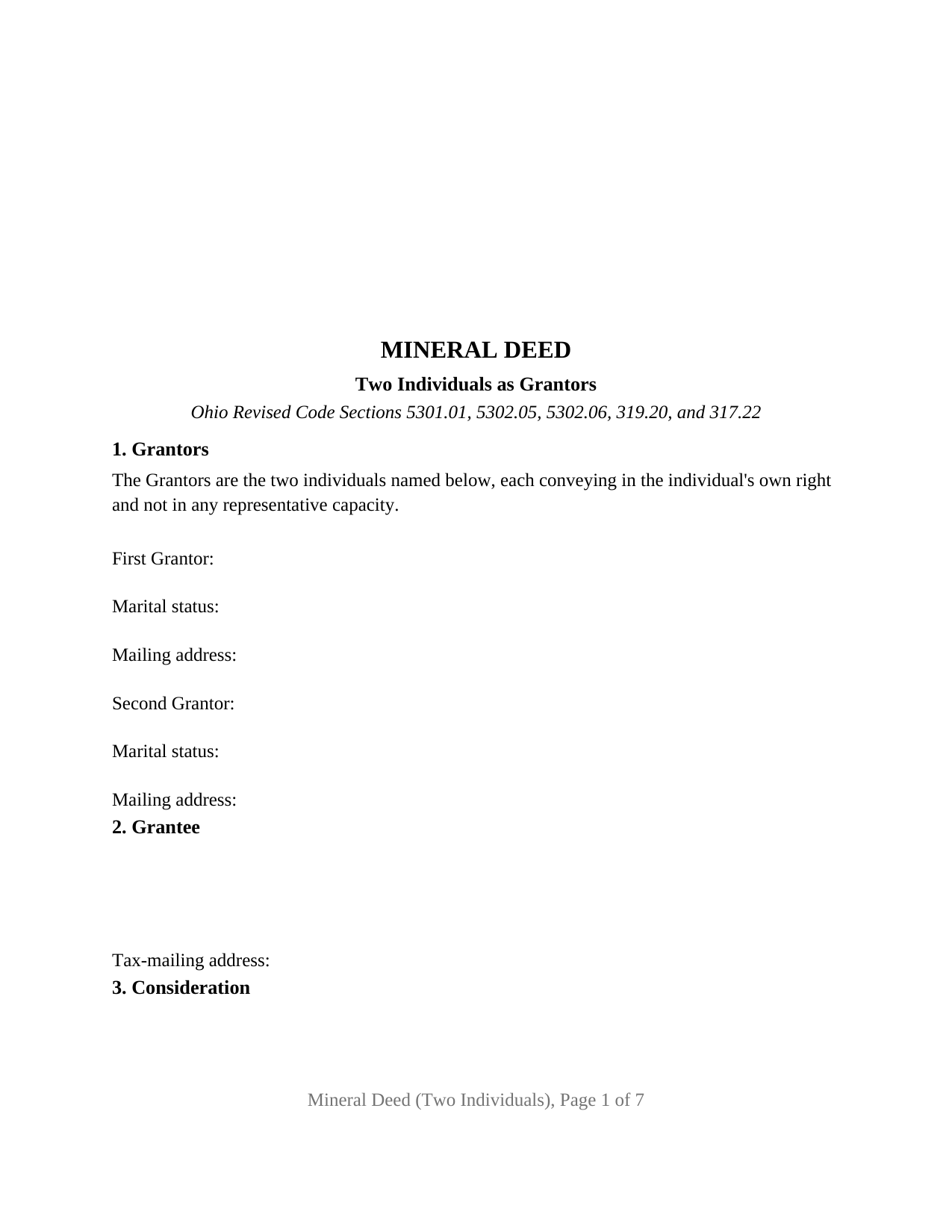
About the Ohio Mineral Deed (Two Individuals)
How to Use This Form
- Select your county from the list
- Download the county-specific form
- Fill in the required information
- Have the document notarized if required
- Record with your county recorder's office
What Others Like You Are Saying
"Thanks for providing this service. We had searched for weeks for the correct documents. It might hel…"
"The staff of DEEDS.COM is in a class of excellence all by themselves! From my own personal experienc…"
"Most complete and affordable documents that I was able to locate online. Excellent printed out prese…"
"Very pleased with the service, easy to download and print"
"The instructions and example for filling out the form were very clear and detailed making the whole …"
4.8/5 from 4,836 reviews. Read all
This Ohio mineral deed is arranged for two individuals as grantors. Two people who own a mineral interest together, each signing in the individual's own right, grant the oil, gas, coal, and other minerals under described Ohio land with general warranty covenants, and the deed carries a dower release line, a signature block, and a separate acknowledgment certificate for the spouse of each grantor. The package prepares the deed under Ohio Revised Code Sections 5302.05 and 5302.06 for recording in any Ohio county.
Two grantors, two dower releases, four certificates
The signature side of the deed is what sets this configuration apart. Ohio dower under Section 2103.02 gives a married person's spouse a life estate in one third of the real property the other spouse was seized of during the marriage, and a severed mineral interest is real property. The statutory form in Section 5302.05 answers that interest with a release line, and this deed prints the release once for each grantor: each spouse named in Section 7 releases to the grantee all rights of dower in the interest conveyed. Below the two grantor signature blocks sit two spouse signature blocks captioned as dower releases, and the deed closes with four acknowledgment certificates. Where a grantor is unmarried, that grantor's spouse line, spouse block, and certificate stay blank. Two siblings selling an inherited mineral interest and two co-owners consolidating a mineral estate in a buyer present the two-grantor pattern this deed recites; the form is not arranged for a single grantor, three or more grantors, or a trustee, entity, or attorney-in-fact on the granting side.
A mineral interest conveyed with general warranty covenants
A deed that grants, with general warranty covenants, carries the four covenants Section 5302.06 spells out: lawful seisin in fee simple, freedom from encumbrances, good right to sell and convey, and a warranty against the lawful claims and demands of all persons. Section 5302.03 provides that the word grant alone implies no covenant, so the deed prints the statutory phrase verbatim. Here the premises are a mineral interest rather than a surface tract: Section 5 states the interest conveyed, all of the grantors' oil and gas rights or an undivided fraction of them, and Section 6 lists what the conveyance is subject to, such as an existing oil and gas lease, because the covenant against encumbrances does not reach what the deed excepts.
What a recorded mineral deed does under the Dormant Mineral Act
Ohio's Dormant Mineral Act, Section 5301.56, lets a surface owner have a severed mineral interest deemed abandoned unless a saving event occurred in the preceding twenty years, and a recorded title transaction concerning the interest is one of those events; a recorded mineral deed is a title transaction under Section 5301.47(F). Recording this deed therefore gives the notice that protects the grantee against a later purchaser under Section 5301.25 and restarts the twenty-year window that keeps the mineral rights from being declared abandoned.
Auditor transfer before recording
A conveyance of minerals or mineral rights passes through the county auditor before the recorder takes it. Section 317.22 keeps a mineral conveyance out of the record until it bears the auditor's conveyance fee stamp and transfer endorsement, and Section 319.20 requires the grantee's tax-mailing address and a reference to the prior recorded instrument through which the grantors claim title; the deed carries both in the places the Section 5302.05 form puts them.
Built to the Ohio recording standard
The deed is laid out to Section 317.114: a three inch blank top margin on the first page for the stamps, one inch side and bottom margins, a one and one half inch top margin on later pages, and twelve point type. The preparer's name required under Section 317.111 has its own block, and each acknowledgment certificate prints the Ohio short form of Section 147.55(A) with the venue left open, so each signer can acknowledge on any date before any officer Section 5301.01 names.
The package includes the fillable Ohio mineral deed form, a completed example filled in for a realistic Harrison County fact pattern with two married grantors and their spouses, and the guide that walks through every section, the signing of all four signers, and the auditor transfer and recording steps. This description and the guide describe the form and the governing Ohio statutes in general terms; they are not legal advice.
Important: County-Specific Forms
Our mineral deed (two individuals) forms are specifically formatted for each of the 88 counties in Ohio.
After selecting your county, you'll receive forms that meet all local recording requirements, ensuring your documents will be accepted without delays or rejection fees.