Ohio Mineral Deed (Husband and Wife)
County Specific Legal Forms Validated as recently as October 27, 2026 by our Forms Development Team
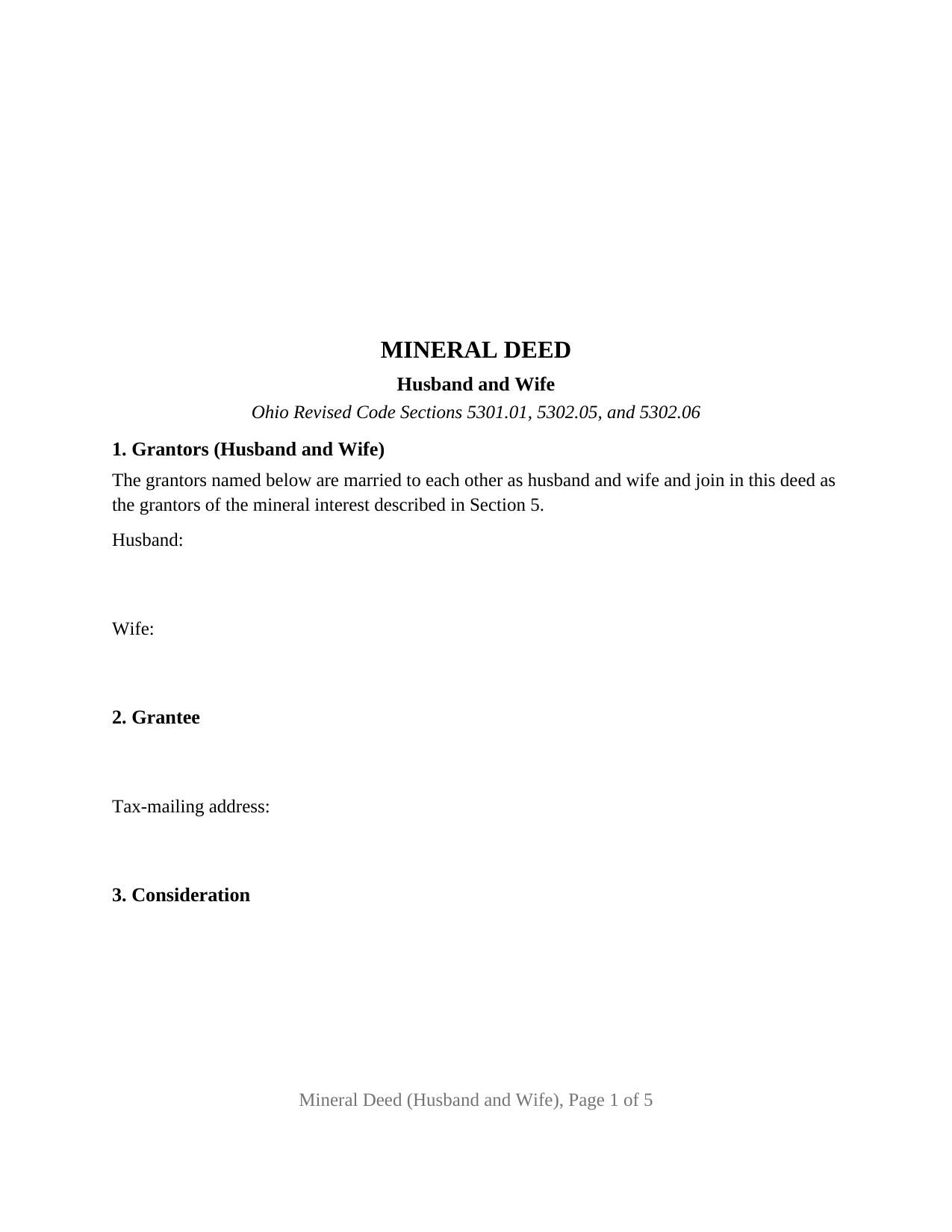
About the Ohio Mineral Deed (Husband and Wife)
How to Use This Form
- Select your county from the list
- Download the county-specific form
- Fill in the required information
- Have the document notarized if required
- Record with your county recorder's office
What Others Like You Are Saying
"Seems like this is a very easy process to get what you need."
"This site was recommended by my County's Clerks office website. Let me tell you when I received my s…"
"Deeds.com provides outstanding service! Quick e-recording, at a reasonable price, and if there are a…"
"Good experience, good service too - thanks."
"Easement deed contract was easy to complete, however after additional research raises some concerns …"
4.8/5 from 4,836 reviews. Read all
This Ohio Mineral Deed recites two grantors, a husband and wife, who together convey an interest in the oil, gas, and other minerals under Ohio land. Both spouses sign one deed as grantors, the conveyance carries general warranty covenants, and each spouse releases dower in the interest conveyed, so a single instrument moves the mineral interest and closes the dower question for both spouses.
Why both spouses sign an Ohio mineral deed
Ohio keeps statutory dower. Under Revised Code Section 2103.02, a spouse who has not released dower holds a life estate in one third of the real property the other spouse owned during the marriage, and a severed mineral estate is an interest in real property. The Chapter 5302 statutory deed forms print a sentence by which the grantor's wife or husband releases all rights of dower, and this deed adapts it for two grantors who are each other's spouse: each grantor, as the wife or the husband of the other grantor, releases all rights of dower therein.
A warranty that reaches the mineral estate
The operative words are the ones Section 5302.05 prints for a general warranty deed: the grantors grant, with general warranty covenants. Section 5302.03 makes clear that the word grant alone implies no covenant, and Section 5302.06 fixes what the phrase means: the grantors covenant that they are lawfully seized of the granted premises, that the premises are free from encumbrances, that they have good right to sell and convey, and that they will warrant and defend the interest forever against the lawful claims of all persons. Section 5302.01 lets the statutory forms be altered as circumstances require, and here the granted premises are the mineral interest rather than the surface.
What the deed conveys and what stays behind
The deed defines the conveyed interest in its own words: the stated whole or fractional interest in all of the oil, gas, and other minerals in, on, and under the described land, the rights of ingress, egress, exploration, development, production, and removal, and the grantors' share of royalties, bonuses, and delay rentals under any existing oil and gas lease, to the extent attributable to the interest conveyed. An exceptions box carries an existing lease, a coal or royalty interest severed earlier in the chain, and matters of record. The surface is not conveyed, and under Section 5301.58, effective September 23, 2026, pore space is not conveyed either, because the deed does not expressly include it.
Two grantors, two acknowledgment certificates
The form recites exactly two grantors, married to each other, with a separate name and address blank for the husband and for the wife, and it carries two signature blocks and two acknowledgment certificates in the Ohio short form of Section 147.55(A), so the spouses may acknowledge on different dates, before different notaries, or in different states. A married couple selling the minerals under a family farm, and spouses conveying a fractional interest they inherited together, present the pattern this deed recites. A sole-grantor deed in which the other spouse signs only to release dower, a trustee or company grantor, a grantor acting through a power of attorney, and three or more grantors each follow a different structure, and the form is not set up for them.
The auditor comes before the recorder
A conveyance of minerals or mineral rights follows the same county path as a deed of land. Section 317.22 keeps it out of the record until the county auditor has stamped it for the conveyance fee statement under Section 319.202 and endorsed it transferred or transfer not necessary, so the deed prints the grantee's tax-mailing address and a prior instrument reference, the two items Section 319.20 requires. The form is built to the Section 317.114 standard format in twelve point type with the preparer statement of Section 317.111. Once recorded, the deed is a title transaction of the kind the Dormant Mineral Act, Section 5301.56, counts against abandonment of a severed mineral interest for the following twenty years.
The package contains the fillable Ohio Mineral Deed (Husband and Wife), a completed example filled in for a Guernsey County conveyance of the full mineral interest under a 61 acre tract, and a guide that walks through every section, the dower release, the auditor and recorder steps, and the grantee vesting forms Ohio recognizes. The deed, the example, and the guide describe the form and the governing Ohio statutes in general terms; they are not legal advice.
Important: County-Specific Forms
Our mineral deed (husband and wife) forms are specifically formatted for each of the 88 counties in Ohio.
After selecting your county, you'll receive forms that meet all local recording requirements, ensuring your documents will be accepted without delays or rejection fees.