Ohio Mineral Deed (Individual Grantor by Attorney-in-Fact or POA)
County Specific Legal Forms Validated as recently as October 27, 2026 by our Forms Development Team
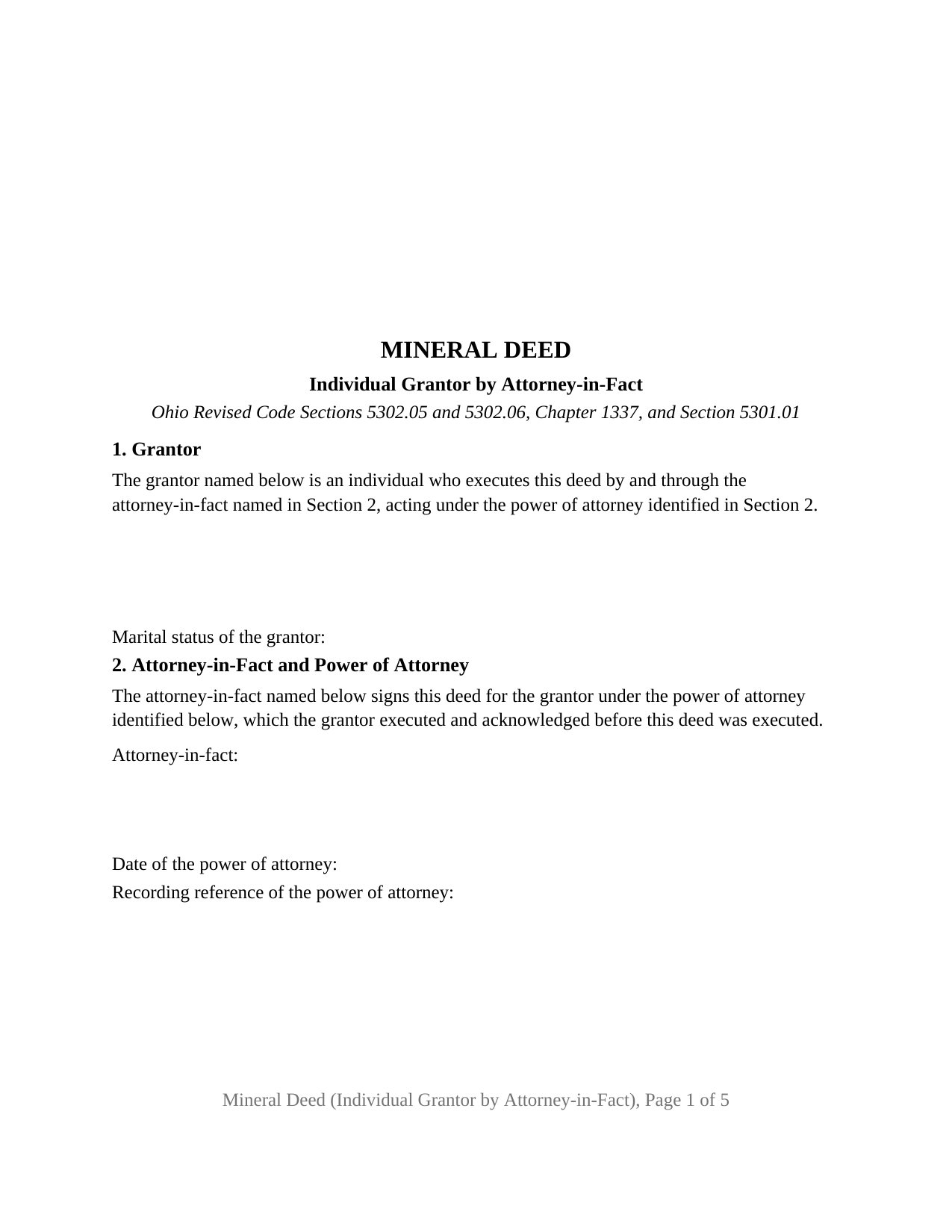
About the Ohio Mineral Deed (Individual Grantor by Attorney-in-Fact or POA)
How to Use This Form
- Select your county from the list
- Download the county-specific form
- Fill in the required information
- Have the document notarized if required
- Record with your county recorder's office
What Others Like You Are Saying
"Very easy and I appreciate that when you hover over the blank, directions pop up and tell you what t…"
"You form was good the only thing that did not work was the download to fill it out !!! I use a Mac s…"
"This is a great service. It was easy to find and the instructions were complete and easy to follow."
"Quit Claim deed for North Carolina did not include all of the information I needed (two separate not…"
"5 Stars isn't enough! I worked with KVH today (12-30-20) to get some deeds filed in Dallas County be…"
4.8/5 from 4,836 reviews. Read all
When the owner of an Ohio mineral interest cannot sign, an agent holding a power of attorney signs the deed in the owner's name, and the power of attorney goes into the county record ahead of the deed. This Ohio mineral deed is arranged for exactly that execution: one individual grantor, one attorney-in-fact who signs for the grantor, general warranty covenants under Section 5302.05 of the Ohio Revised Code, and a second signature block through which the grantor's spouse, where there is one, releases dower in person.
A signature in the grantor's name, by an agent
Section 1337.02 of the Revised Code requires a deed made by virtue of a power of attorney to contain the name of the grantor, and provides that it conveys the grantor's interest as fully as if the grantor had executed it in person. Section 1337.45 reads general authority over real property to include conveying with or without covenants or warranties, and Section 1337.42(G) binds the principal to the agent's act. The deed names the grantor in Section 1 and the attorney-in-fact and the power of attorney in Section 2; its operative sentence is fixed text, the grantor, acting by and through the attorney-in-fact, grants, with general warranty covenants, the described mineral interest. The attorney-in-fact signs the principal's name, then by, then the agent's own name, and acknowledges on the Section 147.55(E) short form.
The power of attorney is recorded first
Section 1337.04, amended effective October 24, 2024, makes the order of events a recording rule: the power of attorney is executed and acknowledged by the principal before the deed, and recorded in the county where the land lies before the deed is recorded, with one recorded later the same day counted as recorded first. Where the order was missed, the section supplies a cure by supporting affidavit. Section 2 of the deed carries the power of attorney's date and recording reference, so the chain a title examiner follows is on the face of the instrument.
What the general warranty promises about minerals
Section 5302.06 gives the phrase general warranty covenants four promises: lawful seisin in fee simple, freedom from all encumbrances, good right to sell and convey, and a warranty against the lawful claims and demands of all persons. Those promises reach the whole chain of title, which is why the deed's encumbrances section lists the existing lease, any outstanding royalty or reservation, and anything the grantor keeps back. The mineral interest is defined in fixed text as the oil, gas, coal, and other minerals in, on, and under the described land, with the rights belonging to them; a fractional-interest line conveys an undivided fraction instead of the whole.
One grantor, one agent, and the dower signature
This configuration recites one individual grantor and one attorney-in-fact, and it carries two signature blocks, ATTORNEY-IN-FACT FOR GRANTOR and SPOUSE OF GRANTOR (if applicable), each followed by its own acknowledgment certificate. The grantor's marital status is a factual entry rather than a fixed recital, so the form carries a married grantor, whose spouse signs the second block to release dower under Sections 2103.02 and 5301.04, and an unmarried grantor, for whom that block stays blank. The spouse signs in person, because dower belongs to the spouse and the grantor's power of attorney does not reach it; where the agent is the grantor's spouse, that person signs both blocks in both capacities. An aging royalty owner whose adult child holds a durable power of attorney, and an out-of-state owner whose Ohio agent signs at closing, present the pattern this deed recites; a grantor signing personally, two or more grantors, an entity or trustee grantor, and a spouse acting through a separate agent present different patterns.
Through the auditor, then the recorder
Section 317.22 keeps a conveyance of mineral rights out of the record until the county auditor has stamped it and endorsed the transfer, with the DTE 100 fee statement or DTE 100EX exemption statement filed under Section 319.202. The deed carries the grantee's tax-mailing address, the prior instrument reference, and the Section 317.111 preparer statement, and prints to the Section 317.114 format.
The package includes the fillable mineral deed, a completed example prepared for a Harrison County fact pattern, and the guide that walks through each section, the power of attorney requirements, the dower release, the auditor's transfer, and recording. The description and the guide describe the form and the governing Ohio statutes in general terms; they are not legal advice.
Important: County-Specific Forms
Our mineral deed (individual grantor by attorney-in-fact or poa) forms are specifically formatted for each of the 88 counties in Ohio.
After selecting your county, you'll receive forms that meet all local recording requirements, ensuring your documents will be accepted without delays or rejection fees.