Oklahoma Quitclaim Deed
County Specific Legal Forms Validated as recently as October 19, 2026 by our Forms Development Team
About the Oklahoma Quitclaim Deed
How to Use This Form
- Select your county from the list
- Download the county-specific form
- Fill in the required information
- Have the document notarized if required
- Record with your county recorder's office
What Others Like You Are Saying
"EXCELLENT SERVICE. WILL MAINTAIN CONTACT FOR FUTURE REFERENCE. THANK YOU!"
"Easy to work with. Fair price. Nice, efficient service. Would definitely use Deeds.com again for any…"
"At first I didn't trust all the 5 star reviews. So, I contacted lawyers to check their prices. The p…"
"The product was just what I needed. Not being the sharpest computer user I stumbled a little but aft…"
"I found this site to be very easy to use . I found and printed what I needed in just a few minutes a…"
4.8/5 from 4,829 reviews. Read all
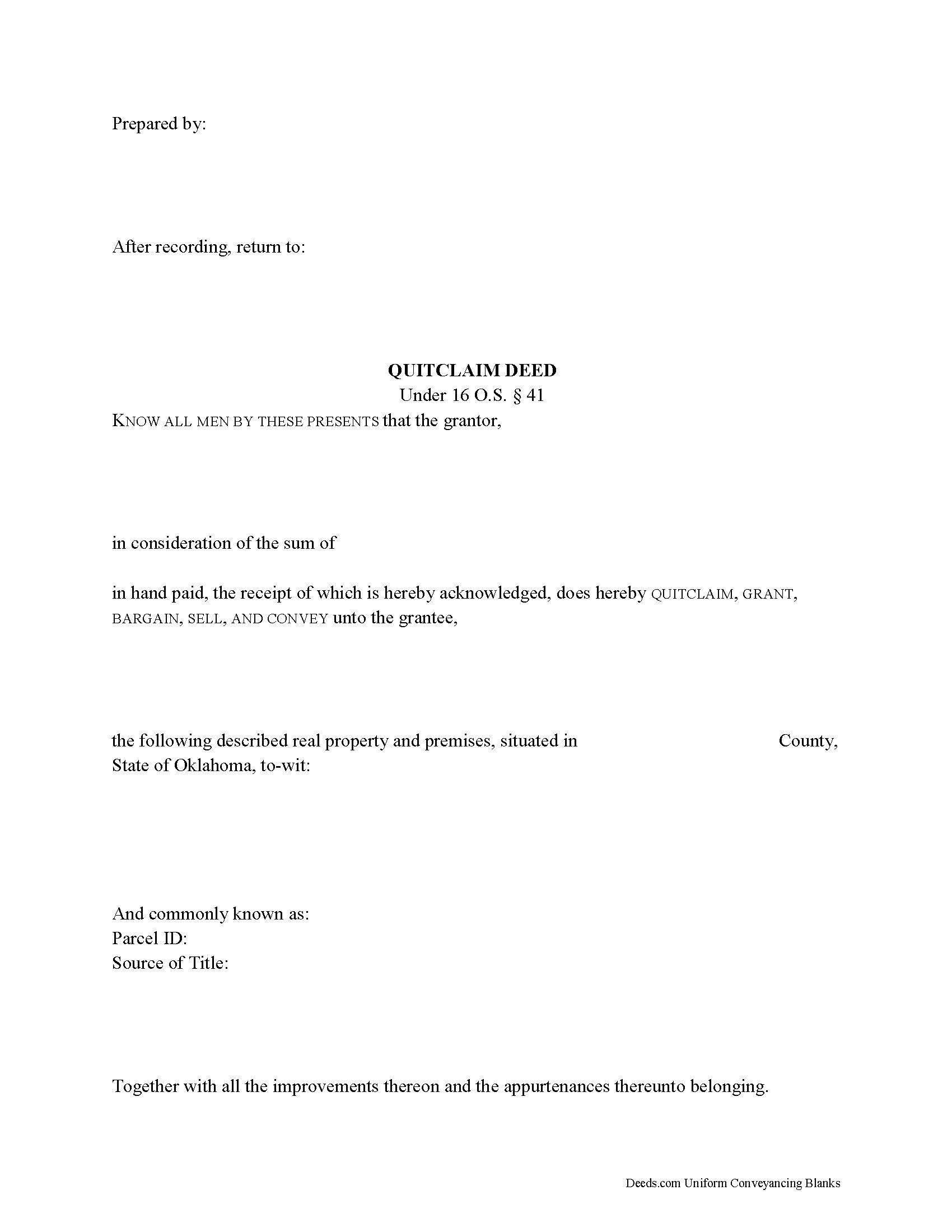
Oklahoma writes its quitclaim deed as an edit, not as a form of its own. Title 16, Section 41 takes the statutory warranty deed, inserts one word into the granting sentence, and strikes the closing promise; what survives that subtraction is the quitclaim. This deed carries that edit: the granting words read do hereby quitclaim, grant, bargain, sell and convey, nothing follows about warranting the title, and Section 18 measures the result at all the right, title, and interest of the maker in the premises described.
A deed the statute defines by what it removes
The subtraction is the whole legal difference. Section 19 loads a warranty deed with covenants that arise unless express words limit them: seizin of an indefeasible fee, full power to convey, freedom from encumbrances, quiet possession, and defense of the title. Drop the warranty phrase and none of them exists, which is why a recorded mortgage, a judgment lien, a plat restriction, and a severed mineral interest sit where the record left them. Section 29 works the other direction, deeming an estate conveyed by deed a fee simple unless limited by express words, so the release reaches the grantor's whole interest. Section 13 prints the omission and the no-covenant statement on the deed's face, and a capitalized paragraph above the signatures repeats it.
Open blocks, and the words the parties supply
This is the base configuration, built for people signing in their own names. The grantor block and the grantee block each hold one or two names, and neither preprints a status, a capacity, or a co-ownership label: whatever the signers recite about themselves, and however the grantees take, those words are entered rather than chosen from print. Two signature blocks close the deed, each with its own certificate in the individual short form of 49 O.S. Section 119, so two signers may appear before different officers on different days; where one grantor conveys, the second pair stays blank. One owner conveying to one grantee, two co-owners releasing into a single name, and one owner conveying to two grantees who take together are the count patterns this arrangement recites. A corporation, a company, a partnership, a trustee, an agent under a power of attorney, and three or more owners on a side each call for subscription rules and certificates this form does not carry.
What the grantee entry decides
Oklahoma reads co-ownership out of the deed's own words. Under 60 O.S. Section 74 joint tenancy exists only where the transfer document expressly declares it, and tenancy by the entirety only where the grantor elects it between spouses, so two grantees named with no designation take as tenants in common, each share passing through that owner's estate at death. The guide sets out each recognized form with the words that create it, because here the designation is an entry rather than preprinted.
The marital line and the rule behind it
The homestead rule reaches into execution itself. Under 16 O.S. Section 4, carrying Article XII, Section 2 of the state constitution, a deed touching the homestead of a couple whose marriage still stands is valid only when both of them subscribe it. Homestead character turns on occupancy and on the limits of 31 O.S. Sections 1 and 2, none of which the recorded chain shows, so Section 12 takes the grantor's statement of marital status and occupancy.
Two gates and a two inch margin
Documentary stamp tax attaches under 68 O.S. Section 3201 above $100 of consideration or value, at 75 cents for each $500, and Section 10 takes the tax or the exemption paragraph of Section 3202. Section 11 answers 60 O.S. Section 121, which keeps a covered deed off the record unless the notarized land ownership affidavit of the party taking title rides along as an exhibit, or an exemption appears on the deed's face. The pages follow 19 O.S. Section 298 as SB57 rewrote it in 2024, which speaks of top margins rather than a first-page top margin: two inches at the top of every page, an inch elsewhere, 12 point body text. People shopping for a quit claim deed or a quick claim deed in Oklahoma are looking at this instrument; the statutes spell it as one word.
The package holds the fillable deed, a completed example run through a Payne County conveyance, and a plain language guide to the fourteen sections, the vesting choices, and the recording steps. These materials describe Oklahoma law in general terms and are not legal advice.
Important: County-Specific Forms
Our quitclaim deed forms are specifically formatted for each of the 77 counties in Oklahoma.
After selecting your county, you'll receive forms that meet all local recording requirements, ensuring your documents will be accepted without delays or rejection fees.