Rhode Island Quitclaim Deed (Divorce)
County Specific Legal Forms Validated as recently as October 12, 2026 by our Forms Development Team
About the Rhode Island Quitclaim Deed (Divorce)
How to Use This Form
- Select your county from the list
- Download the county-specific form
- Fill in the required information
- Have the document notarized if required
- Record with your county recorder's office
What Others Like You Are Saying
"Service was outstanding. I had the results very quickly. Definitely will use this service again"
"What a great set of documents, including instructions and examples. Also has a set of bonus document…"
"Easy to use,thanks"
"How about a single button zip download of the files displayed instead of downloading them one at a t…"
"Thank you for helping. Deeds online service is so good. I would refer to my friends or whoever if th…"
4.8/5 from 4,836 reviews. Read all
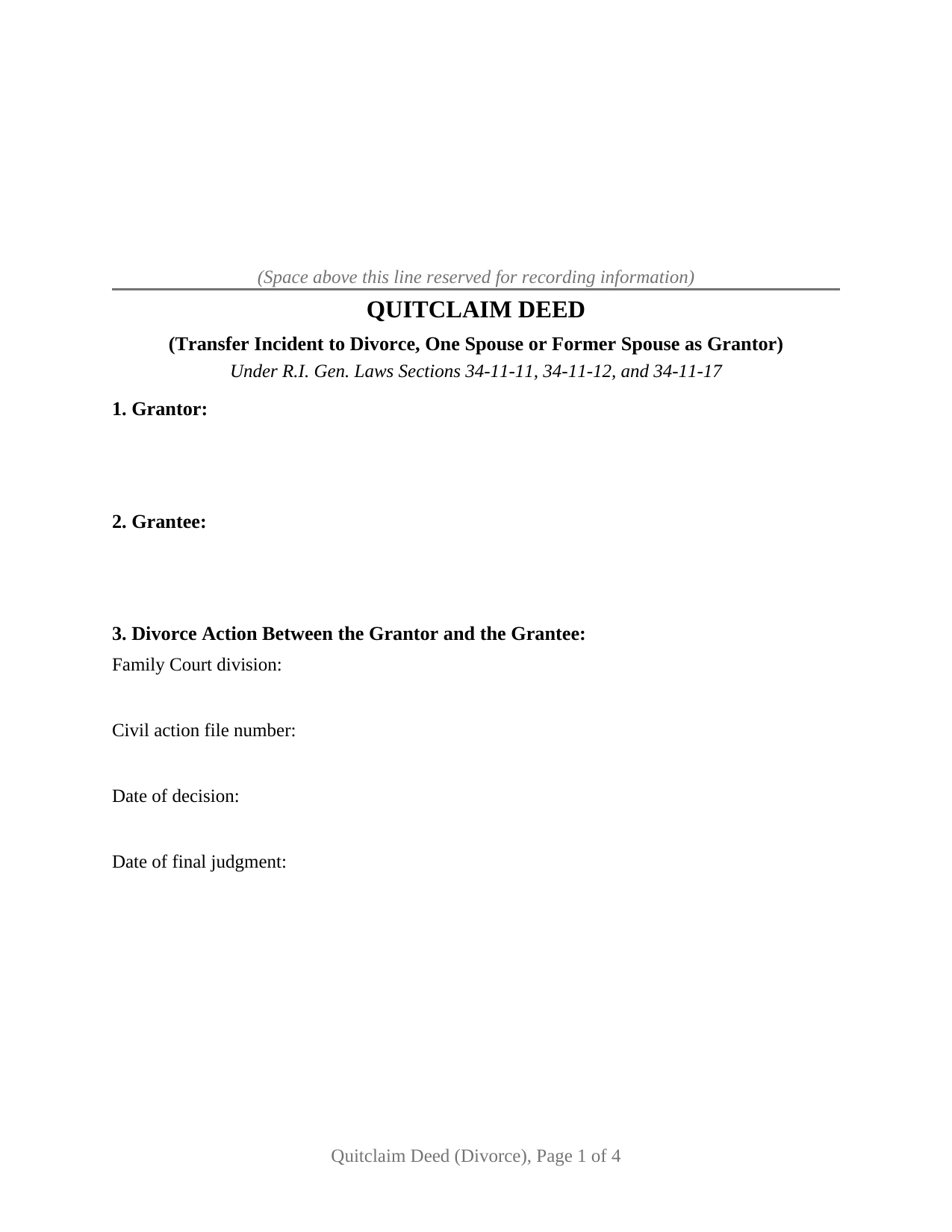
Section 11 of this deed says nothing about the land. It states that the conveyance is a transfer of property made incident to the divorce identified earlier in the instrument, and a Rhode Island tax regulation gives that one sentence work to do: 280-RICR-20-10-1.20 provides that a recital in the deed that the property was transferred incident to divorce discharges the lien imposed by Section 44-30-71.3(c) for nonresident withholding. This Rhode Island quitclaim deed is configured for that setting, one spouse or former spouse conveying real estate to the other in connection with a divorce.
What the deed borrows from the Family Court file
Four short lines in Section 3 carry the case: the county division of the Family Court, the civil action file number, the date of the decision, and the date of the final judgment. The last two are separate lines because Rhode Island separates the two events. Section 15-5-23(a) provides that no judgment for a divorce becomes final and operative until three months after the trial and decision, so a deed signed inside that interval records a decision date while the judgment line still reads that no judgment has entered. Section 4 then names the provision the transfer answers to, a settlement agreement paragraph, a decision, a final judgment, or an agreement merged into one of them.
None of that gives the deed its force. Section 15-5-16.1 lets the Family Court assign to either spouse a portion of the estate of the other, and provides that an assignment made by the court is regarded as a judgment for debt, on which suit may be brought or execution may issue for property due and undelivered. Dividing the property and conveying it are two different acts, and this instrument performs the second one.
A covenant that reaches one spouse's own years of ownership
The word quitclaim promises more here than it does in most states. Section 34-11-12 prints the statutory form and Section 34-11-17 supplies its content: fee simple passes, and the grantor stands behind the title against lawful claims of anyone claiming by, through, or under that grantor, and against nobody else. On a divorce deed the covered ground is the conveying spouse's own period on the title, so a lien that spouse allowed to attach falls inside it while a boundary problem from a prior owner falls outside. Section 34-11-27 sets the size of the transfer at whatever estate the grantor holds on the day of signing.
One signature, fourteen numbered sections
Exactly one person signs this deed: an individual grantor acting for that grantor's own account, whose typed name sits under the signature rule where Section 34-11-1.1 places it, above a single certificate printing what Section 34-12-1 asks an officer to certify. Section 7 records the vesting deed, which is where a reader learns how the grantor held. Transfers reaching the land evidence records in this configuration include a spouse conveying the former marital home to the spouse awarded it, and a former spouse living in another state who signs before an officer there. Structures the deed does not recite include two owners conveying together, a conveyance during a marriage with no court action to identify, and a signature drawn from a power of attorney or a fiduciary office. Where spouses still hold by the entirety, Cull v. Vadnais keeps that estate beyond either of them acting alone.
Taxed on consideration, recorded by the town
No divorce category appears anywhere in Section 44-25-2, whose exemptions run to debt security instruments, government grantors, and a few named project and affordable housing transfers. Consideration decides instead: the conveyance tax reaches $3.75 for each $500 above one hundred dollars, doubling on residential consideration above the 2026 indexed figure of $824,000 that Division of Taxation Advisory 2026-02 states, while a deed on which nothing is paid carries the Section 44-25-1(c) sentence in Section 10 in place of stamps. Recording is municipal, one city or town clerk with no county office anywhere in the state. Searchers reach the instrument as a divorce deed, a quit claim deed after divorce, or a divorce quitclaim deed.
Three files arrive with the purchase: the blank deed as a fillable PDF, a completed example worked through a Westerly conveyance following a Washington County judgment, and a plain language guide covering the fourteen sections, the acknowledgment, and the fee and tax arithmetic. These materials describe Rhode Island law in general terms and are informational only; they are not legal advice.
Important: County-Specific Forms
Our quitclaim deed (divorce) forms are specifically formatted for each of the 5 counties in Rhode Island.
After selecting your county, you'll receive forms that meet all local recording requirements, ensuring your documents will be accepted without delays or rejection fees.