Rhode Island Quitclaim Deed (Married Grantor with Non-Owner Spouse Joinder)
County Specific Legal Forms Validated as recently as October 9, 2026 by our Forms Development Team
About the Rhode Island Quitclaim Deed (Married Grantor with Non-Owner Spouse Joinder)
How to Use This Form
- Select your county from the list
- Download the county-specific form
- Fill in the required information
- Have the document notarized if required
- Record with your county recorder's office
What Others Like You Are Saying
"Exactly what we were looking for and filled out everything in minutes. Great value!"
"It was very simple and easy to fill out the information need to do the warranty deed."
"I LOVE THIS SITE KEEP UP THE GREAT WORK YOUR DOING THNKS KEVIN"
"The website made it easy to find and print out the documents I needed. The whole process was straigh…"
"Super easy to use! Totally satisfied. Thanks."
4.8/5 from 4,832 reviews. Read all
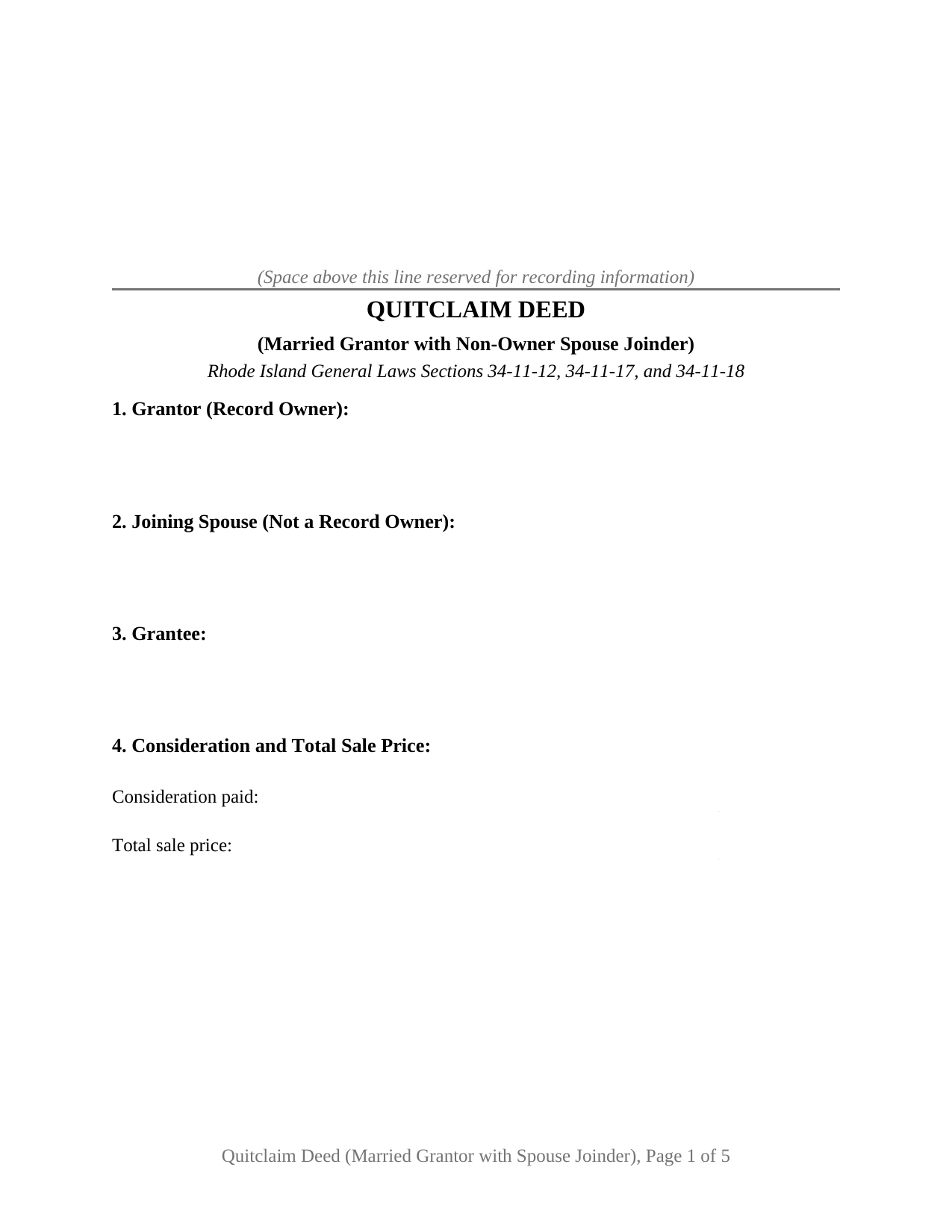
The second signature on this deed conveys no title at all. In this configuration of the Rhode Island quitclaim deed, one married record owner is the only grantor, and a spouse who owns nothing of record signs a joinder block releasing whatever interest that spouse might turn out to hold. One signature moves the title; the other closes a question a title examiner would otherwise have to raise.
What Rhode Island actually asks of a non-owner spouse
Less than most states. Dower and curtesy were abolished by Section 33-25-1, and Section 33-25-2 replaced them with a life estate for a surviving spouse in real estate a decedent owned at death. Its next subsection governs a lifetime deed: property conveyed away before death, whether or not money changed hands, escapes that life estate if the conveyance was recorded in the city or town land evidence records before the owner died. The Rhode Island Supreme Court called that interest a mere expectancy in Pezza v. Pezza, and in Barrett v. Barrett it held the recording subsection displaced the illusory transfer test, upholding a pre-death recorded conveyance into a trust against a widow's claim. No statute conditions a lifetime conveyance on a non-owner spouse's signature, and this form says so plainly.
A release, not a requirement
The joinder block is here because a release settles the record, not because a statute demands one. In Section 10 the joining spouse releases and quitclaims to the grantee, with quitclaim covenants, all right, title, interest, claim, and demand, if any, naming the estate of homestead under Section 9-26-4.1 and any interest arising under Chapter 33-25. Those two words, if any, carry the weight: a quitclaim release moves whatever exists and nothing beyond it, so where the spouse held nothing the section releases nothing and the record still answers the question.
Homestead is why that framing matters. Rhode Island's estate of homestead, now five hundred thousand dollars, arises automatically by operation of law, with no declaration filed, no statement in a deed, and no other documentation. It belongs to an owner, and a spouse holding no title sits inside that owner's family rather than holding a separate estate, which is why a release of whatever may exist fits the structure and a release drafted as a conveyance of some defined marital interest would not.
Covenants from the owner, and from the spouse
Rhode Island's quitclaim deed is no bare release: Sections 34-11-17 and 34-11-18 oblige a grantor to warrant and defend against lawful claims of anyone claiming by, through, or under that grantor. This deed prints the covenant phrase twice, in the conveyance and again in the joinder, so the spouse stands behind the spouse's own dealings in the chain as well.
One grantor, two certificates, thirteen sections
The form recites one record owner signing as grantor, and one spouse signing solely under the release, with a printed name beneath each signature as Section 34-11-1.1 contemplates. A separate acknowledgment certificate follows each signature, printing what Section 34-12-1 asks a certificate to show. Separate certificates are not something Rhode Island law demands; the paired layout exists so the two acknowledgments can fall days apart, before different officers, as the example shows. Patterns that put this structure into the record include an owner who bought before the marriage and is now selling, an owner conveying an inherited parcel into a trust, and a closing where a title company wants the release on record. Where both spouses hold record title the deed carries two grantors instead, an unmarried sole owner recites no joinder, and fiduciary or entity grantors recite capacity language this form does not carry.
Recording, the fees, and the tax
Rhode Island keeps land evidence records city by city and town by town, with no county recording office, so the finished quit claim deed goes to one municipal clerk. Fees are statewide though offices are local: Section 34-13-7 charges eighty dollars for a quitclaim deed plus a dollar per page and a ten percent surcharge for preserving municipal records, and Section 42-8.1-20 adds four dollars for the Historical Records Trust. Local practice still bites: Warwick guidance cuts off electronic recording at three in the afternoon.
The download holds three files: the blank deed as a fillable PDF, a completed example worked through a Warwick sale, and a guide covering all thirteen sections, both acknowledgments, the fee and tax arithmetic, and recording. These materials explain Rhode Island law at a general level and are not legal advice.
Important: County-Specific Forms
Our quitclaim deed (married grantor with non-owner spouse joinder) forms are specifically formatted for each of the 5 counties in Rhode Island.
After selecting your county, you'll receive forms that meet all local recording requirements, ensuring your documents will be accepted without delays or rejection fees.