Rhode Island Quitclaim Deed (Trustee Grantee)
County Specific Legal Forms Validated as recently as October 20, 2026 by our Forms Development Team
About the Rhode Island Quitclaim Deed (Trustee Grantee)
How to Use This Form
- Select your county from the list
- Download the county-specific form
- Fill in the required information
- Have the document notarized if required
- Record with your county recorder's office
What Others Like You Are Saying
"Quick, responsive service always!! Preferred way to record documents. Thanks Deeds.com!!"
"Amazing service. Immediate responses at all hours of the day and prevent late in the evening! Patien…"
"I'm not too bright and I made a mess of things when I tried to create my own deed. It was lucky that…"
"The product I purchased looks great and I added Adobe to be able to copy it, but for some reason I c…"
"Whole process was very easy and quick. Forms were easy to fill, examples were quite appropriate. Rec…"
4.8/5 from 4,832 reviews. Read all
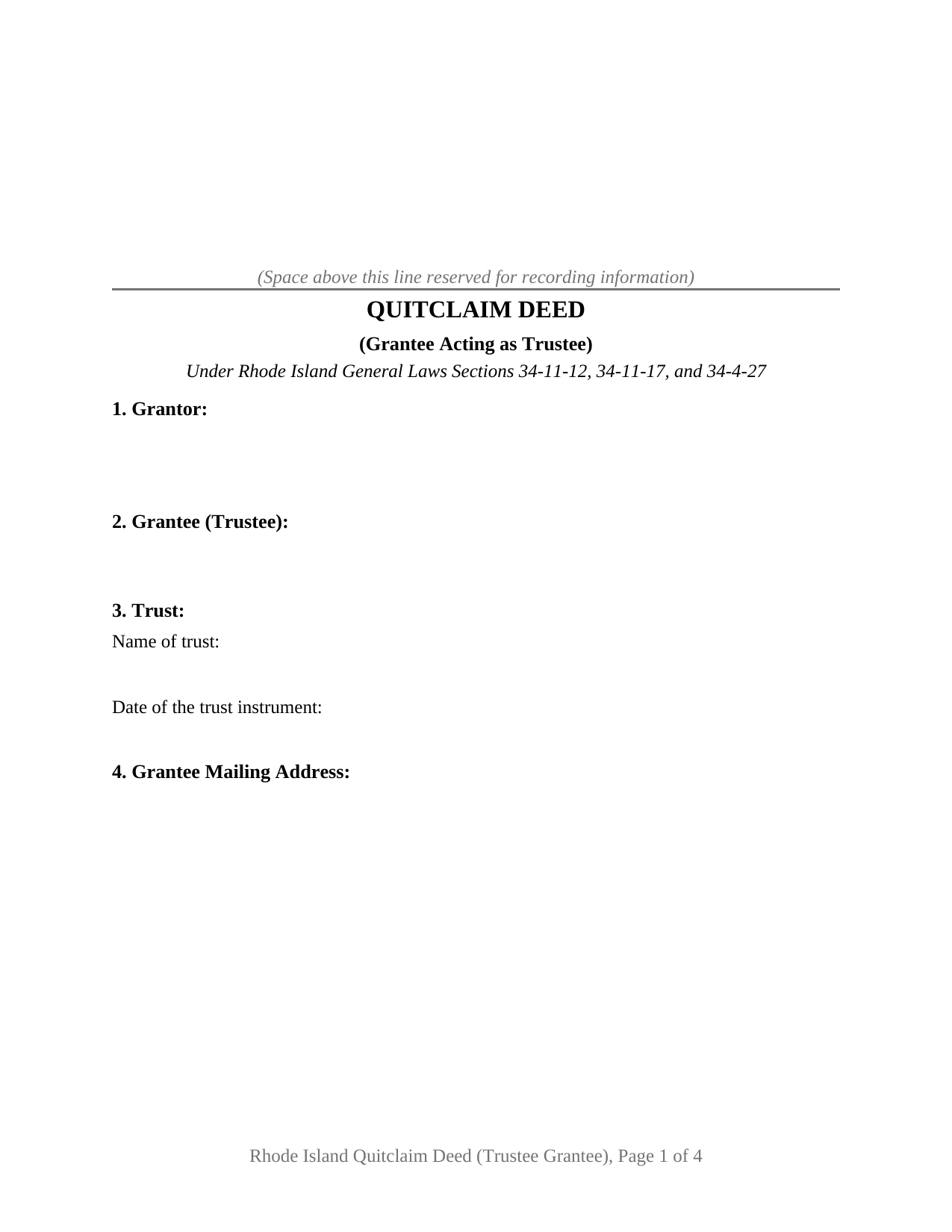
The grantee line is where this Rhode Island quitclaim deed parts company with the rest of its family. It names a person, and then it names the capacity that person takes in: trustee of a stated trust, under a trust instrument of a stated date. One individual grantor signs, one acknowledgment certificate follows that signature, and record title lands in a trustee rather than in someone holding for himself or herself.
Where the trust chapter puts the title
Section 34-4-27 of the General Laws opens with an instruction about who the grantee is: property to be held in trust is conveyed to the trustees of the subject trust. This form follows that instruction on its face. Section 2 names the trustee and prints the capacity, Section 3 records the trust name and the date of the trust instrument, and the conveyance section has the grantee take and hold the property as trustee of that trust and not individually. Section 34-4-28 backstops deeds drafted the other way: a conveyance to a named trust that never names the trustees as grantees is not defective on that account, and title vests in the trustees of the named trust.
The recording that waits for the trustee's turn
Moving a parcel into a trust and selling one out of a trust carry different paperwork here, and a single statute draws the line. An affidavit or memorandum of trust may be recorded when a trust is created, amended, restated, or revoked. It stops being optional later: a transfer or mortgage of trust property by the trustees calls for the trust instrument, as amended or restated, or a memorandum of trust in its place, to reach the record first. Executed by each settlor or by each current trustee, that memorandum states the trust name and dates, the trustee's authority to convey or mortgage, whether anything in the trust cuts back that power, and how successor trustees are appointed. It is drafted and recorded separately and is not part of this package.
Covenants measured by the grantor, not by the trust
The quitclaim deed of this state is a covenant instrument rather than a bare release. The statutory form at Section 34-11-12 carries the phrase with quitclaim covenants, and Section 34-11-17 sets its reach: fee simple passes, and the warranty answers for claims arising by, through, or under the grantor. A trustee grantee takes exactly that protection, no broader for being a fiduciary. Section 34-11-27 fixes the size of the transfer at whatever estate the grantor holds when the deed is signed.
One grantor, one trustee, one certificate
The form recites one individual grantor signing personally, with a printed name beneath the signature for Section 34-11-1.1, and one acknowledgment certificate printing the substance Section 34-12-1 asks a certificate to show. The trustee signs nothing here, because a grantee takes under a deed without executing it; the trustee's own signature turns up later, on a memorandum of trust or on the deed carrying the property back out. Patterns appearing in the land evidence records in this shape include a sole owner funding a family trust and an owner passing an inherited parcel to the trustee of an existing trust. Configurations this form does not recite include two owners conveying together, and a trustee on the granting side.
Filed with a clerk, taxed at the counter
No county records deeds in this state, so a trust transfer deed goes to the clerk of the one city or town where the parcel sits. The trustee's mailing address travels with the deed for Section 34-11-1.2, while Section 34-11-1.4 asks for a total sale price only where the conveyance results from a sale. Funding a trust often involves no payment at all, which is why Section 6 holds the sentence Section 44-25-1(c) contemplates, that the consideration is such that no documentary stamps are required. There is no trust exemption from the conveyance tax; the list at Section 44-25-2 runs elsewhere.
The download holds the blank deed as a fillable PDF, a completed example worked through a Jamestown conveyance to a trustee, and a plain language guide covering the twelve numbered sections, the acknowledgment, the tax statements, and municipal recording. Searchers reach this instrument as a quit claim deed to a trustee or a deed into a living trust; the recorded document is the same statutory conveyance under any of those names. The materials describe Rhode Island law in general terms; they are informational and are not legal advice.
Important: County-Specific Forms
Our quitclaim deed (trustee grantee) forms are specifically formatted for each of the 5 counties in Rhode Island.
After selecting your county, you'll receive forms that meet all local recording requirements, ensuring your documents will be accepted without delays or rejection fees.