Rhode Island Quitclaim Deed (Two Grantors)
County Specific Legal Forms Validated as recently as October 9, 2026 by our Forms Development Team
About the Rhode Island Quitclaim Deed (Two Grantors)
How to Use This Form
- Select your county from the list
- Download the county-specific form
- Fill in the required information
- Have the document notarized if required
- Record with your county recorder's office
What Others Like You Are Saying
"Great service, fast easy to use, accurate forms for our project. Thank you. FTM"
"Exellent and easy! Thqanks!"
"Documents available immediately as advertised. Was easy to understand the guide and complete the dee…"
"User friendly and fast response time!!"
"Really appreciate you he quick response and solution to my problem!! Thank you!!"
4.8/5 from 4,830 reviews. Read all
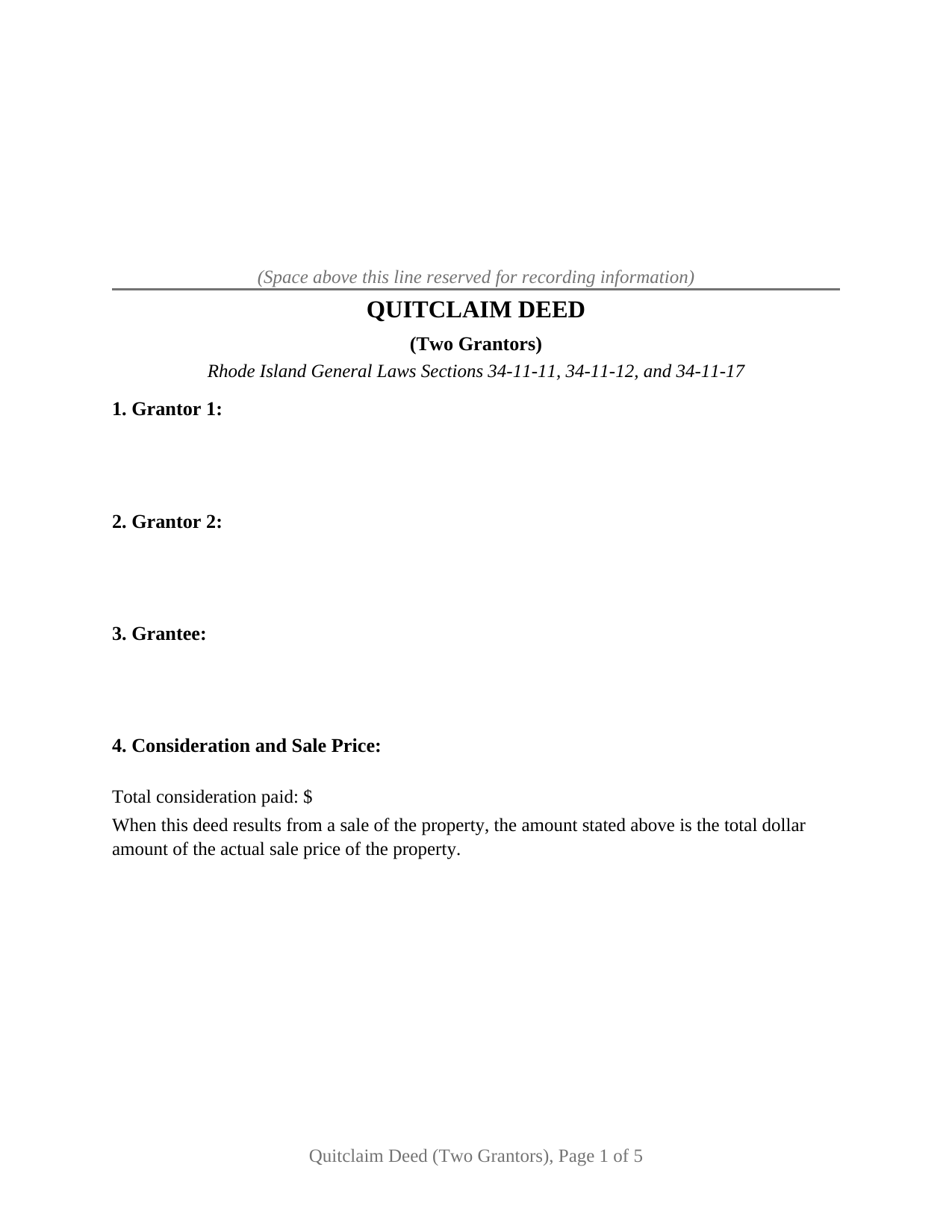
Two record owners, one recorded instrument. This Rhode Island quitclaim deed is configured for exactly two grantors: co-owners who pass both of their interests to the grantee in a single deed, with a signature line for each grantor, a printed name beneath each signature, and a separate acknowledgment certificate for each of the two acknowledgments.
Two interests moving together
Rhode Island General Laws Section 34-11-27 provides that a conveyance passes all the estate the grantor holds at execution, and on a two-grantor deed that rule runs twice: each grantor's undivided interest moves, and together the deed carries whatever the two of them own, whether that is the entire title or a pair of fractional shares. The covenant side of the form scales the same way. Under Section 34-11-17, the statutory phrase with quitclaim covenants warrants the title against persons claiming by, through, or under the grantors and no others, so each grantor stands behind that grantor's own acts in the chain, mortgages granted and interests conveyed, while defects older than their ownership stay outside the covenant.
Married owners and the entirety estate
The pattern that most often puts two grantor blocks on a Rhode Island deed is marriage. Spouses who hold as tenants by the entirety hold the whole estate together, and the Rhode Island Supreme Court's decisions, Cull v. Vadnais among them, put disposal of the estate beyond either spouse acting alone; a voluntary conveyance of entireties property carries both spouses' assent and both spouses' signatures. The two-grantor architecture also appears in the land evidence wherever a co-ownership ends in a single transaction: joint tenants deeding to one buyer, parents passing a shore cottage to an adult child, tenants in common closing out a shared parcel.
Two signatures, two certificates
The form recites two grantors, each signing personally, in an individual capacity. Printed name lines under both signatures match Section 34-11-1.1, which calls for typed or printed names beneath the signatures of signers and notaries. Each grantor's acknowledgment takes its own certificate carrying the substance Section 34-12-1 requires: known to the officer, known to be the party executing, and acknowledged as a free act and deed. Rhode Island law does not require separate certificates; the form carries one per grantor as a matter of design, so a couple may acknowledge on the same afternoon before one notary, or weeks apart in different states, and the deed still assembles cleanly for the record. Configurations outside this pattern, a sole owner conveying alone, an entity or fiduciary grantor, or three or more owners, recite different signature and capacity structures than this deed carries.
Recording in the town where the land lies
Land evidence in Rhode Island is municipal, so the finished deed goes to the recording office of the one city or town where the property sits, and the layout holds the top of the first page and the lower portion of the last page open for recording use. The content the recording statutes look for travels with the deed: the grantee's residence or post-office address that Section 34-11-1.2 calls for, together with the actual sale price on a deed that results from a sale, per Section 34-11-1.4. A sale also takes documentary stamps at three dollars and seventy five cents per five hundred dollars of consideration when the deed is recorded, while a transfer without consideration carries the statement Section 44-25-1(c) contemplates in place of stamps. The guide included with the form walks the fee arithmetic, and the completed example shows a two-grantor sale in Westerly filled in from the first grantor block through the second notary block. Recorded under the name quitclaim deed or quit claim deed, the instrument is the same statutory form either way.
Inside the download
The download delivers the blank two-grantor quitclaim deed as a fillable PDF, a completed example showing every entry for a realistic Rhode Island transaction, and a plain language guide covering each numbered section, both acknowledgments, and municipal recording. The materials describe Rhode Island law generally; they are informational, not legal advice.
Important: County-Specific Forms
Our quitclaim deed (two grantors) forms are specifically formatted for each of the 5 counties in Rhode Island.
After selecting your county, you'll receive forms that meet all local recording requirements, ensuring your documents will be accepted without delays or rejection fees.