Rhode Island Quitclaim Deed (Corporation Grantor)
County Specific Legal Forms Validated as recently as September 9, 2026 by our Forms Development Team
About the Rhode Island Quitclaim Deed (Corporation Grantor)
How to Use This Form
- Select your county from the list
- Download the county-specific form
- Fill in the required information
- Have the document notarized if required
- Record with your county recorder's office
What Others Like You Are Saying
"I found what my lawyer recommended and was able to download it easily."
"Fast, easy and helpful. Highly recommend, my document was recorded within 24 hours."
"Five Stars!"
"Most people coming to this sight will not have the knowledge for deeds. Therefore, I wish there were…"
"Great company to work with, quick responses."
4.8/5 from 4,833 reviews. Read all
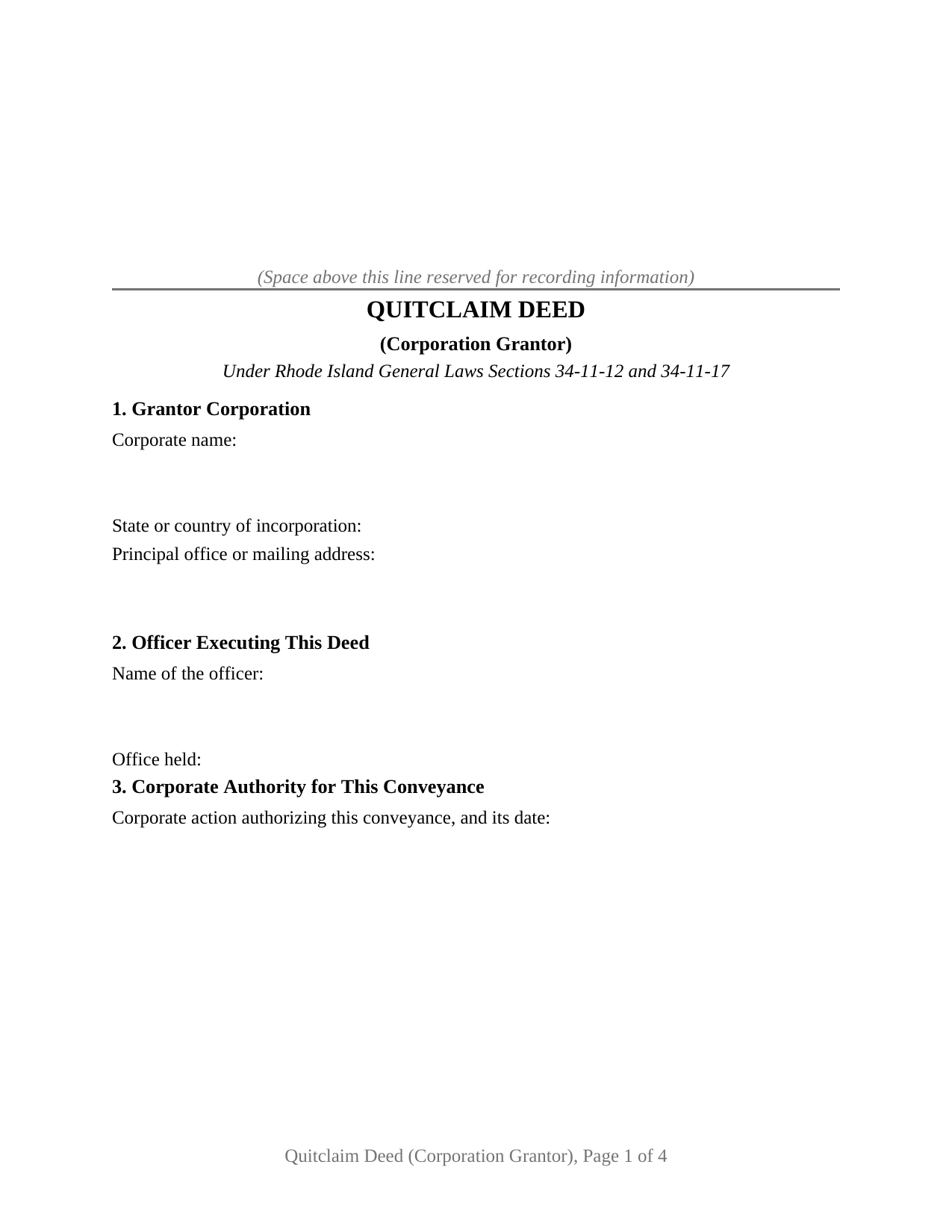
Behind a corporation's deed sits a vote. Rhode Island's Business Corporation Act sorts corporate dispositions of property into two authorization tracks, and this quitclaim deed is configured to put the answer on the record: one corporate grantor, one officer signing in a named office, and a numbered section for the corporate action that authorized the transfer.
Two tracks, and the section that names which one
Part 11 of Chapter 7-1.2 draws the line. Section 7-1.2-1101 governs a sale of assets in the regular course of business. Section 7-1.2-1102 picks up the harder case, a disposition of all or substantially all of a corporation's property and assets falling outside that regular course, and it prescribes a sequence: a board resolution endorsing the disposition and sending it to a shareholders' meeting, written notice to every shareholder twenty days ahead carrying a statement of the right to dissent, then a shareholder authorization that may set the terms or leave the board to set them. Two transfers route back to the earlier section: one to a two-thirds-controlled subsidiary, one for cash. Section 3 of the form takes the resolution, written consent, or vote by name and date, because a title reader meeting this deed years later is asking which track the transaction took.
The corporation grants, an officer signs
Section 7-1.2-302 keeps the two identities apart. Its enumerated powers reach acquiring, owning, holding, and dealing in and with real property, so the estate stands in the corporation rather than in its shareholders. Section 1 prints the corporate name with the state or country of incorporation beside it; Section 2 prints the individual and the office; Sections 11 and 12 state that the signer acts in that office rather than personally, so nothing of the signer's own moves. A printed name line sits under the signature for Section 34-11-1.1, and one certificate carries the Section 34-12-1 substance. The same powers list treats a corporate seal as a power the corporation may keep rather than a deed formality, so the form carries no seal ring.
A covenant that begins when the corporation bought
A quitclaim deed here is no naked release. Section 34-11-12 supplies the form and Section 34-11-17 draws the covenant's boundary: a fee simple moves, and the grantor answers for claims arising by, through, or under itself and for nothing older. Against a corporate seller that line falls at the corporation's own tenure, so a mortgage the corporation granted lands inside it while a boundary dispute from two owners back lands outside. Section 34-11-27 measures what moves at whatever estate stands in the corporate name on the day of signing.
Corporations organized elsewhere
A deed out of a Delaware or Massachusetts corporation raises a registration question, and the statute is direct about what turns on it. Section 7-1.2-1401 gives a foreign corporation no right to transact business here before it procures a certificate of authority. Section 7-1.2-1418 then splits the consequence: the corporation may not maintain an action in a Rhode Island court until it holds one, and it owes the fees and franchise taxes it skipped, while subsection (b) provides that the failure impairs the validity of no contract or act. The deed is not void for the omission.
What a corporate seller meets at the counter
The conveyance tax reaches this deed at $3.75 on each $500 of consideration, and a residential price above the indexed 2026 figure of $824,000 draws a second helping of the same rate; nothing in the exemption list at Section 44-25-2 turns on a grantor being incorporated. Two filings ride beside the deed. Form CVYT-2 carries the acquired real estate company tax, reaching a transfer of a controlling interest in a company that holds Rhode Island realty, and goes to the Division of Taxation five days ahead. Nonresident withholding under Section 44-30-71.3 runs at seven percent where the selling corporation is a nonresident. Neither belongs to this package. Land evidence records are municipal, so one city or town clerk records the deed. Searches reach it as a corporate quit claim deed or a deed out of a company.
Three items arrive in the download: the blank deed as a fillable PDF, a completed example running a Cumberland sale by a Rhode Island corporation from its opening blank through the notary block, and a guide walking all thirteen numbered sections, the certificate, and the fee and tax arithmetic. The materials describe Rhode Island practice at a general level and are not legal advice.
Important: County-Specific Forms
Our quitclaim deed (corporation grantor) forms are specifically formatted for each of the 5 counties in Rhode Island.
After selecting your county, you'll receive forms that meet all local recording requirements, ensuring your documents will be accepted without delays or rejection fees.