Rhode Island Quitclaim Deed (Individual Grantor by Attorney-in-Fact)
County Specific Legal Forms Validated as recently as October 13, 2026 by our Forms Development Team
About the Rhode Island Quitclaim Deed (Individual Grantor by Attorney-in-Fact)
How to Use This Form
- Select your county from the list
- Download the county-specific form
- Fill in the required information
- Have the document notarized if required
- Record with your county recorder's office
What Others Like You Are Saying
"I love how you can get information you need online great program ,outstanding just love it...."
"a lil pricey but i was able to knock out what needed to be done within 2 hours and not all day."
"Quick and easy with great instructions and accurate documents. I plan to make this site a part of ou…"
"Very easy to use. Straightforward and informative"
"worked very well"
4.8/5 from 4,836 reviews. Read all
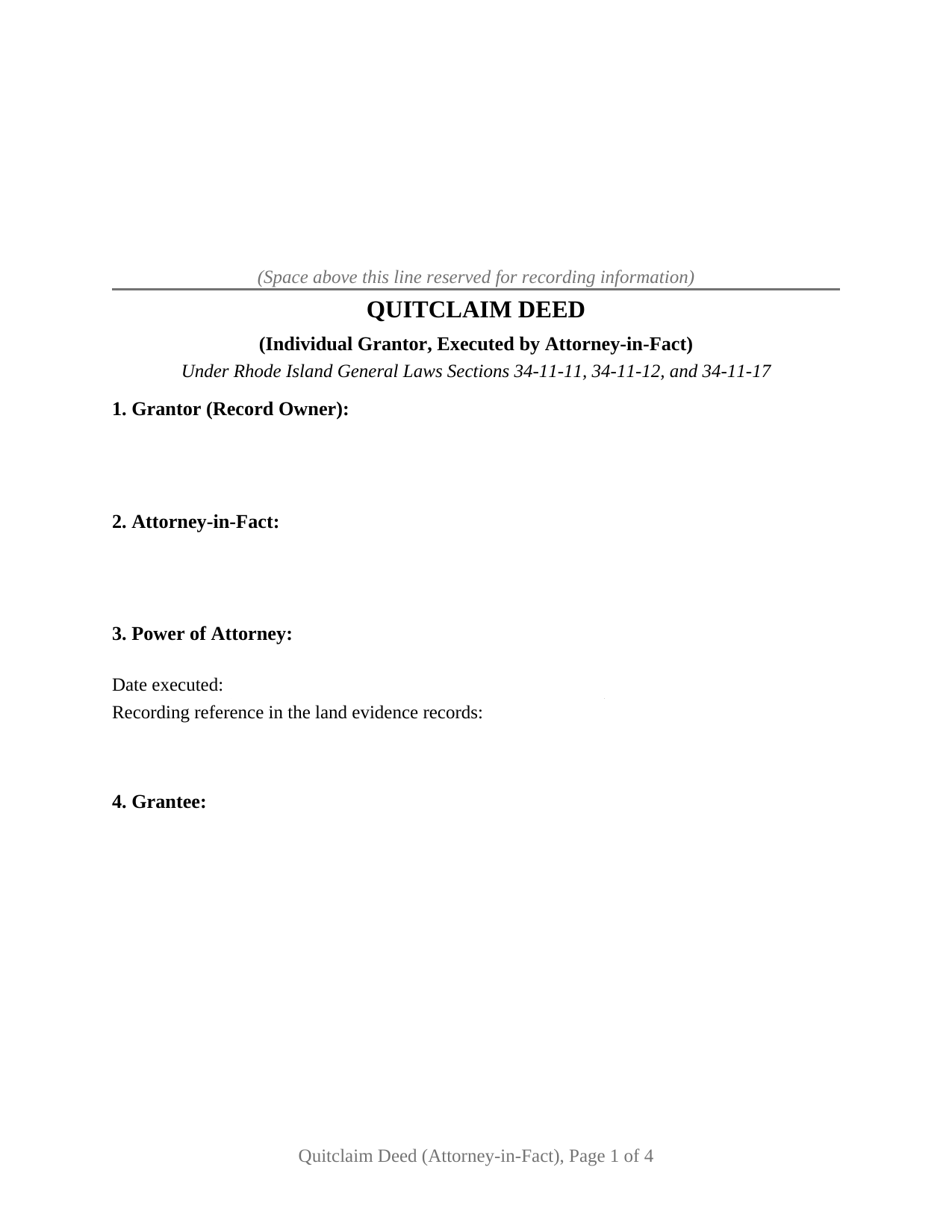
Two names meet on the signature line of this deed, and only one of them owns the land. This Rhode Island quitclaim deed is configured for a single individual record owner as grantor whose deed is signed by an attorney-in-fact: the owner grants, the agent executes, and one acknowledgment certificate belongs to the agent who put pen to paper.
Where an agent gets the power to quitclaim
Rhode Island answers that question with unusual precision. Chapter 18-16, the Short Form Power of Attorney Act, devotes Section 18-16-3 to real estate, and the acts that general real estate authority is construed to cover name this very instrument: to sell, to exchange, to convey either with or without covenants, to quit claim, to release, to surrender, to mortgage, to encumber. Subsection (b) makes those powers equally exercisable over land the principal owned when the power was signed or acquired later, in Rhode Island or elsewhere. Section 18-16-2 keeps the statutory form voluntary and lets the parties agree on a different one, so the deed identifies the power by date and recording reference.
The covenant belongs to the owner, not the signer
Signing and warranting are separate things here. Section 34-11-12 supplies the statutory quitclaim deed and Section 34-11-17 gives its covenant phrase content: fee simple passes, and the warranty answers for lawful claims of persons claiming by, through, or under the grantor and nobody else. The grantor here is the principal, so the covenant is measured against the owner's own chapter of the chain; the agent warrants nothing personally and parts with nothing. Section 11 says so in terms, and Section 34-11-27 fixes the size of the transfer at whatever estate the owner holds on the day the agent signs.
The power belongs in the land evidence records
A deed signed under an agency puts two instruments in front of a title reader. Section 34-13-1 opens its list of recordable instruments with letters of attorney, and Section 34-11-34 carries the caption Conveyances executed by attorney, Recording of power. Section 18-16-2 has the principal acknowledge the power in the manner prescribed for acknowledging a conveyance of real property. Section 34-11-36 adds a long stop: an acknowledgment on an instrument conveying Rhode Island real estate, a power of attorney included, is construed valid after ten years of record, absent a timely challenge. The power is recorded separately and is not part of this package; Section 3 holds a blank for its date and its place in the record.
One signature, one certificate, twelve sections
Section 1 names the owner, Section 2 names the agent, and Section 3 identifies the power. The signature runs in the customary form, the owner's name by the agent as attorney-in-fact, with a printed name line beneath it for Section 34-11-1.1, and the single certificate carries the substance Section 34-12-1 describes together with the representative capacity in its name blank. Ownership patterns that reach the record in this shape include an owner living out of state who leaves a sale to a relative holding a durable power, and an owner whose adult child signs under a power granted years earlier. Configurations this deed does not carry include an owner signing personally, two owners conveying together, and a trustee or corporate officer drawing authority from another source.
What the deed meets at the counter
Recording is municipal here, with no county offices at all, so deed and power reach the clerk of the one city or town where the parcel sits. Fees do not vary by town even though the offices do: Section 34-13-7 puts a quitclaim deed at eighty dollars, a dollar for every page, and a ten percent municipal records preservation surcharge. The conveyance tax takes three dollars and seventy five cents out of every five hundred of consideration above one hundred dollars, and a residential price above the 2026 indexed threshold of $824,000 draws that rate twice. No category in the Section 44-25-2 exemption list depends on who held the pen. Searchers reach this instrument as a power of attorney deed, a POA deed, or an attorney in fact quit claim deed.
The download holds three files: the blank deed as a fillable PDF, a completed example worked through a Tiverton sale signed under a recorded power, and a plain language guide covering the twelve numbered sections, the acknowledgment, and the fee and tax arithmetic. These materials describe Rhode Island practice at a general level and are not legal advice.
Important: County-Specific Forms
Our quitclaim deed (individual grantor by attorney-in-fact) forms are specifically formatted for each of the 5 counties in Rhode Island.
After selecting your county, you'll receive forms that meet all local recording requirements, ensuring your documents will be accepted without delays or rejection fees.