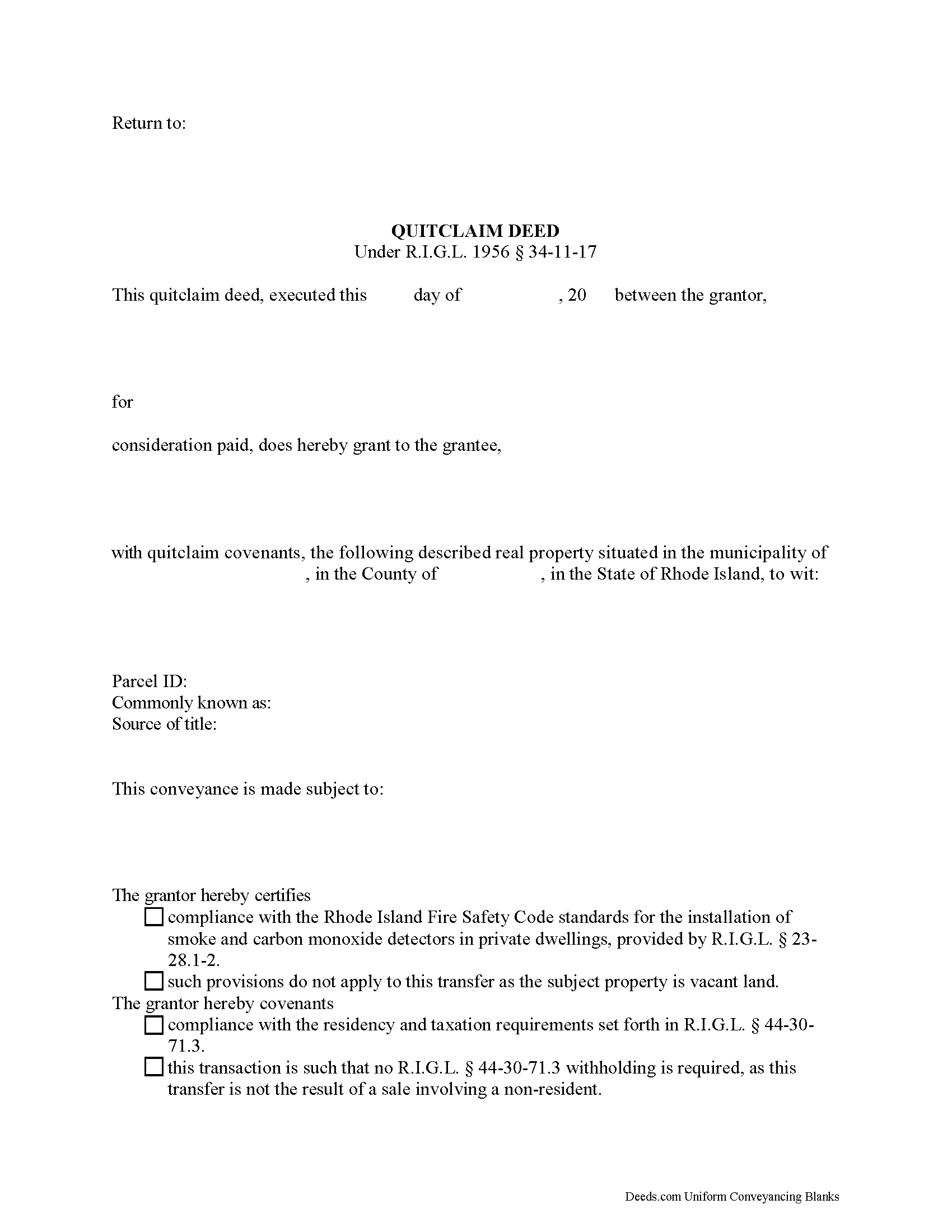
Rhode Island Quitclaim Deed
County Specific Legal Forms Validated as recently as October 16, 2026 by our Forms Development Team
About the Rhode Island Quitclaim Deed
How to Use This Form
- Select your county from the list
- Download the county-specific form
- Fill in the required information
- Have the document notarized if required
- Record with your county recorder's office
What Others Like You Are Saying
"I found the process of downloading and completing the documents very user friendly. Thank you for th…"
"Fantastic! So helpful, got my deed recorded with no problem."
"Easy to use Website. Quick accurate data reporting. I will use the service in the future."
"Your PDF form Personal Representative's Deed was exceedingly helpful."
"The process was quite easy, following the instructional guide. I have yet to find out if the deed wa…"
4.8/5 from 4,832 reviews. Read all
A Rhode Island deed that names two grantees and stops there has answered a question nobody asked aloud. Section 34-3-1 of the General Laws reads a conveyance to two or more people as a tenancy in common unless the instrument declares a joint tenancy, grants to the survivors or survivor of them, or otherwise manifests a different intent. This is the open configuration of the Rhode Island quitclaim deed: one or two individuals a side, party blanks that preprint no status or tenancy wording, and the estate settled by what the parties write there.
Blanks the statute leaves to the parties
Chapter 34-11 gives a drafter unusual room. Section 34-11-11 says the statutory forms may be used, may be altered as circumstances require, and are not the only forms a conveyance may take, and Section 34-11-12 then prints a quitclaim deed of roughly thirty words. Mailing addresses, a price, a tax statement, a source of title: everything a modern land evidence record wants around those words arrives under that permission, and here the grantor and grantee lines are open blanks four lines deep.
Why the phrase does the warranting
No verb in the deed carries a promise. Section 34-11-26 states that grant, grantor, and grantee imply no warranty, and Section 34-11-7 says as much of sell, release, and confirm. The promise lives in three printed words, with quitclaim covenants, which Section 34-11-18 expands into an undertaking to warrant and defend the granted premises forever against lawful claims and demands of anyone claiming by, through, or under the grantor, while Section 34-11-17 gives a deed in that form the force of a conveyance in fee simple. The covenant line falls at the grantor's own years on the title, and Section 34-11-27 sets the quantity at whatever estate the grantor then holds.
Two open party blanks, two signature blocks
The deed recites individuals conveying for their own account, with no capacity or authority language anywhere. Two signature blocks stand under the conveyance, headed GRANTOR and SECOND GRANTOR, each with the printed name line Section 34-11-1.1 calls for and each followed by its own certificate carrying the substance Section 34-12-1 describes. One owner conveying leaves the second block and certificate unused; where two convey, the paired certificates let the signers appear before different officers on different days, as the completed example shows across a state line. Structures this configuration does not print include three or more owners on a side, a company or partnership granting, a trustee or executor stating a fiduciary office, and an agent signing under a power of attorney.
The lines a Rhode Island clerk reads
Four short statutes shape what the numbered sections collect. Section 34-11-1.2 asks for the grantee's name, residence, and post office address, and lets the city or town clerk decline a deed that lacks it. Section 34-11-1.4 asks a sale deed for the total dollar amount of that sale, and Section 44-25-1(c) supplies the sentence an instrument carries in place of documentary stamps where nothing is paid. Then comes the provision nobody expects: under Section 34-11-1.5 a deed transferring land holding a registered historical cemetery endorses that fact in capital letters, so the notation takes a numbered line of its own, completed as None on most parcels.
Eighty four dollars and one town clerk
No county office records anything in this state. Land evidence is kept city by city and town by town, so the signed deed reaches one municipal clerk, and Section 34-13-2 turns recording into constructive notice. Fee schedules published by clerks in Lincoln, East Providence, and Barrington put a quitclaim deed at eighty four dollars for the first page, being the eighty dollars of Section 34-13-7 with the four dollar Historical Records Trust fee of Section 42-8.1-20 added, and a dollar for each page after it. Conveyance tax runs at $3.75 on every $500 of consideration above one hundred dollars, doubling on residential consideration over $824,000 in 2026. Searchers type the instrument as a quit claim deed or a quitclaim deed form; the record answers to each.
Three files download with the purchase: the blank deed as a fillable PDF, a completed example carrying a North Kingstown transfer by two owners through both notary blocks, and a plain language guide walking the fifteen sections, the certificates, the ownership forms Section 34-3-1 leaves open, and municipal recording. What the three describe is Rhode Island law in general terms, which is information rather than legal advice.
Important: County-Specific Forms
Our quitclaim deed forms are specifically formatted for each of the 5 counties in Rhode Island.
After selecting your county, you'll receive forms that meet all local recording requirements, ensuring your documents will be accepted without delays or rejection fees.