Texas Certification of Trust (Single Trustee)
County Specific Legal Forms Validated as recently as October 14, 2026 by our Forms Development Team
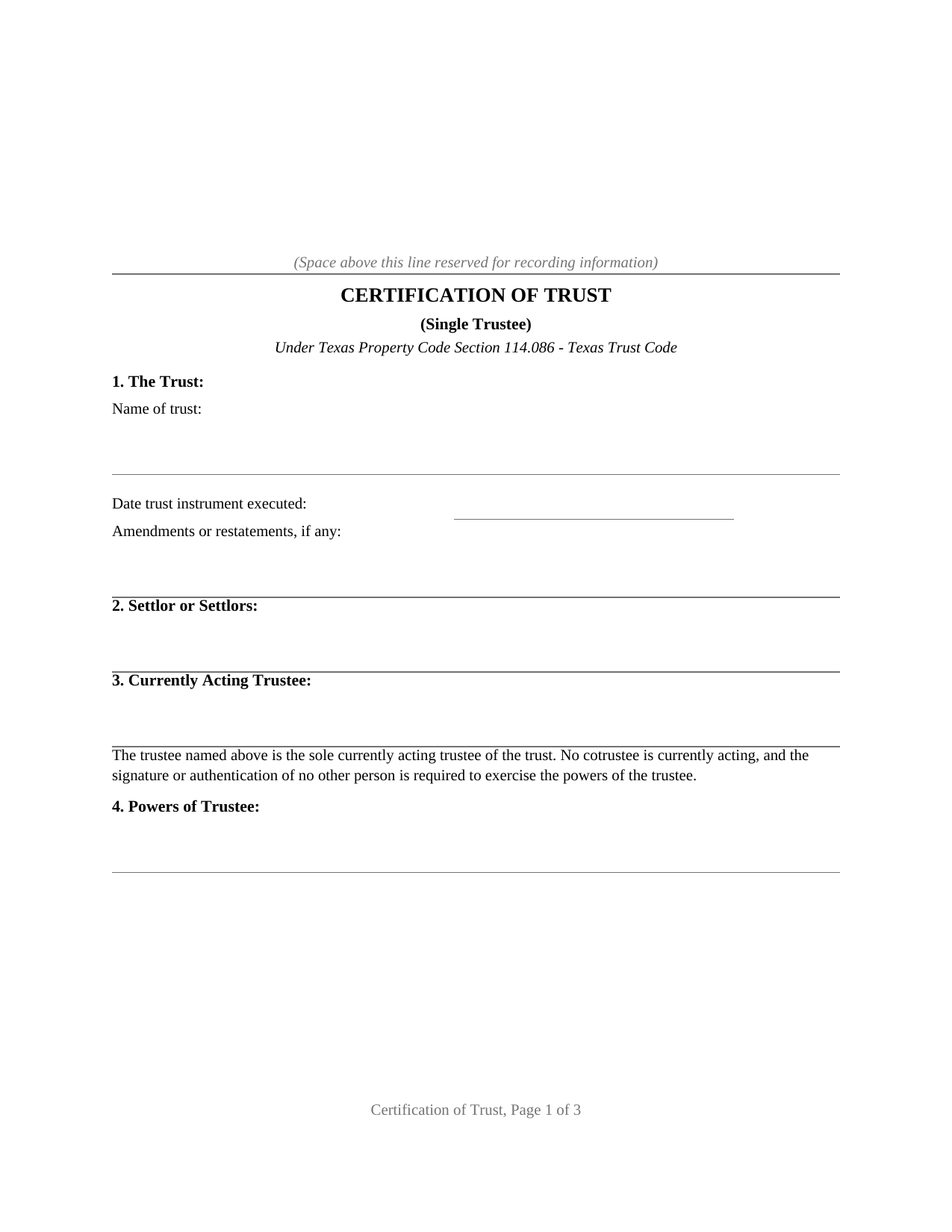
About the Texas Certification of Trust (Single Trustee)
How to Use This Form
- Select your county from the list
- Download the county-specific form
- Fill in the required information
- Have the document notarized if required
- Record with your county recorder's office
What Others Like You Are Saying
"Great Tool! Very easy to complete."
"I found the process of downloading and completing the documents very user friendly. Thank you for th…"
"Easy to navigate"
"Easy to use. Documents as stated."
"So far so good. Looks nice but a more condensed version, when the recorder charges by the page, shou…"
4.8/5 from 4,825 reviews. Read all
A Texas trustee dealing with a bank, a title company, or a buyer is routinely asked to prove two things: that the trust exists, and that the trustee holds the power to act. Handing over the entire trust agreement answers the question at the cost of the trust's privacy. Texas Property Code Section 114.086 supplies the alternative this form prepares: a certification of trust, a short signed statement of the statutory facts that a recipient is entitled to rely on, with the trust's dispositive terms left out. This version of the form is written for a trust with one currently acting trustee and no cotrustee.
The facts the statute lists
Section 114.086 names the contents: the existence of the trust and the date the trust instrument was executed, the identity of the settlor, the identity and mailing address of the currently acting trustee, the trustee's powers (or a statement that they include at least all the powers granted by Subchapter A, Chapter 113 of the Property Code), whether the trust is revocable and who holds the power to revoke it, the cotrustee signing authority, and the manner in which title to trust property is taken. The certification must also state, in the statute's words, that the trust has not been revoked, modified, or amended in any manner that would cause its representations to be incorrect; that sentence is built into the form's operative section. A recipient who relies on the certification without knowledge that it is wrong is protected by the statute, and a recipient who demands the full trust instrument anyway risks liability for damages where a court finds the demand was not made in good faith.
A presumption that lives in the county records
Since September 1, 2023, recording gives the certification a second job. Property Code Section 114.087(d), added by Senate Bill 801, provides that a certification of trust recorded in the county where real property of the trust is located is presumed to correctly identify the trust and the trustee and may be relied upon by a good faith purchaser or lender for value. The form is drafted for exactly that use: it carries an optional section identifying the trust's real property by county and legal description, a notarial acknowledgment so the document is recordable under Property Code Section 12.001, and Texas recording formatting, letter size with the upper part of page one reserved for the county clerk's stamp.
One trustee, stated plainly
Cotrustee authority is one of the statutory content items, and this variant answers it in the form itself: the operative text states that the named trustee is the sole currently acting trustee and that the signature of no other person is required to exercise the trustee's powers. The common fact patterns are a revocable living trust with the settlor serving as sole trustee, the pattern in the completed example, and a sole successor trustee now in office. A trust with two or more acting cotrustees calls for different recitals than this form carries.
The download includes the fillable certification, a guide that walks through each numbered section with the statutory background, and a completed example showing the document filled in for a realistic Travis County fact pattern. The materials are informational and are not legal advice.
Important: County-Specific Forms
Our certification of trust (single trustee) forms are specifically formatted for each of the 254 counties in Texas.
After selecting your county, you'll receive forms that meet all local recording requirements, ensuring your documents will be accepted without delays or rejection fees.