Texas Certification of Trust
County Specific Legal Forms Validated as recently as September 9, 2026 by our Forms Development Team
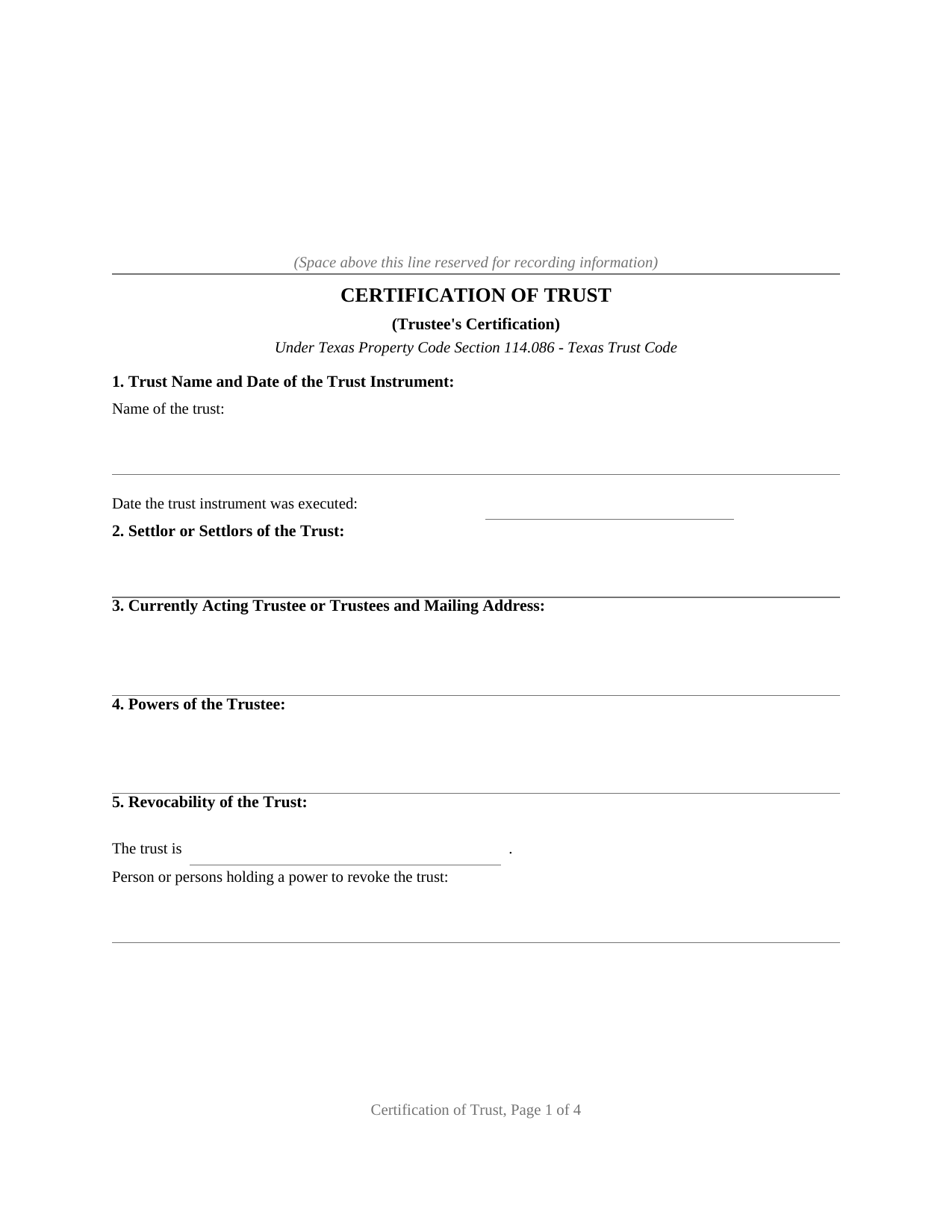
About the Texas Certification of Trust
How to Use This Form
- Select your county from the list
- Download the county-specific form
- Fill in the required information
- Have the document notarized if required
- Record with your county recorder's office
What Others Like You Are Saying
"The process was easy, and efficient. There was a person available to help if needed. Very pleased, w…"
"Very fast service"
"I Found Deeds.com to be fabulous. I had no idea how or where to start to get a quitclaim deed. deeds…"
"Works perfect. Saved money hiring someone to do this work."
"I used the Oklahoma Gift Deed transferring property intra-family, and found it easy to complete. I c…"
4.8/5 from 4,824 reviews. Read all
A Texas trustee is regularly asked to prove the trust: a title company examining a sale, a lender refinancing trust property, a bank retitling an account. Handing over the full trust instrument answers the question at the cost of the family's privacy, because the dispositive terms, who ultimately takes and on what conditions, travel with it. Section 114.086 of the Texas Property Code supplies the alternative this form prepares: a certification of trust, signed by a currently acting trustee, that carries the administrative facts a third party legitimately requires and expressly omits the dispositive terms of the trust.
What the Certification Carries
The statute lists seven items: the trust's existence and the date the trust instrument was executed, the settlor's identity, the currently acting trustee and mailing address, the trustee's powers (stated specifically or by reference to the general powers of Chapter 113, Subchapter A), revocability and who holds a power to revoke, the authority of cotrustees, and the manner of vesting title to trust property. Section 114.086(c) adds one required sentence: the trust has not been revoked, modified, or amended in any manner that would cause the representations in the certification to be incorrect. The form collects the seven items in numbered sections and performs the certification in a single operative paragraph the trustee signs before a notary.
Reliance the Statute Enforces
What gives the certification its force is the reliance structure built around it. A person who acts in reliance on a certification without knowledge that its representations are incorrect is not liable and may assume without inquiry the facts it contains, and a good faith counterparty may enforce the transaction against the trust property as if the representations were correct. The statute also polices the other side of the exchange: a recipient may require excerpts from the trust instrument showing the trustee's designation and power to act in the pending transaction, but a person who demands the entire trust instrument on top of a certification or those excerpts is liable for damages where a court finds the demand was not made in good faith.
Built for the County Records
No statute conditions the certification on recording, but a certification connected to real property is commonly placed of record so later title examiners find it. The form is built for that path. It carries a notarial acknowledgment, which qualifies it for recording under Property Code Section 12.001(a); an optional section identifying the property by county and legal description, so the recorded instrument indexes against the parcel; and a printed statement that the certification is not a conveyance and transfers no interest in real property. Because Section 114.086(b) lets any trustee sign, the form provides a signature block and a separate acknowledgment certificate for one trustee and for a cotrustee who joins.
What Arrives in the Download
The package contains the certification as a fillable PDF formatted to Texas recording standards, a completed example filled in for a realistic Travis County fact pattern, and a plain language guide covering every numbered section, the signing formalities, and recording, including the photo identification requirement at the recording counter for documents presented in person on or after December 4, 2025. The materials are informational and are not legal advice; a Texas attorney can apply Section 114.086 to a particular trust or transaction.
Important: County-Specific Forms
Our certification of trust forms are specifically formatted for each of the 254 counties in Texas.
After selecting your county, you'll receive forms that meet all local recording requirements, ensuring your documents will be accepted without delays or rejection fees.