Texas Transfer on Death Deed (Community Property with Right of Survivorship, Individual Beneficiaries)
County Specific Legal Forms Validated as recently as October 15, 2026 by our Forms Development Team
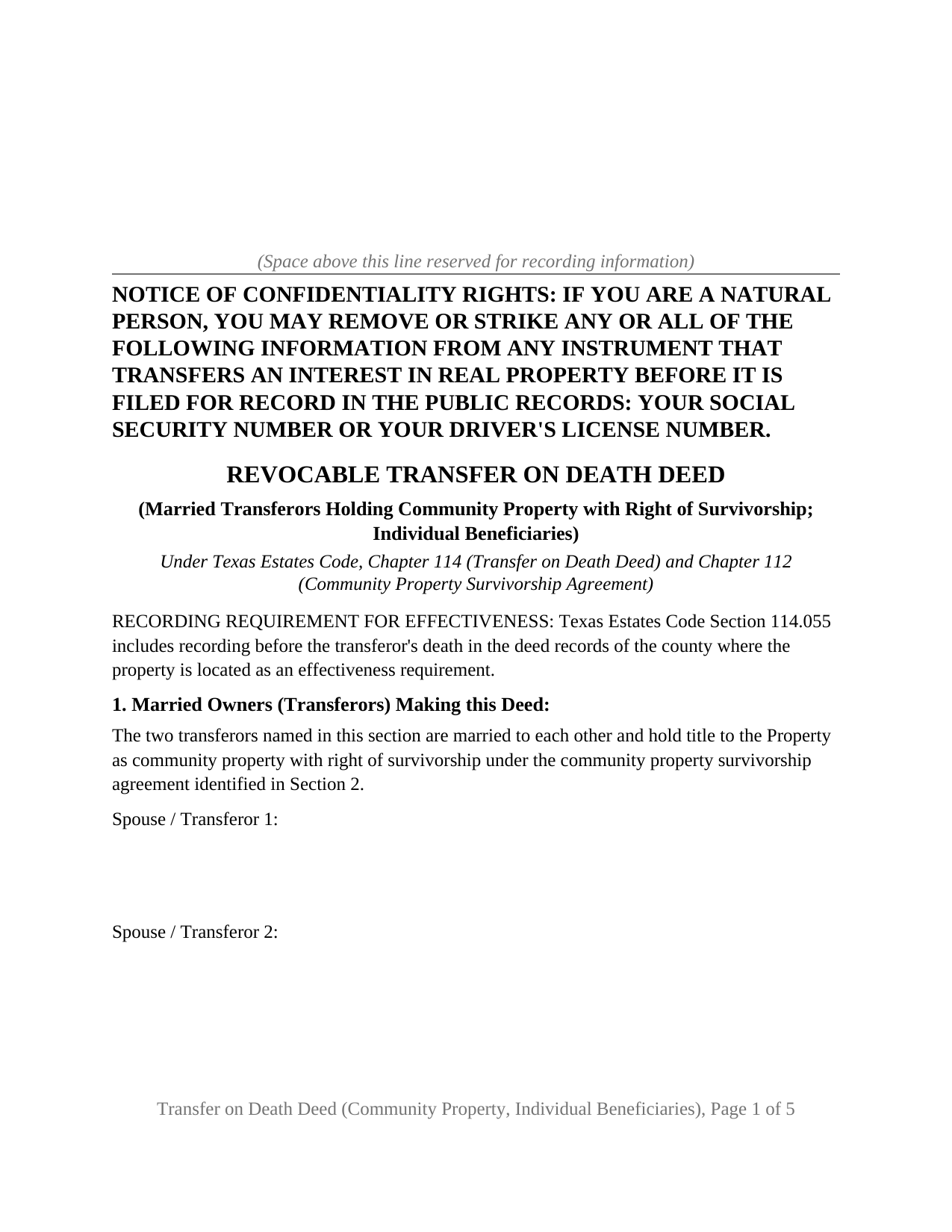
About the Texas Transfer on Death Deed (Community Property with Right of Survivorship, Individual Beneficiaries)
How to Use This Form
- Select your county from the list
- Download the county-specific form
- Fill in the required information
- Have the document notarized if required
- Record with your county recorder's office
What Others Like You Are Saying
"Thank you, I am very satisfied with the process and will provide a final review after the documents …"
"The personal attention and the ease of use is beyond any other service I have used. Thank you for ma…"
"The Web site is very intuitive, organized well and forms are easily found. The instructions provided…"
"Easy to use but the quit claim deep looked old and dated. The example of how to fill out should have…"
"The document I purchased (QuitClaim Deed) had detailed directions explaining how to complete the for…"
4.8/5 from 4,828 reviews. Read all
This Texas transfer on death deed is drafted for two spouses who hold their real property as community property with right of survivorship and who want the people they name, by name, to receive it after both of them have died. The deed designates individual beneficiaries only: natural persons such as children, grandchildren, or other relatives and friends, each identified in that person's own name, under Chapter 114 of the Texas Estates Code.
Beneficiaries Who Are People, Not Entities
Chapter 114 lets a transfer on death deed name a person as beneficiary, and the Estates Code borrows the Government Code definition of person, which reaches corporations, trusts, estates, partnerships, and associations as well as human beings. This form carries the narrower configuration. Its beneficiary sections state that each beneficiary designated in the deed is an individual, a natural person designated in that individual's own name, and the completed example names two adult children as primary beneficiaries and a granddaughter as alternate. A designation of a living trust, a charity, or a family company is one this form is not set up as; its fixed text describes natural persons and nothing else.
What the Deed Recites
The deed recites two transferors who are married to each other and who hold title as community property with right of survivorship under a community property survivorship agreement made under Chapter 112, which the deed identifies by date and recording reference. Both spouses sign, and the form carries an acknowledgment certificate for each signer under the Civil Practice and Remedies Code short form, a layout choice that lets the spouses acknowledge on different dates or before different officers. The operative section states, in the words Section 114.055 calls for, that the transfer to the designated beneficiaries is to occur at the death of the last surviving spouse, and it states that at the first death the deceased spouse's interest passes to the survivor under the agreement while the deed transfers nothing. The deed's warnings in capital letters add that it neither creates, revokes, nor modifies the survivorship agreement, and that it revokes any earlier recorded transfer on death deed for the property to the extent the two are inconsistent.
Because the agreement, not a joint tenancy, carries the first death, the deed does not describe the spouses as joint owners with right of survivorship, a term Section 114.002(3) reserves for co-owners who are not holding community property. Each spouse keeps the ability to revoke the deed as to that spouse's interest by a later recorded instrument, and under Section 114.057 a will cannot do the job.
Shares, Survival, and Lapse Under Chapter 114
The form provides no drafting space for custom share language or a homemade survivorship clause among the beneficiaries. Instead it carries the rules of Section 114.103 as fixed text: a beneficiary takes only by surviving the last surviving spouse by 120 hours, two or more beneficiaries take equal and undivided shares with no right of survivorship among them, and the share of a beneficiary who does not survive lapses and passes as that section provides, which sends a deceased child's share to that child's surviving descendants under the anti-lapse rules of Chapter 255. The optional alternate section names the individuals who take only if no primary beneficiary takes under the deed.
Recording While Both Spouses Are Living
Recording is what makes a Texas beneficiary deed effective. Section 114.055 requires the deed to be recorded before the transferor's death in the deed records of the county where the property lies, and since both spouses are transferors on this form, the deed goes of record while both are alive. The Property Code Section 11.008 notice of confidentiality rights heads the first page in boldfaced capitals above the 12 point size that section requires, the body prints at 12 point over the 8 point floor of Local Government Code Section 191.007, and the top of page one is held open for the clerk's stamp. A non-recorded instructions page at the front of the PDF explains that a long legal description continues on an exhibit page recorded with the deed, and that page comes off before signing.
The package includes the fillable form, a completed example filled in for a realistic Williamson County fact pattern, and the guide that walks through every numbered section and the statutes behind it. This description and the guide describe the form and the governing Texas law in general terms; they are not legal advice.
Important: County-Specific Forms
Our transfer on death deed (community property with right of survivorship, individual beneficiaries) forms are specifically formatted for each of the 254 counties in Texas.
After selecting your county, you'll receive forms that meet all local recording requirements, ensuring your documents will be accepted without delays or rejection fees.