Texas Transfer on Death Deed (Two Tenants in Common, Individual Beneficiaries)
County Specific Legal Forms Validated as recently as October 15, 2026 by our Forms Development Team
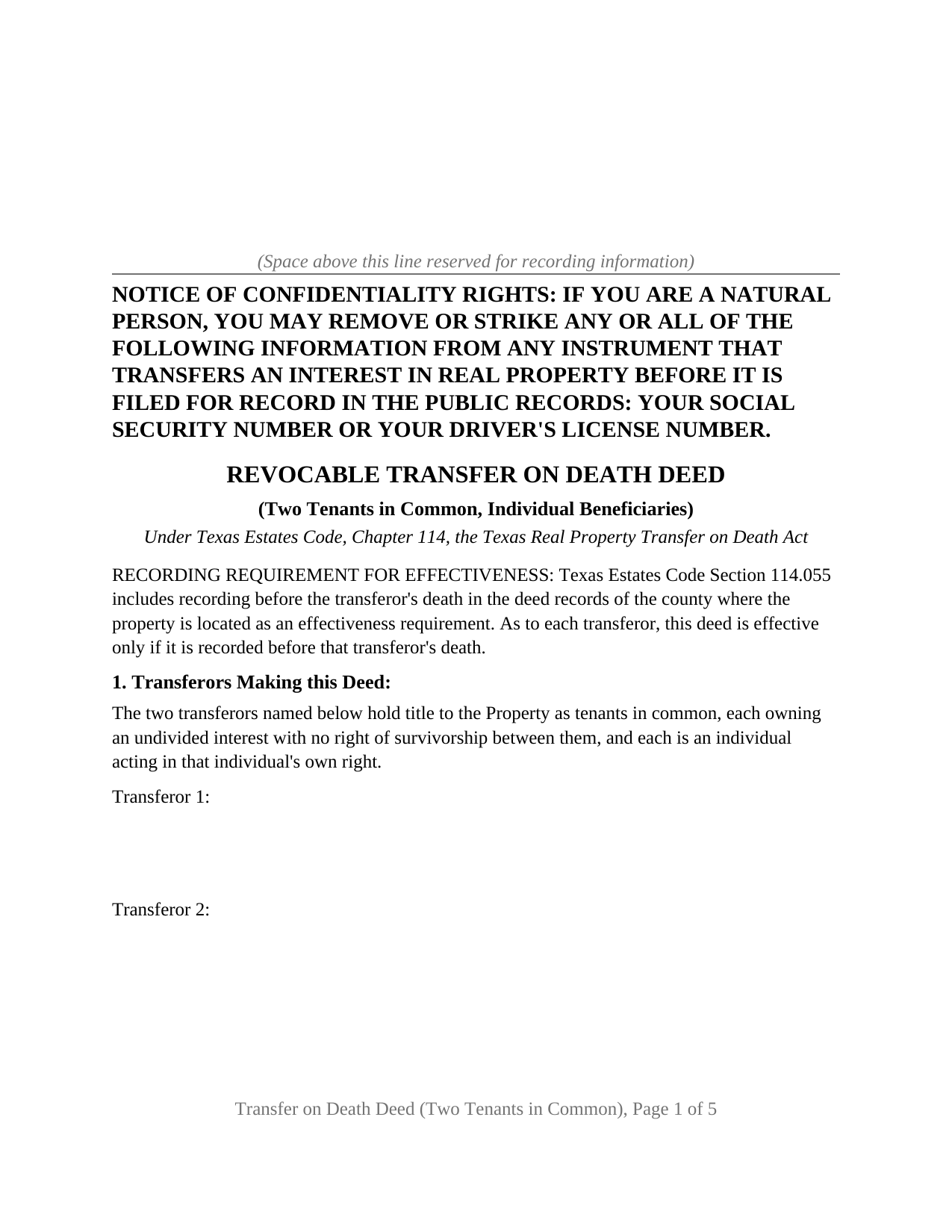
About the Texas Transfer on Death Deed (Two Tenants in Common, Individual Beneficiaries)
How to Use This Form
- Select your county from the list
- Download the county-specific form
- Fill in the required information
- Have the document notarized if required
- Record with your county recorder's office
What Others Like You Are Saying
"Super efficient, extremely responsive , and above all quick turnaround. Thank you! Will definitely u…"
"Very good forms and the online recording was a blessing."
"World class forms and service. Downloaded and prepared the deed in minutes. Used the recording servi…"
"The paperwork for our transfer on death deed was easy to fill out and the county has excepted it for…"
"Simple and easy going process"
4.8/5 from 4,828 reviews. Read all
Two Texas co-owners who hold title as tenants in common each own a separate undivided interest, and each interest passes at its own owner's death. This transfer on death deed form, built for exactly two tenants in common under Chapter 114 of the Texas Estates Code, lets both owners name the same individual beneficiaries in one recorded instrument, with each owner's interest transferring at that owner's death rather than waiting for the second death.
A Deed That Operates Twice
A tenancy in common carries no survivorship: when one co-owner dies, that owner's undivided interest passes through the deceased owner's estate unless a nonprobate arrangement names a taker. This deed is that arrangement for both owners at once. At the first death, the deceased transferor's interest transfers to the beneficiaries named in the deed, who then hold it as tenants in common alongside the surviving transferor. At the second death, the surviving transferor's interest transfers to the same beneficiaries. The form states the transfer sentence that Section 114.055 calls for, and the 120 hour survival requirement of Section 114.103 runs separately from each death.
Why Tenants in Common Have Their Own Form
Section 114.002(3) defines a joint owner with right of survivorship and expressly removes a tenant in common from that term, so the chapter's joint owner provisions, the postponement of the transfer to the last surviving owner and the requirement that all living joint owners join a revocation, do not reach this deed. Section 114.057(d) supplies the rule that does: where a transfer on death deed is made by more than one transferor, a revocation by one transferor does not affect the deed as to the interest of the other. The form recites the tenancy in common in its first section and carries the Section 114.057(d) rule in its warnings.
Two Transferors, One Set of Individual Beneficiaries
The deed carries two transferor blocks, two signature blocks, and two acknowledgment certificates, one for each tenant in common, so the owners may sign on different dates or before different notaries. Its beneficiary section carries a fixed recital that every designated beneficiary is an individual, one box in which both transferors name the same beneficiaries by full name and mailing address, and an optional alternate section for the individuals who take a transferor's interest where no primary beneficiary survives that transferor by 120 hours. Two heirs who received a property through an estate distribution without survivorship language, and co-investors holding a rental house in both names, present the ownership pattern this deed recites. The form is set up for exactly two record owners naming individuals: a sole owner's designation, co-owners who each want different beneficiaries for their own interests, a designation to a trust or company, and title held with a right of survivorship each follow a different pattern. Married transferors sign alone; the guide explains why the homestead joinder rule does not reach a deed that conveys nothing during life.
Revocable, Nontestamentary, and Recorded Before Death
Each transferor keeps full ownership of that transferor's interest during life; the deed transfers nothing until death and may be revoked by a recorded instrument, though a will cannot revoke it. Under Section 114.055 the deed is effective only if it is recorded, before the transferor's death, in the deed records of the county where the property is located, and on a deed made by two transferors that requirement operates interest by interest. Recording promptly after both signatures, while both owners are living, places the deed of record before either death.
Formatted for the Texas County Clerk
The instrument is letter size within Local Government Code Section 191.007, with an identifying heading and the Property Code Section 11.008 notice of confidentiality rights at the top of page one, 12 point body text, a typed name line under each signature, and reserved space for the recording stamp. A non-recorded instructions page at the front of the PDF, removed before signing, covers the entry and exhibit conventions.
The package includes the fillable transfer on death deed as a PDF that is completed on screen or by hand, a completed example filled in for a realistic Bexar County fact pattern, and a plain language guide that walks through every numbered section, signing and notarization, and recording. This description and the guide describe the form and the governing statutes in general terms and are not legal advice.
Important: County-Specific Forms
Our transfer on death deed (two tenants in common, individual beneficiaries) forms are specifically formatted for each of the 254 counties in Texas.
After selecting your county, you'll receive forms that meet all local recording requirements, ensuring your documents will be accepted without delays or rejection fees.