Texas Transfer on Death Deed (One Spouse, Community-Property Interest, Individual Beneficiaries)
County Specific Legal Forms Validated as recently as October 15, 2026 by our Forms Development Team
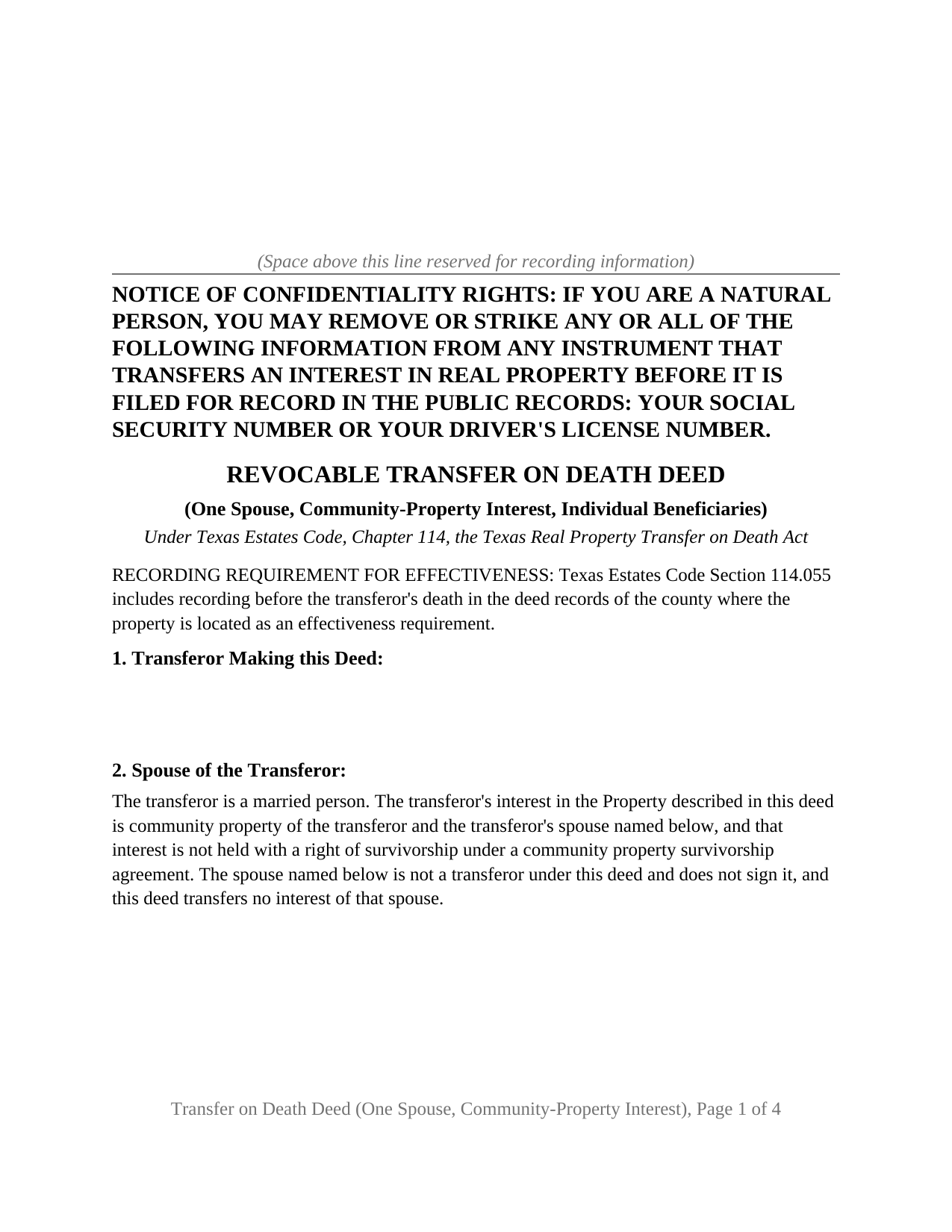
About the Texas Transfer on Death Deed (One Spouse, Community-Property Interest, Individual Beneficiaries)
How to Use This Form
- Select your county from the list
- Download the county-specific form
- Fill in the required information
- Have the document notarized if required
- Record with your county recorder's office
What Others Like You Are Saying
"amazing time and cost saving service for me. Thank you."
"I was very satisfied with your service. Prompt, and thorough. Price was reasonable. Will use your se…"
"Easy to use,thanks"
"Excellent site! Very informative and easy to navigate. I would highly recommend to anyone requiring …"
"I am quite pleased with this website. I was able to complete my task with relative ease thanks to al…"
4.8/5 from 4,828 reviews. Read all
A married Texan can name who receives that spouse's own community-property interest in real estate at death, without probate and without the other spouse signing. This Texas transfer on death deed is built for that configuration: one married transferor, one community-property interest held without a survivorship agreement, and beneficiaries who are individuals.
Half the title, one signature
Community property in Texas belongs to both spouses in undivided halves, whatever name the vesting deed carries. Section 114.051 of the Estates Code lets an individual transfer the individual's interest by a TOD deed, and that is the whole reach of this form: the transferor's undivided community interest. The deed names the transferor's spouse in its own section and states that the spouse is not a transferor and does not sign. During the transferor's life the deed transfers nothing, so the joinder rules that reach a sale or encumbrance of community property or a homestead do not reach it; Section 114.101 says the deed affects no interest or right of any other owner while the transferor lives.
The deed also recites that the interest is not held with a right of survivorship under a Chapter 112 agreement. Where such an agreement exists, the deceased spouse's interest moves to the survivor at the first death and a TOD deed waits for the second; this form recites the absence of that agreement and operates at this transferor's death.
Beneficiaries who are people, not entities
Chapter 114 allows a beneficiary to be any person in the broad Government Code sense, a trust or a company included. This form takes the narrower case: natural persons, each identified by full legal name and mailing address, as primary beneficiaries and optional alternates. A beneficiary takes by surviving the transferor by 120 hours. Where several individuals are named, Section 114.103 gives them equal and undivided shares with no survivorship among them; the share of one who does not survive lapses and passes under the anti-lapse rules of Chapter 255 as if the deed were a devise in a will.
A spouse can be one of those individuals, and Section 114.057(c) then supplies a rule of its own: if the marriage is dissolved after the deed is recorded, the final judgment revokes the deed as to the former spouse once notice of the judgment is recorded before the transferor's death in the county where the deed is recorded. A will does not revoke a recorded TOD deed; revocation takes a later recorded transfer on death deed or a recorded instrument of revocation, prepared and recorded separately and not included in this package.
What this configuration carries
The form prints its configuration as deed text rather than leaving it to a checkbox: one married transferor, one community-property interest, individual beneficiaries. It carries one transferor signature block, one acknowledgment certificate in the Texas short form, a section naming the non-signing spouse, and the statement Section 114.055 requires, that the transfer is to occur at the transferor's death. A home bought during the marriage and deeded to one spouse alone, and one deeded to both spouses with no survivorship language, present the pattern this deed recites. A separate-property interest, title held with a right of survivorship, a beneficiary that is a trust or an entity, and co-owners other than the transferor's spouse follow different patterns and are not what this deed is set up as.
Recording before death
Recording is a condition of effectiveness: under Section 114.055 the deed must be recorded before the transferor's death in the deed records of the county where the property is located; an unrecorded beneficiary deed transfers nothing. The form is laid out for the Texas county clerk: letter size pages, 12 point body text over the 8 point minimum of Local Government Code Section 191.007, the Property Code Section 11.008 notice in boldfaced capitals at the top of the first page, reserved recording space on page one, and beneficiary blanks sized for the mailing address Property Code Section 11.003 contemplates. An instructions cover page, removed before recording, covers the exhibit convention for a long entry.
The package includes the fillable form, a completed example filled in for a realistic Bexar County fact pattern in which a wife names her husband as primary beneficiary and their two children as alternates, and the guide that walks through every numbered section and the community property rules behind the deed. This description and the guide describe the form and the statutes in general terms; they are not legal advice.
Important: County-Specific Forms
Our transfer on death deed (one spouse, community-property interest, individual beneficiaries) forms are specifically formatted for each of the 254 counties in Texas.
After selecting your county, you'll receive forms that meet all local recording requirements, ensuring your documents will be accepted without delays or rejection fees.