Texas Transfer on Death Deed (Two Joint Owners with Right of Survivorship, Individual Beneficiaries)
County Specific Legal Forms Validated as recently as October 15, 2026 by our Forms Development Team
About the Texas Transfer on Death Deed (Two Joint Owners with Right of Survivorship, Individual Beneficiaries)
How to Use This Form
- Select your county from the list
- Download the county-specific form
- Fill in the required information
- Have the document notarized if required
- Record with your county recorder's office
What Others Like You Are Saying
"It is a difficult challenge -- trying to take the needless jargon out of legal transactions so ordin…"
"I am a WA State Attorney and just made my first purchase. The experience was flawless, and I appreci…"
"Top 10 experience, Easy-Fast-Affordable"
"The forms was easy to use and the guides was helpful"
"Forms and instructions are very easy to access. Thank you!"
4.8/5 from 4,828 reviews. Read all
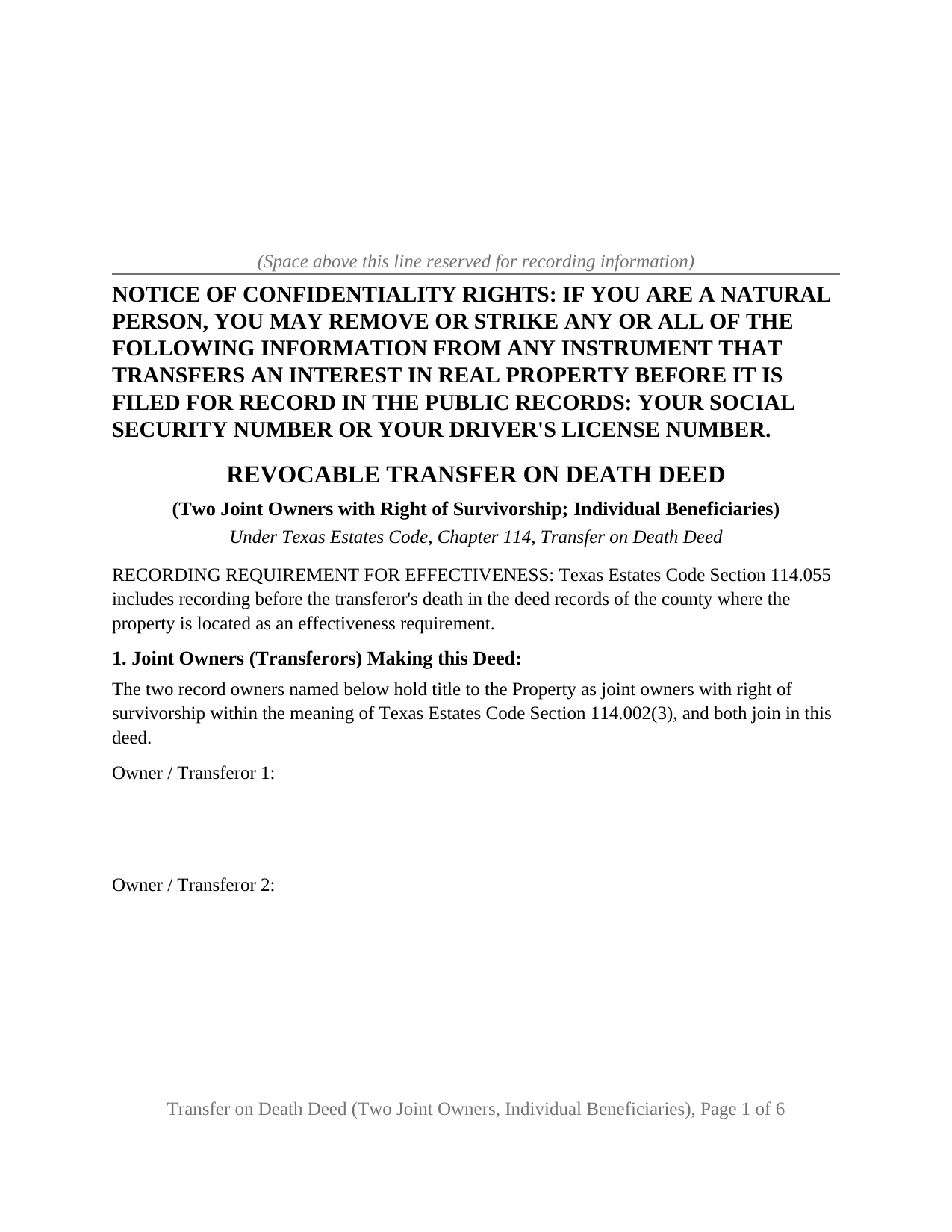
Two Texas co-owners who hold title with a right of survivorship, and who intend the property for named people after both of them are gone, present the configuration this deed carries. The Texas Transfer on Death Deed (Two Joint Owners with Right of Survivorship, Individual Beneficiaries) is a revocable transfer on death deed under Chapter 114 of the Texas Estates Code that fixes both sides of the designation: exactly two joint owners with right of survivorship sign it, and every beneficiary it names is an individual, a natural person identified by full legal name and mailing address, never a trust, a company, or an organization.
Beneficiaries who are people, not entities
Chapter 114 borrows its definition of person from Government Code Section 311.005, so a Texas TOD deed, also searched for as a beneficiary deed, may name a trust, a corporation, or a charity. This form does not: Sections 6 and 7 state, as fixed deed text, that each designated beneficiary is an individual, which brings every rule Chapter 114 writes for a human beneficiary into play. A named individual qualifies by surviving the last surviving owner by 120 hours. Where a named individual dies first, Section 114.103(a)(2) sends the lapsed share through Subchapter D of Chapter 255, the will construction rules, under which the descendants of a beneficiary who was a descendant of the transferor, or of the transferor's parent, step into that beneficiary's place. Where a beneficiary was married to an owner and the marriage is dissolved after recording, Section 114.057(c) revokes the designation as to that former spouse once notice of the judgment is recorded before the owner's death. A trust or a company gives those rules nothing to act on.
What the two owner configuration recites
Section 1 recites that the two record owners hold title as joint owners with right of survivorship within the meaning of Estates Code Section 114.002(3). Section 8 designates the beneficiaries to receive the property only on the death of the last surviving joint owner, and the 120 hour survival clock runs from that death. Both owners sign on labeled signature blocks, and the form carries an acknowledgment certificate for each owner, so the two acknowledgments may be taken on different days before different officers. Co-owners who took title under a deed containing a survivorship agreement and who want named relatives or friends, rather than a trust, to take after the second death present the pattern this deed recites. The deed is not set up as a sole owner's designation, as a designation by spouses holding community property with right of survivorship, as a designation to a trust or an entity, or as a deed for three or more owners.
Equal shares, stated on the deed
The form carries no share entry and no open provision box. Where two or more individuals are named, Section 8 states the Section 114.103(a)(3) rule: concurrent beneficiaries take equal and undivided shares with no right of survivorship among them. An optional Section 7 names alternate individuals, who take only where no primary beneficiary survives the last owner by 120 hours. An unequal division or survivorship among the beneficiaries is outside what the deed recites.
Revocation takes both living owners
A deed made by joint owners with right of survivorship is revoked only if all of the living joint owners revoke it, under Section 114.057(e); after the first death, Section 114.103(c) lets the last surviving joint owner revoke alone. The revoking instrument, prepared and recorded separately and not included in this package, is acknowledged after this deed and recorded before the revoking owner's death. A will does not revoke the deed.
Recorded before the last death
Section 114.055 makes recording before death an effectiveness requirement; in practice the deed is recorded promptly after both acknowledgments, while both owners are living. The deed is built for the clerk's counter: letter size pages within Local Government Code Section 191.007, the Property Code Section 11.008 notice of confidentiality rights in 12 point boldfaced capitals at the top of page one, and open space above it for the recording stamp.
The package contains three items: the fillable deed as a PDF, a completed example filled in for a Harris County fact pattern with two owners and two named individuals, and a guide that walks through every numbered section with the statutes behind it. This description and the guide describe the form and Chapter 114 in general terms and are not legal advice.
Important: County-Specific Forms
Our transfer on death deed (two joint owners with right of survivorship, individual beneficiaries) forms are specifically formatted for each of the 254 counties in Texas.
After selecting your county, you'll receive forms that meet all local recording requirements, ensuring your documents will be accepted without delays or rejection fees.