Texas Transfer on Death Deed (Community Property, Spouse First, Individual Beneficiaries)
County Specific Legal Forms Validated as recently as October 15, 2026 by our Forms Development Team
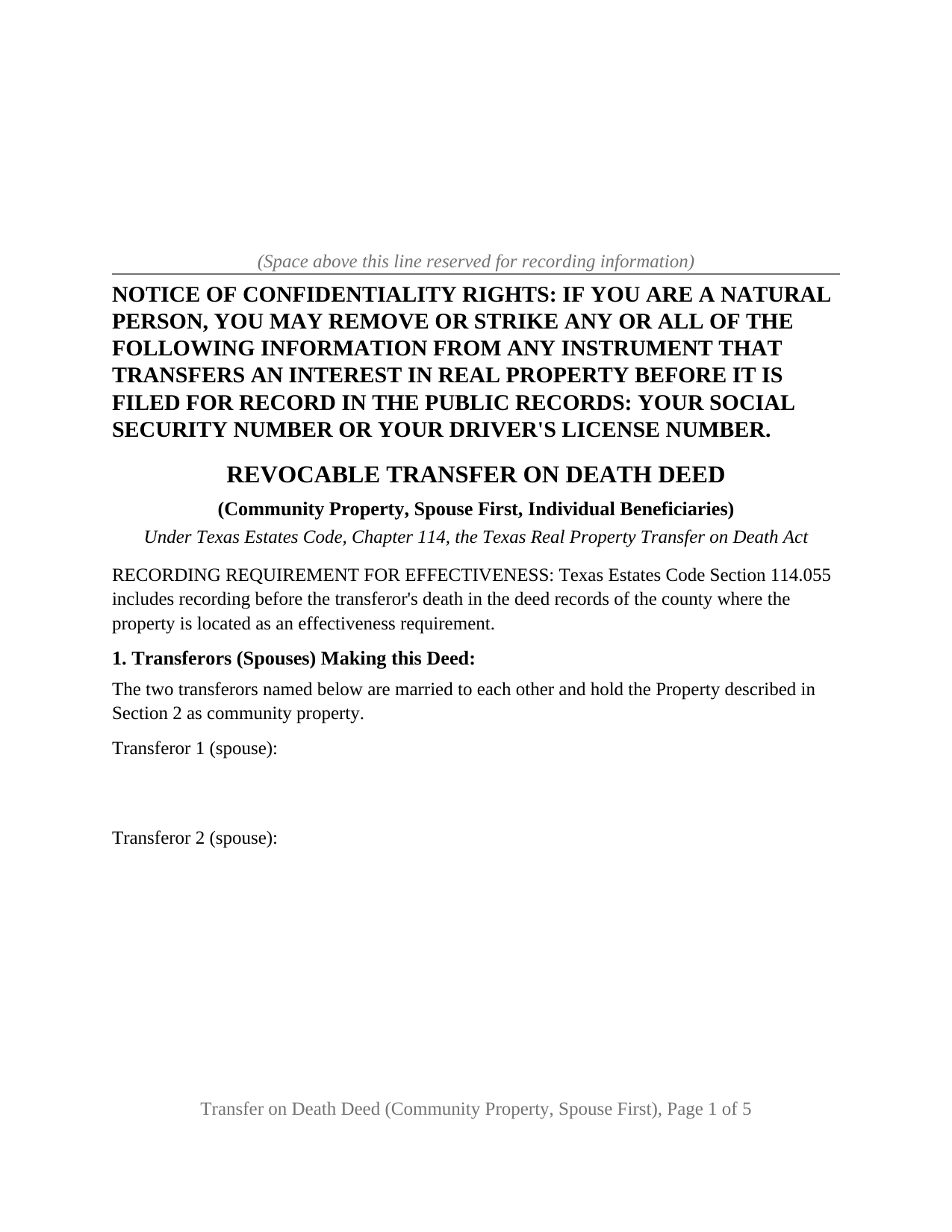
About the Texas Transfer on Death Deed (Community Property, Spouse First, Individual Beneficiaries)
How to Use This Form
- Select your county from the list
- Download the county-specific form
- Fill in the required information
- Have the document notarized if required
- Record with your county recorder's office
What Others Like You Are Saying
"This was just the info I needed"
"My questions were answered promptly. I was not able to locate the deed I was searching for because m…"
"Amazing forms! Order the quitclaim deed forms, got the form and lots of extra forms which is good be…"
"Exactly what I needed and with the help of ChatGPT who needs a damn lawyer for anything."
"Worked well with clear guide!"
4.8/5 from 4,828 reviews. Read all
Two Texas spouses who hold their home as community property can record one transfer on death deed that carries each spouse's interest to the other at the first death and the whole property to their chosen individuals at the second. This form prepares that deed under Chapter 114 of the Texas Estates Code for exactly two spouses, with the spouse first designation printed as fixed deed text and the alternate beneficiaries, natural persons, as its one beneficiary entry. The instrument is also searched for as a TOD deed or a beneficiary deed.
Two Designations in One Recorded Deed
Each spouse owns an interest in community property whether the vesting deed names both spouses or only one, and under Section 114.103(a) a transfer on death deed reaches only the interest the transferor owns at death. The form therefore carries two designations on one instrument. Each transferor designates the other transferor, that transferor's spouse, as primary beneficiary of the interest the designating transferor owns at death, each designation standing as that spouse's own. At the first death, the deceased spouse's interest transfers to the survivor if the survivor lives 120 hours longer. At the second death the primary beneficiary of the survivor's interest is no longer living, and the survivor's entire interest, by then the whole property, transfers to the alternates.
Why This Deed Operates at Each Death, Not Only the Last One
Chapter 114 postpones a deed made by joint owners with right of survivorship until the last joint owner dies, but Section 114.002(3) excludes an owner of community property, with or without a right of survivorship, from that definition. Plain community property carries no survivorship between the spouses; absent a designation, the deceased spouse's interest passes under a will or by intestacy. The spouse first designation does that work inside the deed. The operative section also states that the instrument is a Chapter 114 transfer on death deed and not a community property survivorship agreement under Chapter 112.
Individuals as the Alternate Beneficiaries
The alternates are the individuals who take a spouse's interest when the other spouse does not survive by 120 hours, most often the couple's children, each named by full name and mailing address. The fixed text above the entry states that every alternate is an individual, that the alternates take in equal and undivided shares with no right of survivorship, and that the survival and lapse rules of Section 114.103 govern. The form carries no custom provisions box. A designation naming a trust or an entity, varying the statutory shares, or placing the children ahead of the spouse follows a different pattern from the one this deed recites.
Revocation and Divorce Under Section 114.057
Each spouse may revoke the deed as to that spouse's own interest by an instrument of revocation or a later inconsistent deed, acknowledged after this deed and recorded before that spouse's death; under Section 114.057(d) a revocation by one transferor does not affect the deed as to the other transferor's interest. Section 114.057(c) matters on any deed naming a spouse: a final judgment dissolving the marriage revokes the deed as to the former spouse if notice of the judgment is recorded before the transferor's death, which leaves the alternate designation standing. A will does not revoke the deed. An instrument of revocation, and the affidavit a beneficiary records after a death, are prepared and recorded separately and are not included in this package.
Signing and Recording
Both spouses sign, and the form carries a separate acknowledgment certificate for each signer, so the spouses may appear before a notary on different dates. Under Section 114.101 the deed changes nothing during life, including homestead status and property tax exemptions. Under Section 114.055 the deed is effective only if recorded before death in the deed records of the county where the property is located; recording while both spouses are living places both designations of record at once. The first recorded page carries the Property Code Section 11.008 notice of confidentiality rights in 12 point boldfaced capitals above the title and reserves space for the clerk's stamp, and a non-recorded instructions page at the front describes the exhibit convention for an entry that outgrows its space.
The package contains three items: the fillable transfer on death deed, a completed example prepared on a realistic Williamson County fact pattern, and the guide that walks through each numbered section. This description and the guide describe the form and Texas law in general terms; they are not legal advice.
Important: County-Specific Forms
Our transfer on death deed (community property, spouse first, individual beneficiaries) forms are specifically formatted for each of the 254 counties in Texas.
After selecting your county, you'll receive forms that meet all local recording requirements, ensuring your documents will be accepted without delays or rejection fees.