Texas Transfer on Death Deed (Married Sole Owner, Separate Property, Individual Beneficiaries)
County Specific Legal Forms Validated as recently as October 15, 2026 by our Forms Development Team
About the Texas Transfer on Death Deed (Married Sole Owner, Separate Property, Individual Beneficiaries)
How to Use This Form
- Select your county from the list
- Download the county-specific form
- Fill in the required information
- Have the document notarized if required
- Record with your county recorder's office
What Others Like You Are Saying
"Very helpful! Unfortunately, they didn't have what I needed, but they got back to me quickly and did…"
"A few parts are confusing'.Like sending Tax statements to WHO ?/ The rest is simple I hope.Have not …"
"I was informed that a quit Claim Deed that I had submitted, did not meet county requirements. I orde…"
"Extremely easy to use. The guide and sample were a great source of reference."
"The e-recording service was invaluable. This was my first experience recording a document in any cap…"
4.8/5 from 4,828 reviews. Read all
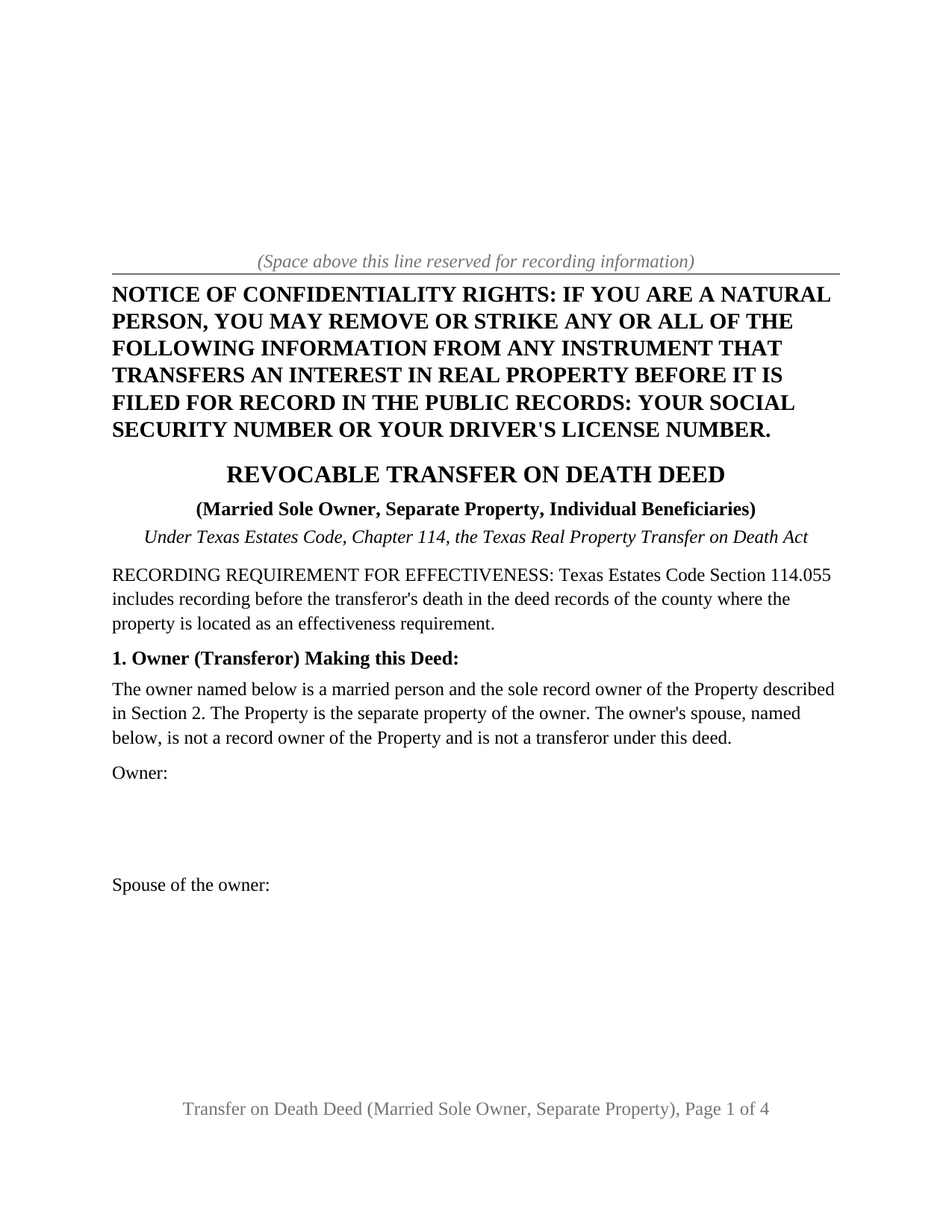
A married Texas owner whose house or land is separate property can name who receives it at death with a transfer on death deed that only the owner signs. This Deeds.com form prepares that deed under Chapter 114 of the Texas Estates Code for one married owner holding separate property and designating individuals as beneficiaries; the spouse is named in the deed as a non-owner and has no signature line.
One Owner, One Signature, a Spouse Named but Not Signing
Under Family Code Section 3.001, separate property is what a spouse owned or claimed before marriage and what the spouse acquired during marriage by gift, devise, or descent; everything else acquired during marriage is presumed community property under Section 3.003. The deed's first section recites that the owner is a married person and the sole record owner, that the property is the owner's separate property, and that the spouse named there is not a record owner and not a transferor.
Why the spouse signs nothing: Family Code Section 5.001 calls for both spouses to join a sale, conveyance, or encumbrance of the homestead, but Estates Code Section 114.101 provides that a transfer on death deed changes nothing during the owner's life, homestead rights included. The form is built on the reading that a deed transferring nothing during life is none of the acts Section 5.001 names, so it carries one signature block and one acknowledgment certificate, both for the owner.
What the Beneficiaries Receive, and When
At the owner's death, Section 114.103 transfers the owner's interest in the property to the designated beneficiaries who survive the owner by 120 hours, and only that interest: for property that is in fact community property, the deed reaches the deceased spouse's community interest alone. The beneficiaries take subject to every lien and other matter affecting title under Section 114.104, without warranty of title. One Texas rule rides over the designation: Article XVI, Section 52 of the Texas Constitution gives a surviving spouse the right to occupy the homestead for life, separate property included, so beneficiaries of a homestead take title subject to that right.
Individual Beneficiaries, Primary and Alternate
Chapter 114 lets a beneficiary be any person as the Government Code defines the word, trusts and entities included. This form fixes the class to individuals: its text prints that each beneficiary named is an individual, with a primary section and an optional alternate section, the alternates taking only if no primary beneficiary takes under the deed. Multiple primary beneficiaries take equal and undivided shares with no right of survivorship under Section 114.103(a)(3), and a lapsed share passes under the anti-lapse rules the chapter borrows from the law of wills. A designation to the owner's spouse is revoked by a later divorce judgment under Section 114.057(c) once notice of the judgment is recorded.
Recording Makes It Effective
Section 114.055 makes recording before the owner's death, in the deed records of the county where the property sits, a requirement for an effective deed, so an unrecorded deed transfers nothing. The deed stays revocable until death; a later inconsistent transfer on death deed or an instrument of revocation, acknowledged after this deed and recorded before death, revokes it under Section 114.057, and a will cannot. That revocation instrument, and the affidavit of death a beneficiary records afterward, are prepared separately and are not included in this package. The form follows the Local Government Code Section 191.007 format standards, with the Property Code Section 11.008 confidentiality notice in bold capitals at the head of page one under a reserve for the clerk's recording stamp.
The Configuration This Deed Recites
The form recites exactly one record owner, married, holding the described property as separate property, and designating one or more natural persons. A home bought years before the wedding, a tract inherited from a parent during the marriage, and a house deeded to one spouse as separate property present the pattern this deed recites. It is not set up as a deed for two record owners, an unmarried owner, community property, survivorship vesting, or a trust or entity beneficiary. The same instrument is also known as a beneficiary deed or TOD deed.
The package contains the blank deed as a fillable PDF, a completed example filled in for a Tarrant County fact pattern, and a guide that walks through each numbered section, signing, and recording. These materials describe the form and the governing Texas statutes in general terms; they are not legal advice.
Important: County-Specific Forms
Our transfer on death deed (married sole owner, separate property, individual beneficiaries) forms are specifically formatted for each of the 254 counties in Texas.
After selecting your county, you'll receive forms that meet all local recording requirements, ensuring your documents will be accepted without delays or rejection fees.