Texas Transfer on Death Deed (Individual)
County Specific Legal Forms Validated as recently as August 18, 2026 by our Forms Development Team
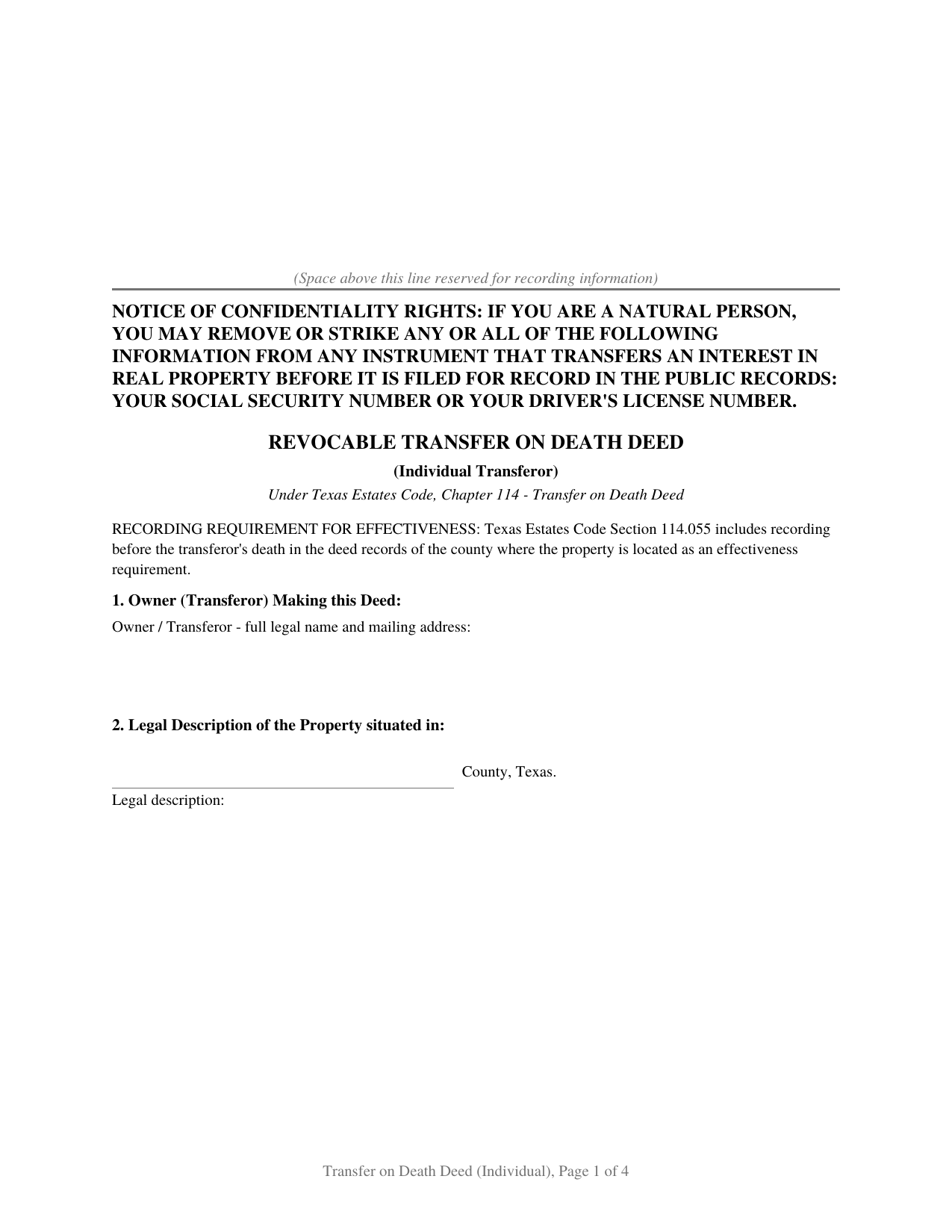
About the Texas Transfer on Death Deed (Individual)
How to Use This Form
- Select your county from the list
- Download the county-specific form
- Fill in the required information
- Have the document notarized if required
- Record with your county recorder's office
What Others Like You Are Saying
"Nice, clear, well formatted documents. Good information provided."
"I wanted the Lady Bird Deed for my estate, and it was very easy to download, fill out and file. My c…"
"It was all I needed and guided me to fill it out."
"well first time my company is using and this what can say. excellent service im very happy, you guys…"
"I recently purchased online DIY legal forms, and I must say I was thoroughly impressed. The document…"
4.8/5 from 4,804 reviews. Read all
A Texas transfer on death deed lets a property owner name who receives their real estate when they die, without probate, without giving up anything during life. This form prepares a transfer on death deed for one owner under Chapter 114 of the Texas Estates Code, the Texas Real Property Transfer on Death Act.
How a Texas Transfer on Death Deed Works
The deed is nontestamentary. It transfers no interest while the owner is alive, so the owner keeps full control: the property can still be sold, mortgaged, or leased, homestead status and property tax exemptions are unaffected, and the deed can be revoked at any time. At the owner's death, the beneficiary named in the deed receives whatever interest the owner holds at that moment, subject to any mortgage or other matters then affecting title.
Texas wrote several of its own rules into Chapter 114. The capacity required is the capacity to make a contract, not a will, and the deed cannot be created through a power of attorney. A will does not revoke or override a recorded transfer on death deed. Most importantly, the deed must be recorded before the owner's death in the county where the property is located; an unrecorded deed transfers nothing, no matter how carefully it was signed and notarized.
Who This Form Describes
This form recites a single transferor: one record owner of Texas real property, married or unmarried, signing alone. A spouse who is not a record owner is not a transferor and has no signature line, and the guide explains why the spousal joinder rule for homestead conveyances does not reach a deed that conveys nothing during life.
Married couples who hold plain community property, the default for property acquired during a Texas marriage, often use a pair of these deeds: each spouse signs one naming the other spouse as primary beneficiary and the same alternates, so the survivor receives the property at the first death and the alternates receive it at the second. Where title carries a right of survivorship, the joint owner and community property versions of this deed recite that vesting instead.
Beneficiaries and Survival
The form provides for primary beneficiaries, optional alternates, and optional special provisions such as unequal shares. Under Section 114.103, a beneficiary must survive the owner by 120 hours, and where no special provision says otherwise, multiple beneficiaries take equal undivided shares.
What Is Included
- The blank form as a fillable PDF, completed on screen or printed and completed by hand
- A plain language guide that walks through every numbered section: what each blank asks, where the information comes from, and what a correct entry looks like
- A completed example showing the entire document filled in for a realistic Texas fact pattern
The document is formatted for Texas recording standards: letter size pages within the dimensions of Local Government Code Section 191.007, body text at 10 point, the notice of confidentiality rights required by Property Code Section 11.008 in 12 point boldfaced capitals at the top of the first page, and reserved space on page one for the county clerk's recording stamp. A 2025 enactment, Senate Bill 16 of the Second Called Session of the 89th Legislature, also directs the county clerk to require photo identification from a person who presents a document in person for filing in the real property records, a step that takes place at the counter and does not change the content of the deed. A separate instructions page included with the form, removed before recording, describes how an entry that outgrows its space continues on a recorded exhibit page, so the recorded deed stays free of worksheet style captions.
Related Texas Forms
A recorded deed is revoked with the Texas Cancellation of Transfer on Death Deed (Individual) or by recording a new, inconsistent deed. After the owner's death, the beneficiary records the Texas Affidavit of Death for Transfer on Death Deed with a certified death certificate to document the transfer in the county records.
Important: County-Specific Forms
Our transfer on death deed (individual) forms are specifically formatted for each of the 254 counties in Texas.
After selecting your county, you'll receive forms that meet all local recording requirements, ensuring your documents will be accepted without delays or rejection fees.