Texas Transfer on Death Deed (Joint Owners with Right of Survivorship)
County Specific Legal Forms Validated as recently as September 25, 2026 by our Forms Development Team
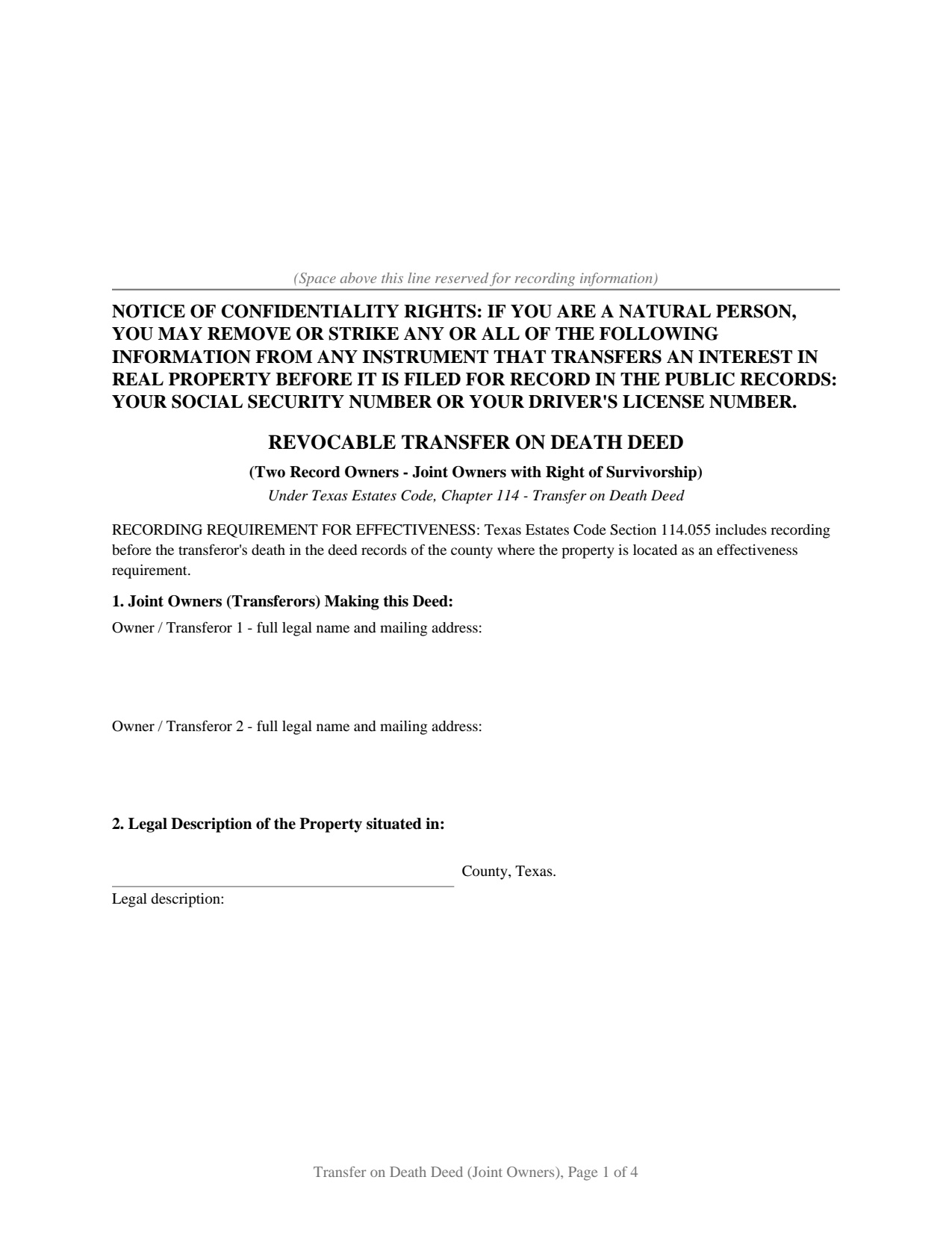
About the Texas Transfer on Death Deed (Joint Owners with Right of Survivorship)
How to Use This Form
- Select your county from the list
- Download the county-specific form
- Fill in the required information
- Have the document notarized if required
- Record with your county recorder's office
What Others Like You Are Saying
"Great resource! Nice to have these forms and information available. No problems at the recorder, in …"
"I was actually quite pleased with the ease of use of this site. I really, really liked the step by s…"
"Found this sight on the internet looking for information to add my fiance' to the house deed. Looks …"
"So far the web site and the tools are a pleasure to use. The price is reasonable. If only getting ri…"
"The TODD form has been notarized and registered with my county Register of Deeds office, so it works…"
4.8/5 from 4,810 reviews. Read all
This Texas transfer on death deed form is designed for two co-owners whose title includes a right of survivorship. It documents a beneficiary designation for the transfer that occurs after both owners have died, under Chapter 114 of the Texas Estates Code.
How the Joint Owner Deed Works
While either owner lives, the survivorship feature in the existing title controls. At the first death, the property passes to the surviving owner under the right of survivorship, and the transfer on death deed does not transfer the property at that point. The deed operates at the death of the last surviving owner, when the named beneficiaries receive the property outside probate. Section 114.103 builds this timing into the statute, and the form's survival requirement is measured from the last surviving transferor, so a beneficiary qualifies by surviving the second death by 120 hours.
Revocation follows a special rule. Under Section 114.057, a transfer on death deed made by joint owners with right of survivorship is revoked only if all living joint owners join in the revocation; the last surviving owner may revoke alone. One of two living owners cannot unilaterally revoke the recorded designation, and a will does not revoke the deed.
Joint Owners with Right of Survivorship in Texas
The statutory definition is narrower than the everyday phrase. Section 114.002(3) covers co-owners whose arrangement passes the whole property to the survivor, and it expressly excludes tenants in common and owners of community property, with or without a right of survivorship. The ownership arrangements described by this form commonly include siblings who inherited a property together, a parent and an adult child, unmarried partners, and other pairs who created survivorship by a written agreement under Estates Code Section 111.001, often inside the vesting deed itself.
Married couples holding community property with right of survivorship under an Estates Code Chapter 112 agreement are addressed in the companion Texas Transfer on Death Deed (Community Property with Right of Survivorship), which contains recitals for that form of vesting. The guide explains how the vesting deed may show the difference between the two arrangements.
Both Owners Sign
The form includes signature lines for both owners and a separate notary certificate for each signer. This allows the owners to acknowledge the deed on different dates or before different notaries, including in different states. Under Section 114.055, the deed must be recorded before death in the county where the property is located. The guide describes the recording timing and the effect of recording the deed while both owners are living.
What Is Included
- The blank deed as a fillable PDF, completed on screen or printed and completed by hand
- A plain language guide that walks through every numbered section: what each blank asks, where the information typically comes from, and how a sample entry may look
- A completed example showing the entire deed filled in for a realistic Texas fact pattern
The deed is formatted for Texas recording standards: letter size pages within the dimensions of Local Government Code Section 191.007, body text well above the statutory minimum, the notice of confidentiality rights required by Property Code Section 11.008 in 12 point boldfaced capitals at the top of the first page, and reserved space on page one for the county clerk's recording stamp. A separate instructions page at the front of the package, removed before recording, covers entry conventions and the exhibit convention for long entries, so the recorded deed stays free of instructional clutter.
Related Texas Forms
The Texas Cancellation of Transfer on Death Deed (Joint Owners) documents revocation of a recorded joint-owner transfer on death deed. The Texas Affidavit of Death (Transfer on Death Deed Beneficiary) documents the death of the owner and the resulting transfer in the county records, together with a certified death certificate. The Texas Transfer on Death Deed (Individual) is designed for a sole owner rather than two joint owners with right of survivorship.
Important: County-Specific Forms
Our transfer on death deed (joint owners with right of survivorship) forms are specifically formatted for each of the 254 counties in Texas.
After selecting your county, you'll receive forms that meet all local recording requirements, ensuring your documents will be accepted without delays or rejection fees.