Texas Trustees Deed (Individual Trustee)
County Specific Legal Forms Validated as recently as September 29, 2026 by our Forms Development Team
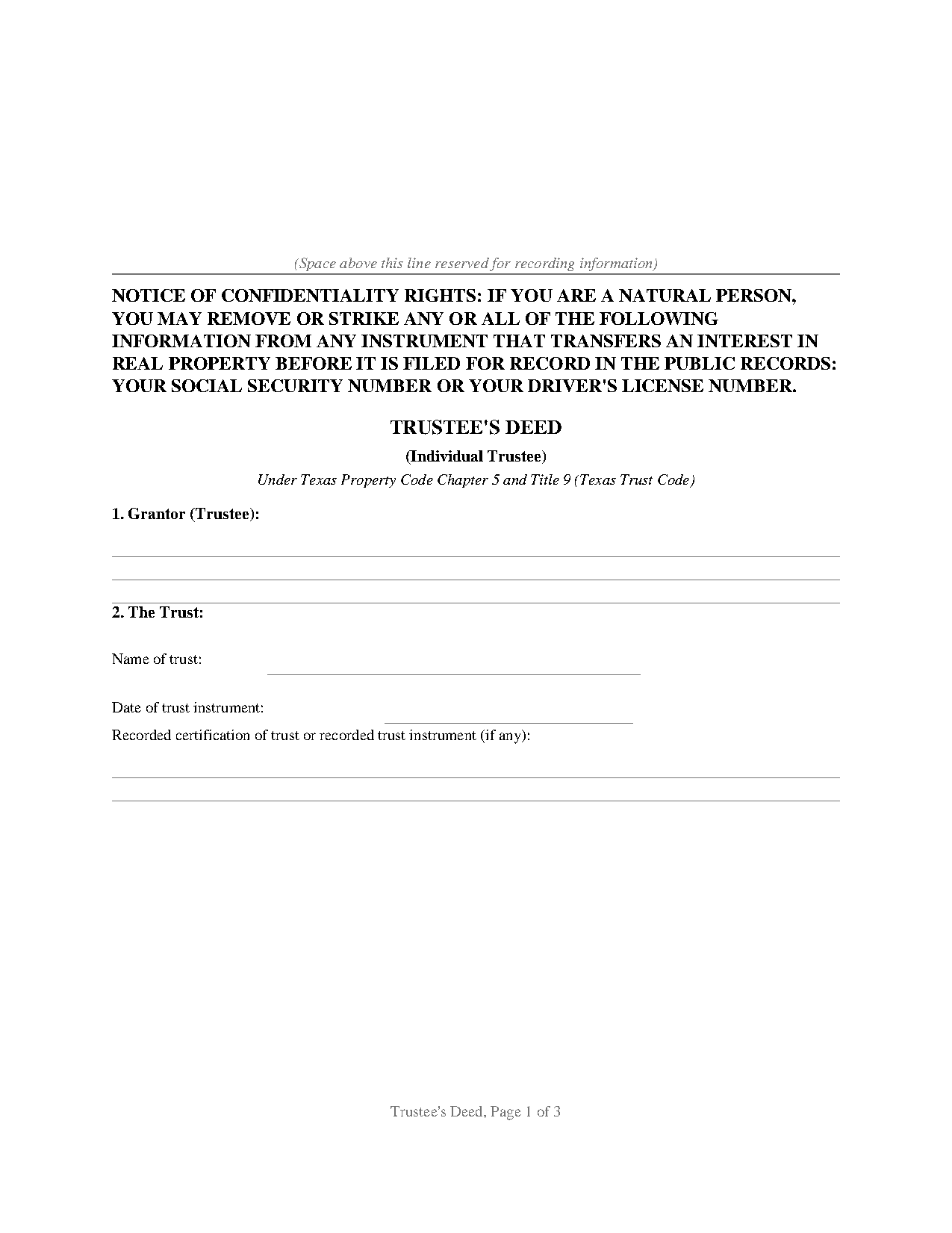
About the Texas Trustees Deed (Individual Trustee)
How to Use This Form
- Select your county from the list
- Download the county-specific form
- Fill in the required information
- Have the document notarized if required
- Record with your county recorder's office
What Others Like You Are Saying
"Love Deeds.com. So easy to work with and quick as well."
"TODD Form would not print surveyor degrees character (superscript "o") in Exhibit A. It al…"
"Simple and straightforward"
"This is my first time using the site for business and I must say this site made it so easy for me. I…"
"FANTASTIC. Sometimes we think know something, glad I found out I was wrong before it was too late."
4.8/5 from 4,825 reviews. Read all
Property held in a Texas living trust is titled in the trustee's name, and when the moment comes to sell it or distribute it to a beneficiary, the trustee is the one who signs the deed. This trustee's deed conveys real property out of an express trust under the Texas Trust Code, with the grantor acting solely as trustee and not individually, and with a special warranty measured by the grantor's own tenure in the title.
A conveyance in a fiduciary capacity
The statutory authority sits in the Trust Code itself. Property Code Section 113.010 authorizes a trustee to contract to sell, sell and convey, or grant an option to sell real property at public auction or private sale, and Section 113.001 places the trust instrument above every statutory power, so the instrument creating the trust remains the first word on the trustee's authority. The deed identifies the trust by name and by the date of the trust instrument, recites the trustee capacity in the granting clause and the warranty, and carries the acknowledgment in the same capacity, so the county record shows a fiduciary conveyance from end to end.
The trust stays off the record
Trust instruments are private documents and ordinarily go unrecorded. Texas bridges the gap with the certification of trust of Property Code Section 114.086, a trustee-signed summary of the trust's existence, its date, the acting trustee, and the trustee's powers; a person relying on one in good faith may assume the facts it states without inquiry. The deed provides a line for the recording reference of a recorded certification of trust, and the companion protections of Sections 114.081 and 114.082 shield people who deal with a trustee in good faith and for fair value.
A warranty measured by the trustee's tenure
The deed conveys with the statutory words of grant from Property Code Section 5.022, then states its warranty expressly: the grantor, in the trustee capacity and not individually, warrants and defends the title against every person lawfully claiming by, through, or under the grantor, but not otherwise. That is the classic Texas special warranty: it covers the title during the grantor's tenure and leaves earlier history outside the covenant, narrower than a general warranty and broader than a deed without warranty, which excludes even the implied covenants of Section 5.023.
One name, two very different deeds
Texas practice uses the phrase trustee's deed for an unrelated instrument as well: the substitute trustee's deed delivered after a nonjudicial foreclosure sale under a deed of trust. This form is not that document; it recites no foreclosure and no power of sale, only the ordinary conveyance of trust-held property by the trustee of an express trust.
Recording the deed
The completed deed records with the county clerk of the county where the property is located, and Texas imposes no transfer tax, so the deed and any exhibits are the whole package. The confidentiality notice required by Property Code Section 11.008 appears at the top of the first page, above reserved space for the recording stamp. The download includes the blank deed as a fillable PDF, a completed example on a realistic Williamson County fact pattern, and a guide covering every numbered section; the materials are informational and are not legal advice.
Important: County-Specific Forms
Our trustees deed (individual trustee) forms are specifically formatted for each of the 254 counties in Texas.
After selecting your county, you'll receive forms that meet all local recording requirements, ensuring your documents will be accepted without delays or rejection fees.