Texas Trustees Deed (Two Cotrustees)
County Specific Legal Forms Validated as recently as August 17, 2026 by our Forms Development Team
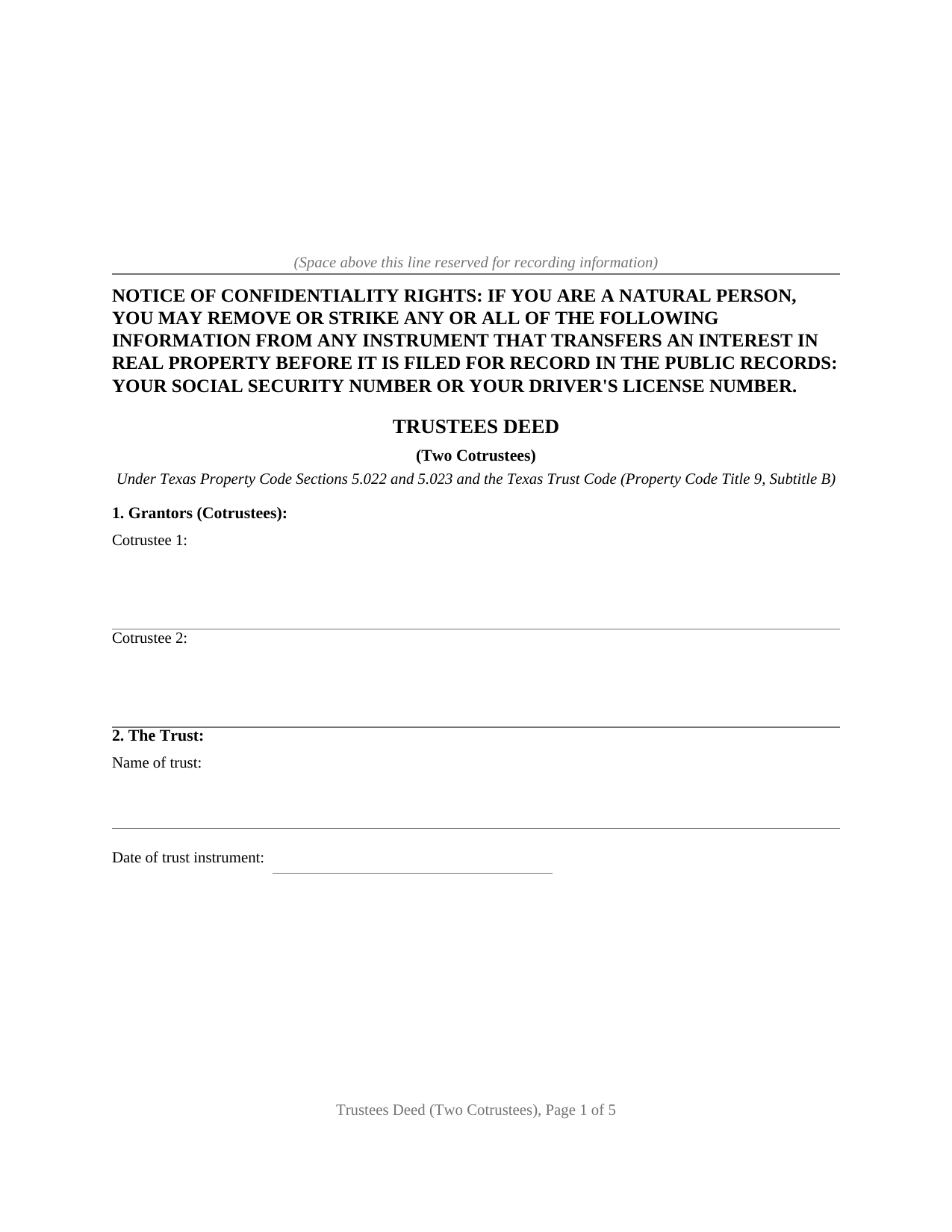
About the Texas Trustees Deed (Two Cotrustees)
How to Use This Form
- Select your county from the list
- Download the county-specific form
- Fill in the required information
- Have the document notarized if required
- Record with your county recorder's office
What Others Like You Are Saying
"Your service is refreshingly clear, simple, and free of superfluous claims or unnecessary marketing.…"
"I liked that the documents could be filled in on my computer. All the documents came out nice, bette…"
"Love this service! So easy and quick"
"The TODD form has been notarized and registered with my county Register of Deeds office, so it works…"
"Turn time was great. Highly recommend."
4.8/5 from 4,825 reviews. Read all
When two cotrustees hold title to Texas real property on behalf of a trust, both must sign the deed that conveys it. Property Code Section 113.085 states why: cotrustees act by majority, and a majority of two is both. This trustees deed is built around that arithmetic, naming both currently serving cotrustees as grantors, identifying the trust by name and date, and carrying separate signature blocks and a separate notary certificate for each signer so the cotrustees may execute on different dates, before different notaries, or in different states.
A conveyance from trust to grantee
The deed conveys with the Texas words of grant, the language Property Code Section 5.022 associates with a deed that carries the property itself rather than merely releasing whatever interest the grantors hold. The distinction matters because Geodyne Energy Income Production Partnership v. Newton Corp., 161 S.W.3d 482 (Tex. 2005), drew a line between a true conveyance and a quitclaim based on whether the language, read as a whole, transfers the property or only the grantor's rights. This deed uses grant, sell, and convey, keeping it on the conveyance side of that line. The habendum clause follows the same pattern, and the return address and grantee address blocks serve the Property Code Section 11.003 address requirement at the recording counter.
The two-cotrustee configuration
The form recites exactly two currently serving cotrustees of the same trust. Both must sign, and the conveyance language states that they join together in the conveyance, satisfying Section 113.085's majority standard for a trust with two trustees. The granting clause and the warranty both run in the cotrustee capacity expressly, so the county records carry a complete fiduciary conveyance from the vesting deed in to this deed out. The conveyance authority rests on Property Code Section 113.010, subject always to Section 113.001, which makes the trust instrument the first word on any trustee's power to sell or convey. A trust whose instrument names only one trustee, or a trust company acting through an officer, presents a configuration that a different form in the Texas trustee deed line addresses.
A warranty scoped to fiduciary tenure
The warranty is special: the grantors bind themselves, solely in their fiduciary capacity and not individually, and the trust estate, to defend the title against claims arising by, through, or under them in that capacity. An express provision under Property Code Section 5.023 limits every covenant implied from the words of grant to the same scope, so no personal obligation reaches the cotrustees' own assets. The trust agreement ordinarily stays private. Property Code Section 114.086 provides for a certification of trust, a trustee-signed summary of the trust's existence, its date, the acting trustees, and their powers, which title examiners review in place of the full instrument. Section 114.081 protects a person dealing with a trustee in good faith and for fair value received by the trust, and Section 114.082 addresses the position of undisclosed beneficiaries whose interest the vesting deed never identified.
Inside the package
The download includes the blank deed as a fillable PDF, a completed example showing the deed filled in for a fictional Williamson County sale by the two cotrustees of a family living trust, and a guide covering every numbered section of the form from the trust identification fields through the recording steps. The deed is formatted for Texas recording, with reserved space for the clerk's recording stamp, the Property Code Section 11.008 confidentiality notice in boldfaced capitals at the top of the instrument page, and the source of title and encumbrances sections that help a subsequent title examiner trace the chain. Texas imposes no transfer tax on deeds, so the instrument and any attached exhibits are the complete recording package. The materials are informational and are not legal advice.
Important: County-Specific Forms
Our trustees deed (two cotrustees) forms are specifically formatted for each of the 254 counties in Texas.
After selecting your county, you'll receive forms that meet all local recording requirements, ensuring your documents will be accepted without delays or rejection fees.