Vermont Assignment of Mortgage
County Specific Legal Forms Validated as recently as October 14, 2026 by our Forms Development Team
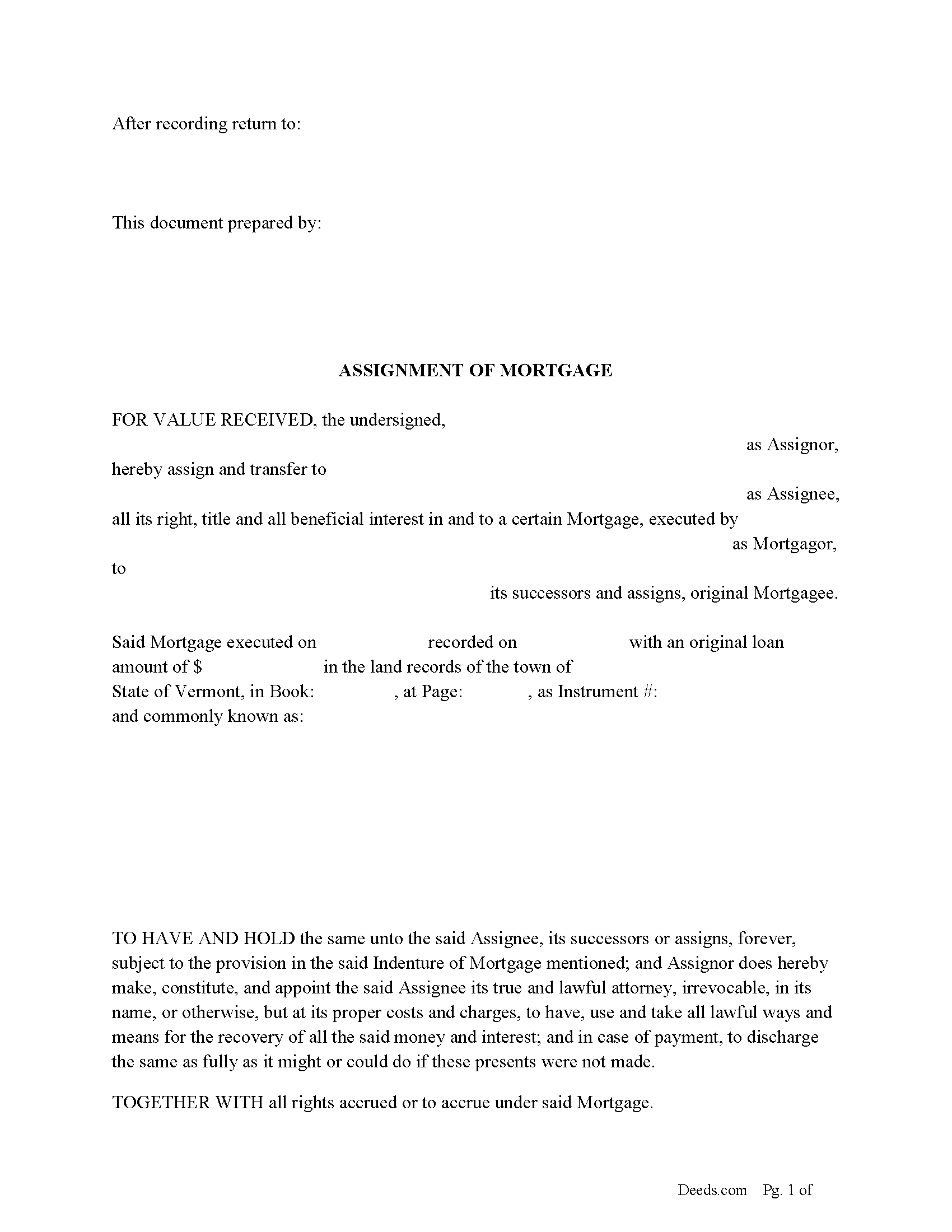
About the Vermont Assignment of Mortgage
How to Use This Form
- Select your county from the list
- Download the county-specific form
- Fill in the required information
- Have the document notarized if required
- Record with your county recorder's office
What Others Like You Are Saying
"It is very good and I would use the site again."
"It was so easy to obtain the necessary documents."
"Your service is sweet. It is self-explanatory and easy to download. I am excited about finding your …"
"Very helpful; information included on the form explanations about Colorado laws in regards to benefi…"
"Great job with these forms. Super easy and up to date, a rare find online these days. Thank you."
4.8/5 from 4,836 reviews. Read all
One individual lender holds the mortgage of record, and one signature moves it. This Vermont assignment of mortgage is set up for a single individual assignor: the natural person named as mortgagee on a mortgage recorded in a Vermont town's land records, or as the current holder under a recorded chain of assignments, transferring that mortgage and the note it secures to a new holder.
One individual holder of record
The form recites one assignor acting in an individual capacity, carries one signature line, and closes with a single acknowledgment certificate completed by the notary. Its operative clause makes an absolute assignment: for value received, the assignor grants, assigns, transfers, and sets over the identified mortgage together with the promissory note or other obligation it secures and all sums due or to become due under it. A seller who financed a buyer and took back a mortgage at closing, a family lender secured by Vermont real estate, and an individual who purchased a private note and mortgage present the pattern this form recites. A bank, company, or trustee assigning a mortgage signs through an officer or fiduciary with a representative acknowledgment, a configuration this form is not set up as; the form's signature block and certificate are individual.
A mortgage that moves like a deed
Vermont is a title theory state, where a mortgage conveys legal title to the mortgagee subject to the borrower's right to redeem, so Vermont title practice treats an outright mortgage assignment as a conveyance of an interest in land. The form follows the conveyance formalities of 27 V.S.A. Section 341(a): the assignor signs, acknowledges before a notary public, and records the instrument in the town clerk's office. Under 27 V.S.A. Section 342, an unacknowledged or unrecorded conveyance is not effectual against anyone but the grantor and the grantor's heirs, which is why the acknowledgment certificate and the recording step carry as much weight here as they do on a deed.
Recorded by town and cross-referenced to the mortgage
Vermont records land instruments through its town and city clerks rather than a county recorder, and the assignment is recorded where the mortgage is recorded. 24 V.S.A. Section 1158 directs that an assignment of a mortgage be duly recorded in the records of the town and that the record carry a marginal cross-reference tying the assignment to the book and page of the mortgage it transfers. The form's mortgage-identification section collects exactly what that notation needs: the mortgagors, the original mortgagee, the mortgage date, the volume and page or document number in the town land records, and any prior assignments of record. The statewide recording fee is 15 dollars per page under 32 V.S.A. Section 1671, and no Vermont property transfer tax return accompanies a mortgage assignment; the Department of Taxes treats assignments and discharges as outside the return-filing category that applies to deeds transferring title.
The record chain behind every payoff
The recorded assignment is what places the new holder in the mortgage's chain of title, and that chain does real work at payoff. Under 27 V.S.A. Section 464(b), the mortgagee of record must execute and deliver a complete discharge within 30 days after the loan is paid, together with any instrument necessary to establish record ownership of the mortgage, on pain of statutory damages. An assignment left unrecorded leaves the assignor as the record holder, the person the discharge statutes and any future closing point at; recording promptly keeps the town record aligned with who actually owns the loan. The guide included with the form walks through the discharge framework, the recording mechanics, and every blank on the instrument.
What the package prepares
The package contains the blank assignment as a fillable PDF, a completed example showing the entire instrument filled in for a realistic Chittenden County fact pattern, and a plain-language guide covering each section, the signing formalities, and the town recording process. The materials describe Vermont law and the form in general terms and are not legal advice; a Vermont attorney can apply these rules to a specific loan or title.
Important: County-Specific Forms
Our assignment of mortgage forms are specifically formatted for each of the 14 counties in Vermont.
After selecting your county, you'll receive forms that meet all local recording requirements, ensuring your documents will be accepted without delays or rejection fees.