Vermont Grant Deed (Entity Grantor)
County Specific Legal Forms Validated as recently as October 23, 2026 by our Forms Development Team
About the Vermont Grant Deed (Entity Grantor)
How to Use This Form
- Select your county from the list
- Download the county-specific form
- Fill in the required information
- Have the document notarized if required
- Record with your county recorder's office
What Others Like You Are Saying
"Perfect"
"High rating, great site and forms were exactly what I needed. Thanks for being there for me."
"My experience on this website has been amazing and the process was very easy to understand and I was…"
"The requested documents I needed were provided and also complete instructions on how to fill them ou…"
"This site is a blessing in disguise-/>"
4.8/5 from 4,836 reviews. Read all
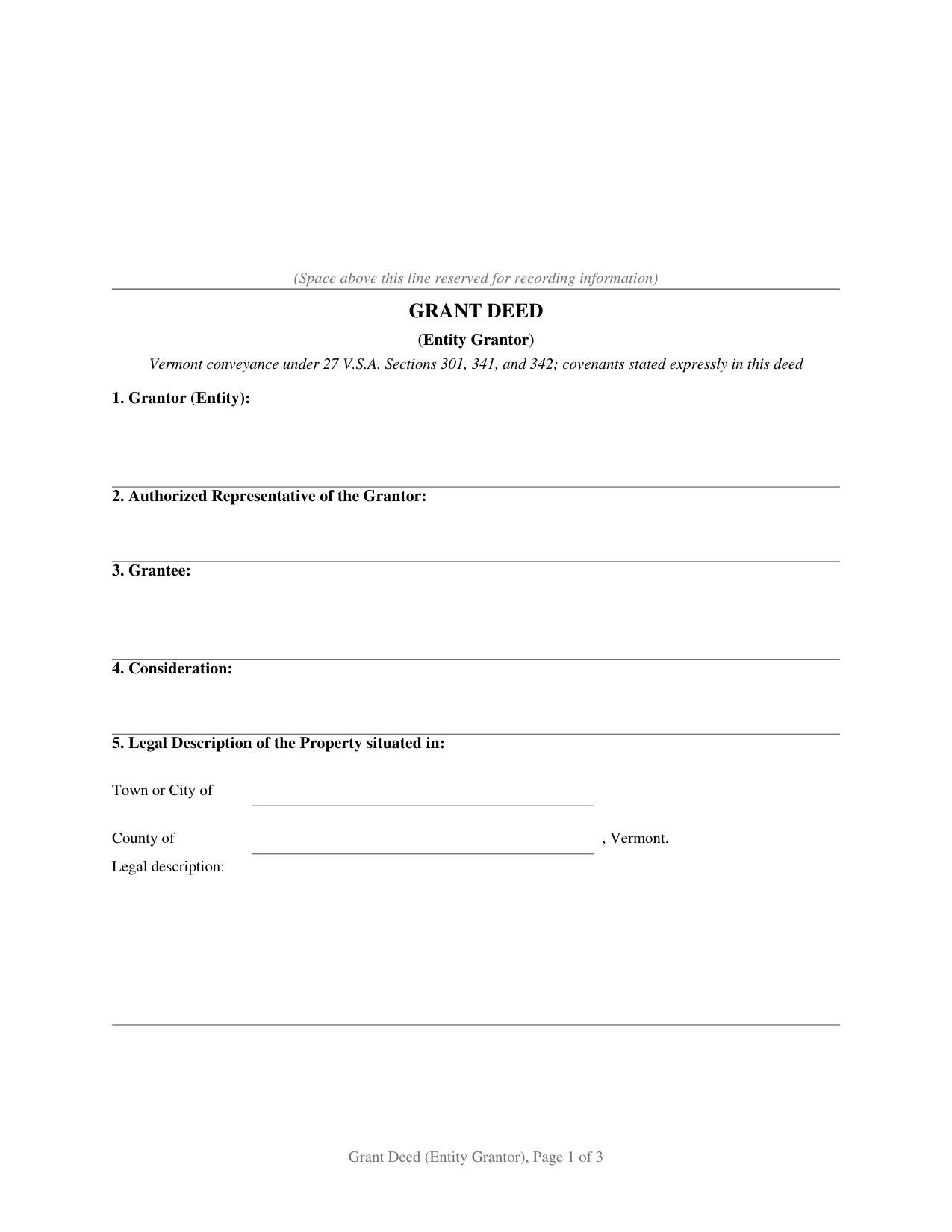
The grantor on this Vermont deed is a company, and the hand that signs it belongs to someone else. This is a Vermont grant deed built for an entity grantor: a limited liability company, corporation, partnership, or other organization deeds Vermont real estate under the express, limited covenants a grant deed states on its face, acting through one authorized representative whose signature and representative-capacity notary certificate complete the instrument.
The Company Signs Through an Authorized Hand
The architecture runs entity first, person second. Section 1 identifies the grantor by legal name, type of organization, and state of formation; Section 2 names the individual authorized to sign and the office that individual holds; and the signature block pairs the entity's name with a By line for the representative's signature, printed name, and title. The notary certificate then follows Vermont's statutory short form for a representative capacity, in which the record is acknowledged by the named individual as the stated type of authority of the named entity, with lines for the notary's printed name and commission number on a paper record. A Vermont limited liability company selling a house it renovated, an out-of-state corporation deeding its Vermont branch property, a partnership conveying land to a retiring partner, and a nonprofit passing a parcel to another organization present the pattern this deed recites. The form is not set up as a conveyance by individual owners, by a married couple, or by a trustee; each of those carries a different grantor section and signing architecture.
No Spouse to Join, One Question to Answer
An entity grantor changes what the deed carries. Vermont's homestead joinder statute, 27 V.S.A. section 141, follows a married owner; a company is not married and holds no homestead, so this form carries no spousal joinder block at all. What stands in its place is the authority question: whether the person signing holds the office the deed names. The deed states that capacity in Section 2, the acknowledgment carries the signer's declaration of representative authority under Vermont's notarial statutes, and the authority itself lives in the operating agreement, bylaws, resolution, or partnership records that a closing assembles alongside the deed.
Two Covenants, Measured by the Company's Tenure
Vermont statutes read no covenants into a deed, so the grant deed's promises appear in its text. The entity covenants that it has conveyed the estate to no one else before this deed, and that no encumbrance of its own making burdens the property beyond the matters listed in the exceptions section; a limiting sentence then holds both covenants to acts of the entity and to claims arising by, through, or under it. For a company that took title on a known date, that boundary reads cleanly in the chain: the covenant window is the entity's period of ownership and nothing earlier. Buyers searching Vermont land records for a limited covenant deed or a special warranty style conveyance find this instrument in the space between a full warranty deed and a bare quitclaim.
The Town Clerk's Counter
Vermont deeds record municipally: the clerk of the town or city where the land lies takes the deed at a statewide fee of $15.00 per page, and under 27 V.S.A. section 342 an unrecorded conveyance holds the estate against no one beyond the grantor itself. A completed Property Transfer Tax Return, Form PTT-172, belongs to the same visit; 32 V.S.A. section 9608 keeps the clerk from receiving the deed for recording without it, and the tax, a combined 1.47 percent on an ordinary transfer, falls to the transferee and goes to the Vermont Department of Taxes. A legal description drawn from a recorded plat cites the map book and page where the plat is recorded, the citation 27 V.S.A. section 341(b) contemplates.
The download supplies the entity grantor deed as a fillable PDF opening with a removable instructions page; a completed example carried through a St. Albans, Franklin County sale by a Vermont limited liability company, from the entity block to the representative-capacity certificate; and a plain language guide to each numbered section, the co-ownership forms open to grantees, the notarization of a representative's signature, and the recording and transfer tax filing. These materials explain Vermont law generally and are not legal advice.
Important: County-Specific Forms
Our grant deed (entity grantor) forms are specifically formatted for each of the 14 counties in Vermont.
After selecting your county, you'll receive forms that meet all local recording requirements, ensuring your documents will be accepted without delays or rejection fees.