Vermont Grant Deed (Married Grantor with Non-Owner Spouse Joinder)
County Specific Legal Forms Validated as recently as September 16, 2026 by our Forms Development Team
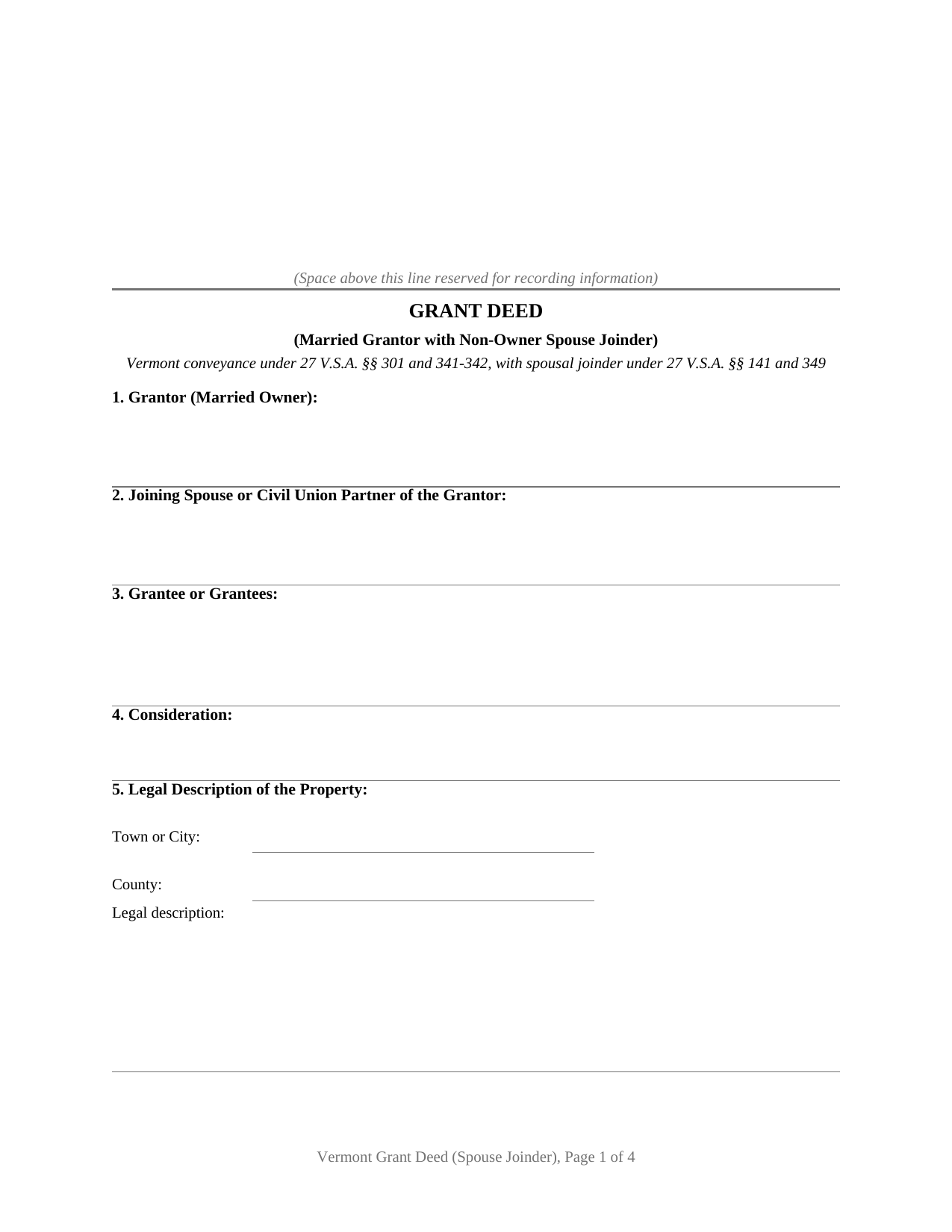
About the Vermont Grant Deed (Married Grantor with Non-Owner Spouse Joinder)
How to Use This Form
- Select your county from the list
- Download the county-specific form
- Fill in the required information
- Have the document notarized if required
- Record with your county recorder's office
What Others Like You Are Saying
"Great service"
"Friendly user"
"this is the only site that helped me out"
"So easy to navigate."
"Thanks so much. Lawyers wanted $150 but with your help and my facts I knocked it out in less than 1 …"
4.8/5 from 4,815 reviews. Read all
This Vermont grant deed carries two signature lines but only one grantor. It is configured for a married owner who holds record title alone: that owner conveys Vermont real property with express, limited covenants of title, while the owner's spouse or civil union partner, who owns no record interest, signs a dedicated joinder block whose entire legal work is the release of homestead and marital rights.
A Joinder Signature That Conveys Nothing
The architecture is one grantor identity block, one granting clause, and a separate joinder section naming the spouse or civil union partner. The joining signer appears in Section 2, signs the second signature block, and acknowledges before a notary just as the grantor does, each signature feeding its own certificate in Vermont's statutory short form with the printed name and commission number the notarial statutes call for on a paper record. What the joinder section says matters as much as who signs it: the joining spouse or civil union partner releases all right, title, and interest in the property, including homestead rights under 27 V.S.A. chapter 3, while giving none of the deed's covenants and conveying no record title. An owner who took title before the marriage and now sells the family residence, and an owner deeding out property that has always stood in one name while the couple lives on it, present the pattern this deed recites. The form is not set up as a conveyance by two record co-owners, by spouses who both appear on the vesting deed, or by an unmarried owner; those patterns carry different grantor sections and different signature architecture.
Why Vermont Law Asks for the Second Signature
Vermont homestead law reaches a married owner even when the marriage never touched the record title. 27 V.S.A. section 141 keeps a married owner's conveyance of the homestead from operating as to the homestead when the spouse does not join in executing and acknowledging it, and 27 V.S.A. section 349(a)(2) reaches conveyances of homestead property to anyone other than the owner's spouse without that joinder. The statute pairs the two acts, execution and acknowledgment, which is why the joinder block on this form connects to its own notary certificate rather than to a bare signature line. Buyers and title examiners searching a Vermont chain read the recorded joinder as the closing of the homestead question this deed would otherwise leave open.
Two Express Covenants, Measured by One Ownership
No Vermont statute supplies deed covenants by implication, so this form writes its grant deed covenants into the text: the grantor has conveyed the estate to no one else before this deed, and no encumbrance the grantor made or suffered burdens the property beyond what the exceptions section states. A limiting sentence confines both promises to the grantor's own acts and to claims arising by, through, or under the grantor. Because the record owner here is a single person, the covenant period is that one owner's tenure, and the joining spouse stands outside the covenants entirely. Shoppers comparing a limited covenant deed or a special warranty style conveyance against a full warranty or a bare quitclaim find this instrument in that middle register.
One Stop at the Town Clerk
The finished deed records with the clerk of the Vermont town or city where the land lies, at $15.00 per page, and under 27 V.S.A. section 342 the recording is what makes it good against the world beyond the grantor and the grantor's heirs. A completed Property Transfer Tax Return rides with it; 32 V.S.A. section 9608 stops the clerk from recording without the return and any required Act 250 certificate, and the buyer owes the tax itself, a combined 1.47 percent on an ordinary transfer with a reduced bracket on the first $200,000 of a principal residence, paid to the Vermont Department of Taxes.
The download includes the deed as a fillable PDF opening with a removable instructions page, a completed example worked through a Stowe, Lamoille County sale from the grantor block through both notary certificates, and a plain language guide to every numbered section, the vesting choices open to grantees, the homestead joinder statutes, and the trip through recording and the transfer tax. The materials describe Vermont law in general terms and are not legal advice.
Important: County-Specific Forms
Our grant deed (married grantor with non-owner spouse joinder) forms are specifically formatted for each of the 14 counties in Vermont.
After selecting your county, you'll receive forms that meet all local recording requirements, ensuring your documents will be accepted without delays or rejection fees.