Vermont Grant Deed (Grantor to Own Revocable Trust)
County Specific Legal Forms Validated as recently as September 30, 2026 by our Forms Development Team
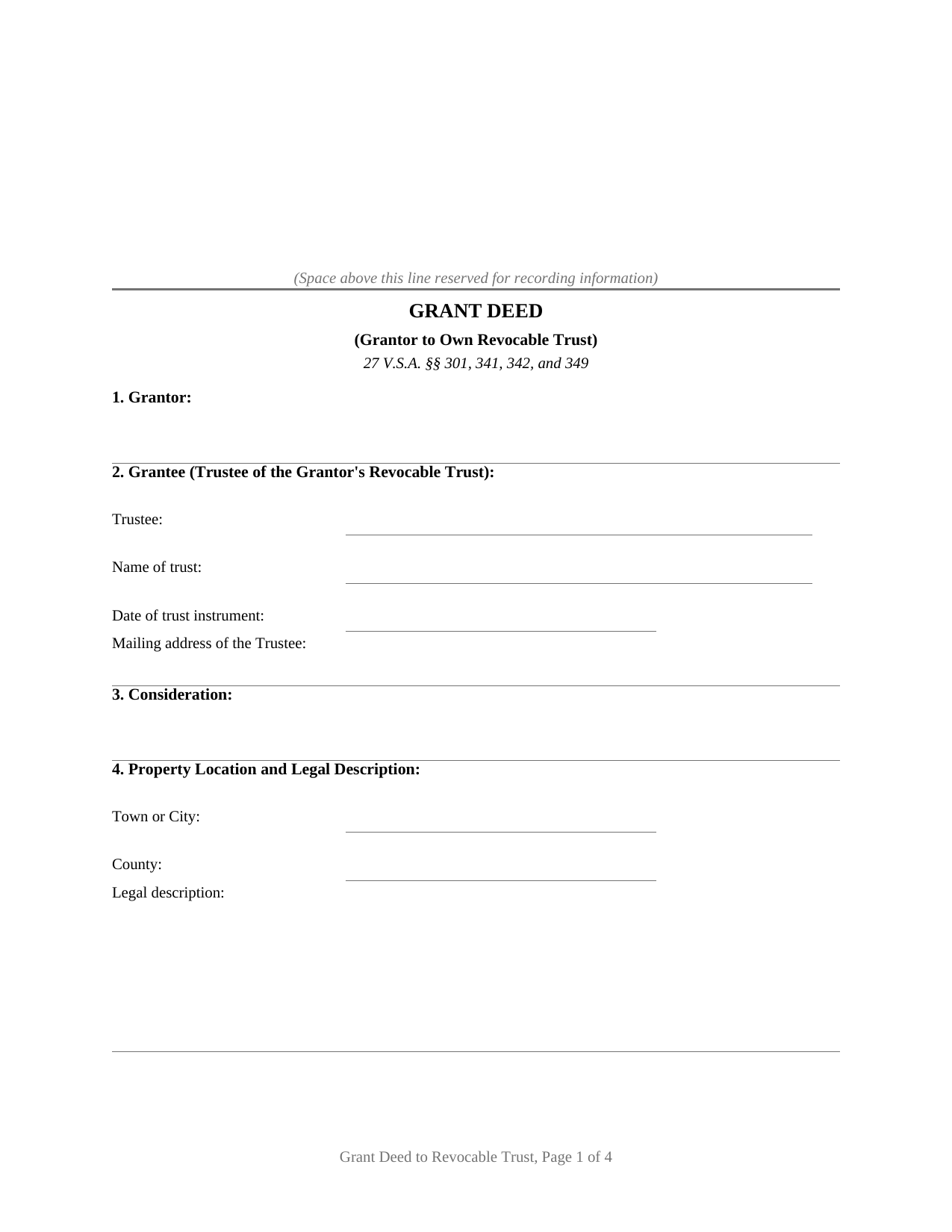
About the Vermont Grant Deed (Grantor to Own Revocable Trust)
How to Use This Form
- Select your county from the list
- Download the county-specific form
- Fill in the required information
- Have the document notarized if required
- Record with your county recorder's office
What Others Like You Are Saying
"The forms are incredibly easy to fill out. Thanks for the examples!"
"Excellent ...easy, timely!"
"This is a great service! Very much needed."
"Great to find this makes for easy work when you need to secure your ownership of a property!!Thanks …"
"Great and prompt service. Thank you for your assistance. Paul R. Ashe, Esq."
4.8/5 from 4,817 reviews. Read all
This Vermont grant deed is drawn for a conveyance in which the same name can appear on both sides of the instrument. It is the trust-funding configuration: an individual owner conveys Vermont real property to the trustee of the owner's own revocable trust, most often the owner in a trustee capacity, carrying the two limited covenants a Vermont grant deed spells out expressly.
One Owner, Two Capacities
The grantor section identifies a single individual, and the grantee section carries the three identifiers that together vest trust title: the trustee who takes the property, the exact name of the trust, and the date of the trust instrument. 27 V.S.A. section 349 recognizes a direct conveyance to oneself in another capacity, and the deed states that recognition on its face, so the record shows a completed transfer even where grantor and trustee are one individual. An owner retitling a home into a revocable living trust at the center of an estate plan, and an owner moving a rental parcel into the trustee's name to complete that plan, present the pattern this deed recites. The form is not set up as a conveyance out of a trust, as a deed by two settlors funding a shared trust, or as a company's transfer; each of those carries a different grantor architecture. Nor does the deed create the trust it funds: under 27 V.S.A. section 303 a trust concerning land rests on a signed written instrument, and this deed presumes that instrument already exists.
The Return Is Filed, the Tax Is Usually Not Owed
Vermont bars a town clerk from receiving a deed for recording without a completed Property Transfer Tax Return under 32 V.S.A. section 9608, and that bar reaches a trust-funding deed even when no money changes hands. What changes is the arithmetic on the return. Two entries on the 32 V.S.A. section 9603 exemption list speak to this transfer: subdivision (5) reaches transfers in trust without actual consideration to the extent of the benefit to the donor, and subdivision (6) reaches a mere change in the form of ownership with no change in beneficial ownership. An owner funding a revocable trust the owner can undo at will commonly stands inside both descriptions. The exemption is claimed on Form PTT-172 itself, the return travels to the clerk's counter with the deed, and the $15.00 return filing fee applies alongside the $15.00 per page recording charge.
Covenants From an Owner Who Keeps Control
No Vermont statute reads covenants into a deed, so this form writes the grant deed pair into its text: the grantor has conveyed the estate to no one else before this deed, and no encumbrance of the grantor's making burdens the property beyond what the deed's exceptions section lists. A limiting sentence confines both covenants to the grantor's own acts and to claims arising by, through, or under the grantor. On a transfer into the owner's own revocable trust the covenants take an unusual posture: the same person typically stands at both ends of them, and the promises matter mostly to later title examiners reading the chain. Searchers reach this instrument as a living trust deed, a trust transfer deed, or a limited covenant conveyance occupying the ground between a warranty deed and a quitclaim.
Homestead, Marriage, and the Clerk's Counter
A married owner deeding the homestead meets Vermont's joinder statutes even when the deed runs to the owner's own trust: the trustee is not the spouse, so 27 V.S.A. sections 141 and 349(a)(2) call for the spouse or civil union partner to join in the execution and acknowledgment. A conditional joinder section, with a signature line and a notary certificate of its own, carries that second signature where homestead rights exist and otherwise stays empty. The finished deed records with the clerk of the town or city where the land lies, Vermont keeping its land records municipally, and under 27 V.S.A. section 342 the recorded deed is what holds the estate against anyone beyond the grantor and the grantor's heirs.
The download supplies the deed as a fillable PDF opening with a removable instructions page; a completed example carried through a Montpelier, Washington County trust funding, from the grantor block through the trustee vesting and both notary certificates; and a plain language guide to each numbered section, the trust-title vesting the grantee clause carries, the joinder statutes, and the path through recording and the transfer tax return. These materials describe Vermont law in general terms and are not legal advice.
Important: County-Specific Forms
Our grant deed (grantor to own revocable trust) forms are specifically formatted for each of the 14 counties in Vermont.
After selecting your county, you'll receive forms that meet all local recording requirements, ensuring your documents will be accepted without delays or rejection fees.