Vermont Grant Deed (Joint Grantors)
County Specific Legal Forms Validated as recently as September 25, 2026 by our Forms Development Team
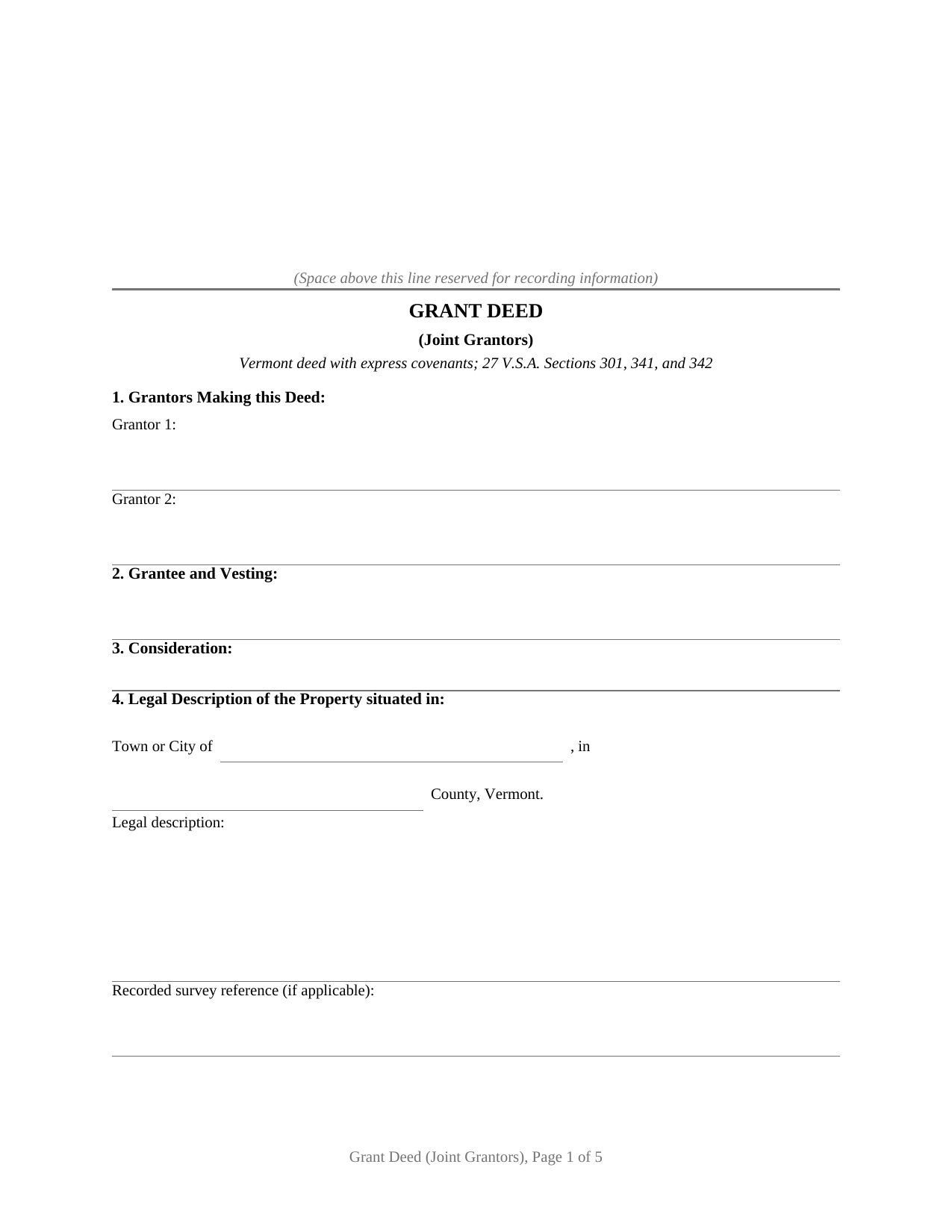
About the Vermont Grant Deed (Joint Grantors)
How to Use This Form
- Select your county from the list
- Download the county-specific form
- Fill in the required information
- Have the document notarized if required
- Record with your county recorder's office
What Others Like You Are Saying
"First time using Deeds.com. Downloaded the PDF forms for creating an Illinois Mortgage and Promissor…"
"You made this so easy to process the Executor Deed. THANK YOU a thousand times. Appreciate that all …"
"Excellent service. Documents easy to understand and use."
"service from your team was quick and very accurate. My experience was excellent."
"This is the first time I use this site, and it was very easy and user friendly. I was able to fill o…"
4.8/5 from 4,815 reviews. Read all
Two grantor signature blocks, a separate acknowledgment certificate for each, and a granting clause both owners give together: this is a Vermont grant deed configured for exactly two grantors. Co-owners conveying Vermont real property in one instrument, with the express limited covenants that make a grant deed, complete a single fillable form built around that two-signer architecture.
Two Grantors, One Conveyance
The form recites exactly two grantors: two identity blocks in the grantor section, two signature lines with printed names and dates, and an acknowledgment certificate for each signer in the Vermont statutory short form wording, so the grantors may sign on different dates, in different counties, or in different states. A married couple deeding a home they hold as tenants by the entirety, two siblings passing co-owned land to a single buyer, and unmarried co-owners selling a parcel they took title to together present the two-grantor pattern this deed recites. It is not set up as a sole owner's deed, a trustee's deed, or an entity's conveyance; each of those carries a different signing architecture.
For spouses, the two-grantor shape is itself the legal point. Vermont title practice treats a conveyance to a married couple as a tenancy by the entirety, and under 27 V.S.A. Section 349(a)(2) neither spouse conveys an entireties or homestead interest to a nonspouse unless the other joins in the conveyance. Both spouses signing as grantors on one deed places that joinder on the face of the record. Where the two grantors are not married to each other, a conditional joinder block waits at the end of the form for a grantor's spouse or civil union partner holding homestead rights under 27 V.S.A. Section 141, and stays blank when no such joinder applies.
Covenants Both Grantors Give, Ending at Their Own Acts
Vermont deeds carry only the covenants written into them, so this form writes the grant deed pair in full. The grantors covenant that the estate they are deeding has gone to no one else before this instrument, and that no encumbrance of their own making burdens the property beyond the matters the deed lists in its exceptions section. A boundary sentence then holds both promises to the signers' own acts and to claims that trace by, through, or under them; nothing in the deed defends against defects that predate the grantors or arise through strangers. That middle ground between a full warranty deed and a bare quitclaim leads buyers and title searchers to this same instrument under the names limited covenant deed and special warranty style conveyance, and on a two-grantor deed, both owners stand behind the covenants together.
From the Grantee Clause to the Town Clerk
The grantee section accepts one or more grantees under any Vermont vesting: 27 V.S.A. Section 2 supplies tenancy in common as the default for two or more unmarried grantees, recognizes a joint tenancy created by express survivorship words, and leaves a conveyance to spouses to the entireties treatment of Vermont title practice. The signed deed then goes to the clerk of the municipality where the land lies, since Vermont land records are town and city records; under 27 V.S.A. Section 342, an unrecorded deed holds the estate against no one beyond the grantors and their heirs. At the counter, 32 V.S.A. Section 9608 conditions recording on a complete Property Transfer Tax Return filed with the deed, while the tax itself, a combined 1.47 percent on an ordinary transfer with lower principal residence brackets, goes to the Department of Taxes. Recording runs 15 dollars per page, and a description that leans on a recorded survey cites its book and page under 27 V.S.A. Section 341(b).
The download delivers three pieces: the two-grantor deed as a fillable PDF, opening with an instructions page that is removed before recording; a completed example worked through a Brattleboro, Windham County sale, from both grantor blocks to the final notary line; and a plain language guide to each numbered section, the forms of grantee co-ownership Vermont recognizes, the entireties and homestead joinder rules, and the recording and transfer tax steps. The materials describe Vermont law in general terms and are not legal advice.
Important: County-Specific Forms
Our grant deed (joint grantors) forms are specifically formatted for each of the 14 counties in Vermont.
After selecting your county, you'll receive forms that meet all local recording requirements, ensuring your documents will be accepted without delays or rejection fees.