Vermont Grant Deed (Individual Grantor)
County Specific Legal Forms Validated as recently as October 5, 2026 by our Forms Development Team
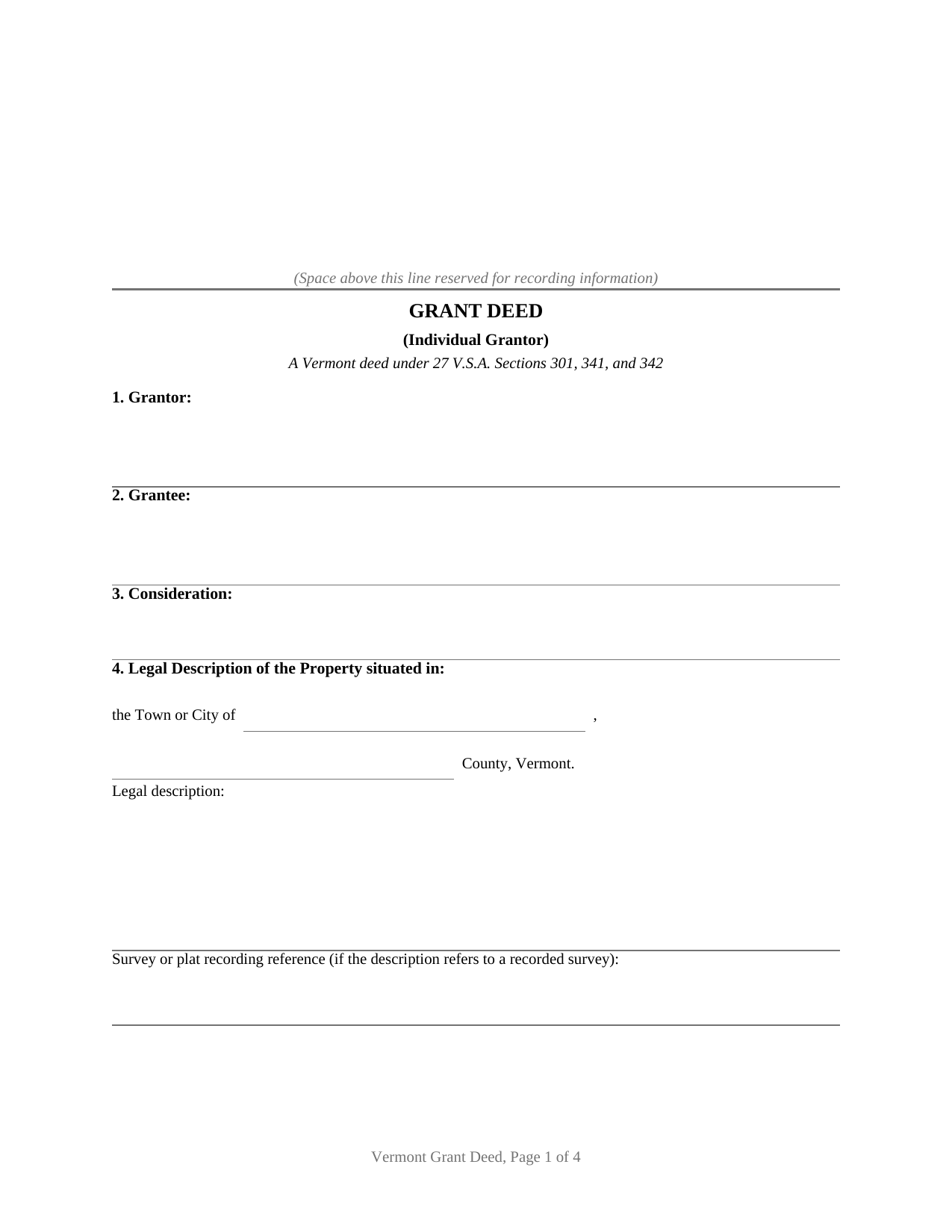
About the Vermont Grant Deed (Individual Grantor)
How to Use This Form
- Select your county from the list
- Download the county-specific form
- Fill in the required information
- Have the document notarized if required
- Record with your county recorder's office
What Others Like You Are Saying
"It's an instant download. I was very pleased that it included instructions and any necessary additio…"
"Easy to use. I was able to find out what I needed quickly and was able to download the information n…"
"It was a very easy to use application. I can only give it four stars because I have yet to receive c…"
"Very easy process from you so far, thanks! i don't hav a computer, only an apple iphone, so on a day…"
"I was very pleased. It was the form I needed. I was getting discouraged by companies that wanted me …"
4.8/5 from 4,836 reviews. Read all
Every promise in a Vermont deed is written on its face, and this one is built around two of them. This is a Vermont grant deed set up for a single individual grantor: one owner conveying Vermont real property with the limited covenants of title that define a grant deed, in a fillable form that pairs the conveyance with the homestead joinder Vermont law attaches when a married owner deeds the home.
Covenants the Deed States, Because Vermont Implies None
Vermont has no general statutory deed form and no statute that reads covenants of title into a deed by implication. In states with grant deed statutes, the single word grant quietly carries two covenants; in Vermont, those covenants exist only where the instrument spells them out. This form states them expressly: the grantor has not previously conveyed the same estate or any interest in it to anyone other than the grantee, and the property is free from encumbrances made or suffered by the grantor, except as the deed discloses. A limiting sentence then fixes the boundary, extending the covenants only to acts of the grantor and claims arising by, through, or under the grantor, and no further. The result sits between a full warranty and a bare release: more assurance than a deed with no covenants at all, without the open ended defense of the entire chain of title that a warranty deed's covenant package takes on. Searchers reach this instrument as a grant deed, a limited covenant deed, or a special warranty style conveyance; on the Vermont record, the covenant language itself is what does the work.
One Grantor, and the Joinder Vermont Adds for the Homestead
The form recites exactly one individual grantor: one identity section, one signature block, and one acknowledgment certificate in the Vermont statutory short form wording, with the printed notary name and commission number lines the notarial statutes describe for a paper record. A sole owner selling to a neighbor, an unmarried owner deeding land to family, and a single person conveying an investment parcel present the pattern this deed recites. The grantee section accepts one or more grantees with any vesting Vermont recognizes, from sole ownership through tenancy in common, joint tenancy, or tenancy by the entirety for married grantees, under 27 V.S.A. Section 2.
What the form holds in reserve is Vermont's homestead rule. Under 27 V.S.A. Sections 141 and 349, a married owner's conveyance of the homestead is inoperative as to the homestead unless the spouse or civil union partner joins in the execution and acknowledgment of the deed. A conditional spousal joinder block, with its own signature line and its own acknowledgment certificate, carries that joinder when it applies and stays blank when it does not. The form is not set up as a deed by two co-owner grantors, a trustee, or an entity grantor; each of those patterns carries a different signing architecture.
Recorded with the Town Clerk, Filed with the Transfer Tax Return
Vermont records land title by municipality, not by county: the deed goes to the clerk of the town or city where the land lies, and under 27 V.S.A. Section 342 it is recording that makes the conveyance effectual against anyone beyond the grantor and the grantor's heirs. The statewide recording fee is $15.00 per page under 32 V.S.A. Section 1671. The deed does not travel alone: 32 V.S.A. Section 9608 bars the clerk from recording a deed evidencing a transfer unless a completed Vermont Property Transfer Tax Return accompanies it, and the transferee pays the tax, at an ordinary combined rate of 1.47 percent with a lower principal residence bracket, to the Department of Taxes rather than to the town. A deed whose description refers to a recorded survey either cites the volume and page where the survey is recorded or is accompanied by it, under 27 V.S.A. Section 341(b). The form reserves the top of its first page for the clerk's recording information and keeps its text within the statutory page definition.
The download contains the grant deed as a fillable PDF that opens with a non-recorded instructions page, a completed example filled in for a Milton, Chittenden County fact pattern showing every entry from the granting clause through the notary blocks, and a plain language guide covering each numbered section, the ways grantees may hold Vermont title, the homestead joinder, and the path through recording and the transfer tax. The materials describe Vermont law in general terms and are not legal advice.
Important: County-Specific Forms
Our grant deed (individual grantor) forms are specifically formatted for each of the 14 counties in Vermont.
After selecting your county, you'll receive forms that meet all local recording requirements, ensuring your documents will be accepted without delays or rejection fees.