Vermont Grant Deed (Married Couple as Grantors)
County Specific Legal Forms Validated as recently as September 18, 2026 by our Forms Development Team
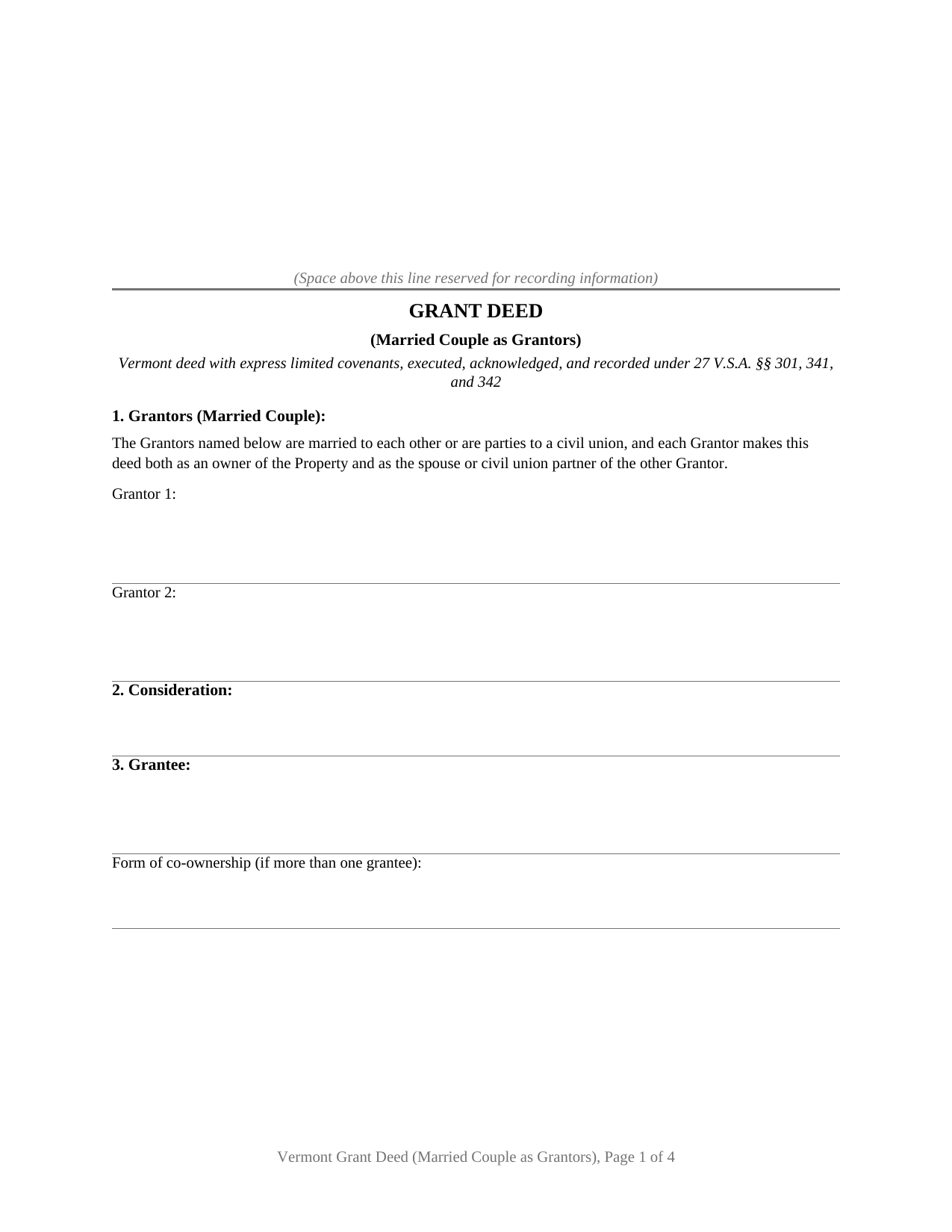
About the Vermont Grant Deed (Married Couple as Grantors)
How to Use This Form
- Select your county from the list
- Download the county-specific form
- Fill in the required information
- Have the document notarized if required
- Record with your county recorder's office
What Others Like You Are Saying
"Easy, quick and very proficient. I am glad I used Deeds."
"Excellent website with examples on how to fill out forms. Even better was the help from the office o…"
"I AM DELIGHTED TO BE PARTY TO DEEDS.COM. THE PROCESS IS DOWN-TO-EARTH AND VERY USER FRIENDLY. I MUST…"
"Got the report. However, Retrieving process was not clear."
"I ordered a Transfer of Deed on Death document. It was easy to fill in, came with a useful guide and…"
4.8/5 from 4,815 reviews. Read all
Vermont treats a married couple's real estate as an estate neither spouse deeds away alone. Property held by the entirety carries no separable share for either spouse to convey or encumber without the other, the Vermont Supreme Court said in Cooper v. Cooper, and 27 V.S.A. section 349(a)(2) keeps an entireties or homestead interest from passing to a nonspouse unless the other spouse joins in the conveyance. This Vermont grant deed is configured for a married couple as grantors: one instrument in which both spouses convey together and both stand behind the express limited covenants that make a grant deed.
Covenants Given by the Couple, Bounded by the Couple
Vermont writes no covenants into a deed by statute, and no Vermont statute defines a grant deed, so this form spells out its two promises and makes its signers the measure of them. The grantors covenant that the estate deeded here went to no one before, and that nothing of their own making encumbers the Property beyond what the deed's exceptions section lists; a boundary sentence then confines both covenants to the grantors' own acts and to claims tracing by, through, or under them. On a married couple's deed that boundary takes a clean shape: the couple's period of ownership is a single period, and the covenants cover it with both spouses bound. Buyers and title searchers reach this middle ground between a warranty deed and a bare quitclaim under the names limited covenant deed and special warranty style conveyance.
The Marriage Is the Architecture
The grantor section recites two grantors married to each other or joined in a civil union, and the operative section has each spouse join in the execution and acknowledgment of the deed and release all right, title, and interest, including homestead rights under 27 V.S.A. chapter 3. That wording tracks the two joinder statutes that follow a married Vermont owner to a closing: 27 V.S.A. section 141, which makes a homestead conveyance inoperative as to the homestead unless the owner's spouse joins in the execution and acknowledgment, and the section 349 nonspouse rule for entireties and homestead property. Because each grantor's spouse is the other grantor, the deed holds no conditional joinder block for an outside signer; two grantor signature blocks, each feeding a certificate in Vermont's short form wording with the printed name and commission number lines the notarial statutes list for a paper record, are the whole execution apparatus. Spouses selling the home they hold by the entirety, a couple deeding land whose record title stands in one spouse's name, and civil union partners conveying a parcel acquired together present the pattern this deed recites. The form is not set up as a sole owner's conveyance or as a deed by co-owners who are not married to each other, and trustee and entity grantors carry a different signing architecture altogether.
To the Town Clerk, With the Return
Vermont land records live with town and city clerks, so the signed deed records in the municipality where the land lies at the statewide fee of $15.00 per page, and under 27 V.S.A. section 342 recording is what makes the conveyance effectual against anyone beyond the grantors and their heirs. A completed Property Transfer Tax Return, Form PTT-172, travels with the deed; 32 V.S.A. section 9608 keeps the clerk from recording without the completed return and the required Act 250 certificate, and the transferee pays the tax, ordinarily a combined 1.47 percent with a reduced principal residence bracket, to the Department of Taxes rather than to the town. The grantee clause accepts one or more grantees under any form Vermont recognizes, with tenancy in common the 27 V.S.A. section 2 default for unmarried co-grantees who state no other form.
The download holds three pieces: the deed as a fillable PDF opening with a non-recorded instructions page that comes out before signing; a completed example worked through a Middlebury, Addison County home sale, from the paired grantor blocks to the second notary certificate; and a plain language guide to each numbered section, the ways grantees may hold Vermont title, the marital joinder statutes, and the recording and transfer tax steps. The materials describe Vermont law in general terms and are not legal advice.
Important: County-Specific Forms
Our grant deed (married couple as grantors) forms are specifically formatted for each of the 14 counties in Vermont.
After selecting your county, you'll receive forms that meet all local recording requirements, ensuring your documents will be accepted without delays or rejection fees.