Vermont Quitclaim Deed (Divorce)
County Specific Legal Forms Validated as recently as October 7, 2026 by our Forms Development Team
About the Vermont Quitclaim Deed (Divorce)
How to Use This Form
- Select your county from the list
- Download the county-specific form
- Fill in the required information
- Have the document notarized if required
- Record with your county recorder's office
What Others Like You Are Saying
"Gift Deed is exactly what was required. Thank you!"
"Excellent customer service!!!!!"
"Warranty Deed was just what I needed.Easy to complete and accepted by the county."
"Easy to use and very quick turn around ... Very satisfied with ease of use and services provided ..."
"I was very pleased with the quick turn around on a response to my inquiry. Further guidance was dire…"
4.8/5 from 4,830 reviews. Read all
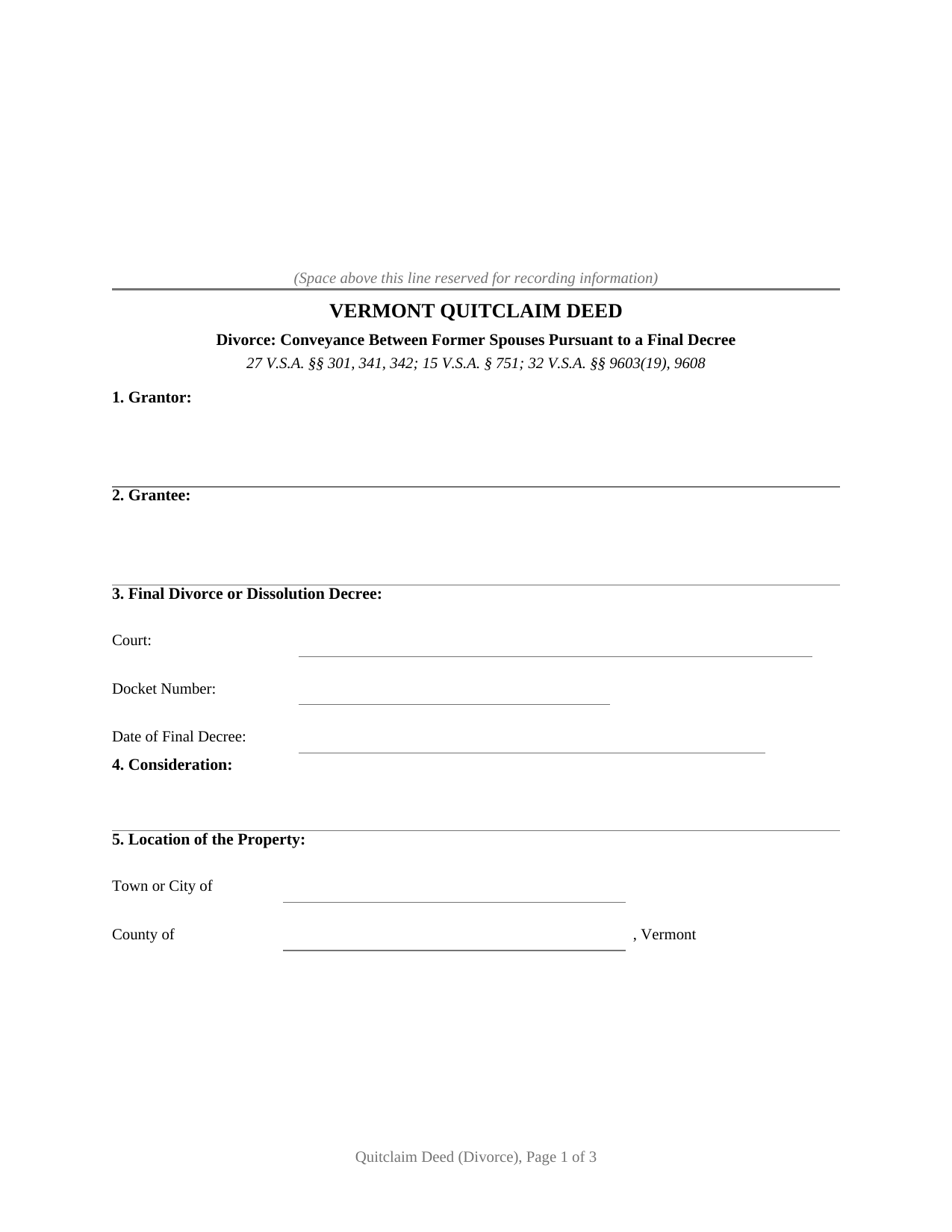
Three entries no other part of a Vermont quitclaim deed collects sit near the top of this one: a court, a docket number, and the date a divorce decree became final. This is a Vermont quitclaim deed configured for divorce, one former spouse conveying real estate to the other under the judgment that ended the marriage or civil union. Searchers spell it quit claim deed or quick claim deed and look for it as a divorce deed.
The deed that carries out the judgment
Vermont divides marital real estate through the divorce judgment itself. Under 15 V.S.A. section 751, the court settles the parties' property rights by provisions in the judgment that equitably divide and assign the property, and title in either party's name is immaterial to that power. The judgment, though, lives in a court file; the land records learn of the change when a deed records. A numbered section of this form identifies the decree by court and unit, docket number, and date, and the operative text recites that the conveyance is made pursuant to that decree, so an examiner reading the chain sees the judgment behind the release.
What the divorce already did to the title
Married Vermont couples commonly hold the home as tenants by the entirety, and the Vermont Supreme Court held in Preston v. Chabot, 138 Vt. 170 (1980), that divorce destroys that estate and creates a tenancy in common by operation of law. The former spouses then stand as co-owners of undivided halves, and this deed is how the half the decree awarded away moves. The grantor remises, releases, and forever quitclaims all right, title, and interest held at delivery, carrying no covenant or warranty of title; Vermont prescribes no statutory quitclaim form and reads no covenants into an ordinary deed. Where record title stood in the grantor's name alone, the same release carries the whole of it.
One signature, on either side of the nisi period
The form recites exactly one grantor and one grantee, identifies their decree in its third numbered section, and runs through eleven sections to a single signature block and one acknowledgment certificate. No spousal joinder machinery appears on it, and Vermont's divorce timing explains why. A decree of divorce is a decree nisi that becomes absolute 90 days after entry under 15 V.S.A. section 554: a grantor signing after that date is unmarried, so the joinder statute for married owners never attaches, and a grantor signing during the nisi period conveys to a grantee who is still, in law, the grantor's spouse, a direct conveyance 27 V.S.A. section 349 permits. A refinance closing in which one former spouse buys out the other's half of the homeplace, a judgment awarding the house to the parent staying in it with the children, and former civil union partners dividing Vermont land after a dissolution under 15 V.S.A. section 1206 present the pattern this deed recites. The form is not set up as a conveyance between spouses whose marriage continues, as a release by an owner with no decree behind it, or as an instrument for two grantors conveying together; each of those follows a different signing architecture.
Exemption 19 on the transfer tax return
The finished deed goes to the clerk of the Vermont municipality where the land lies, at $15 per page statewide. No transfer deed records without the tax paperwork: 32 V.S.A. section 9608 requires the completed Vermont Property Transfer Tax Return, Form PTT-172, and its Act 250 certificate before the clerk may accept the deed, and a decree-driven transfer often reports no tax due. 32 V.S.A. section 9603(19) exempts transfers under a court judgment decreeing the disposition of real estate of the parties to a civil marriage, claimed by number on the face of the return, which is filed even at zero tax. Where value beyond the decree's division changes hands, the general rate of 1.25 percent plus the 0.22 percent clean water surcharge applies.
What the download contains
The package holds the divorce quitclaim deed as a fillable PDF that opens on an instructions sheet removed before recording, a completed example worked through for a Randolph, Orange County record in which an ex-wife releases her interest in the former marital home to her ex-husband under their Family Division decree, and a plain language guide covering each numbered section, grantee vesting under Vermont law, the divorce and conveyance statutes, notarization, and recording. The materials describe Vermont law in general terms and are not legal advice.
Important: County-Specific Forms
Our quitclaim deed (divorce) forms are specifically formatted for each of the 14 counties in Vermont.
After selecting your county, you'll receive forms that meet all local recording requirements, ensuring your documents will be accepted without delays or rejection fees.