Vermont Quitclaim Deed (Individual)
County Specific Legal Forms Validated as recently as October 19, 2026 by our Forms Development Team
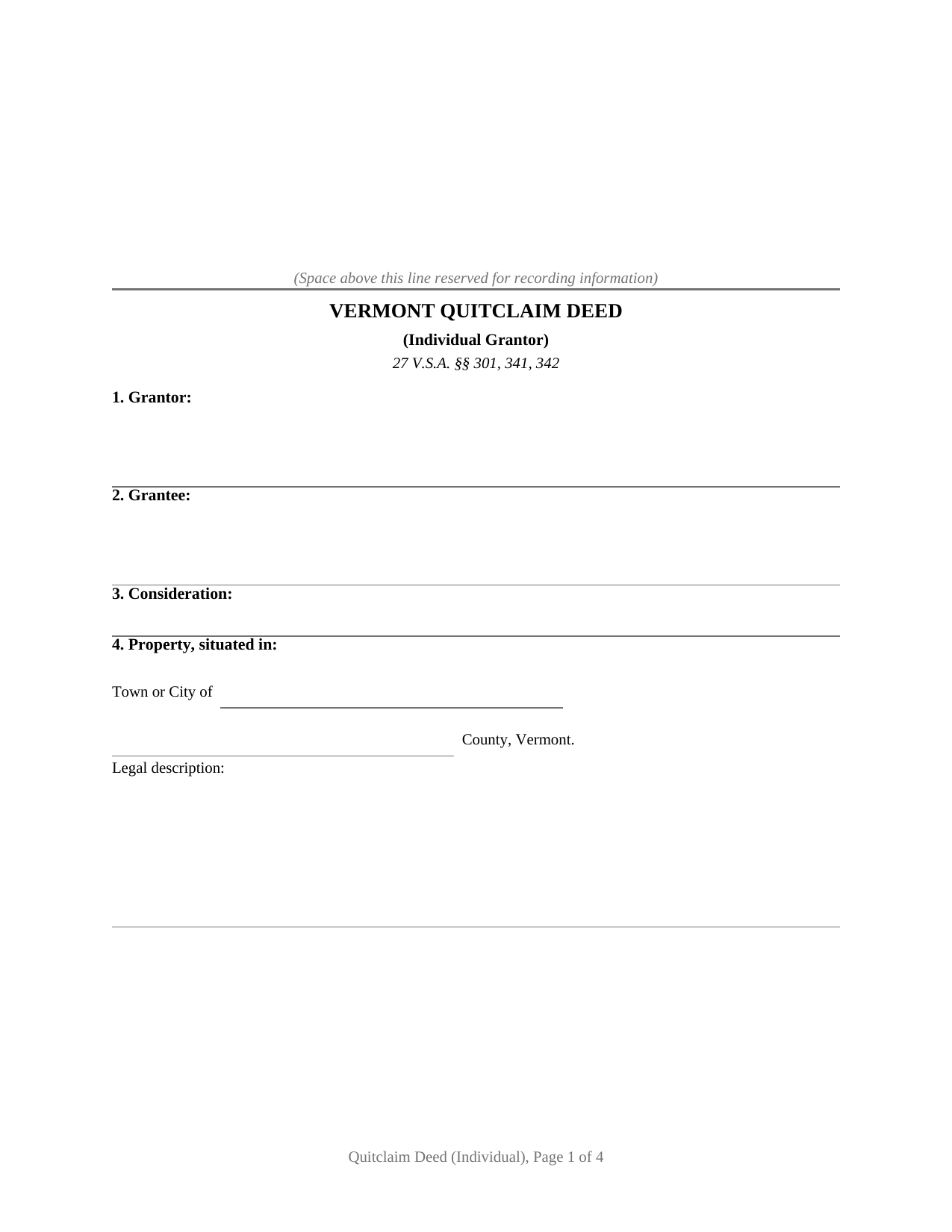
About the Vermont Quitclaim Deed (Individual)
How to Use This Form
- Select your county from the list
- Download the county-specific form
- Fill in the required information
- Have the document notarized if required
- Record with your county recorder's office
What Others Like You Are Saying
"Digital anything can be extremely convenient and quick, and my experience with Deeds.com has been ex…"
"Amazingly simple, easy to download and use. Excellent service, Thank You"
"Very pleased with deeds.com. I highly recommend them to anyone, from clueless beginners like myself …"
"Was fairly easy to complete but my situation wasn't covered so I had to make a call to get help. Wil…"
"This site is a blessing in disguise-/>"
4.8/5 from 4,836 reviews. Read all
One signature line carries this deed: a single Vermont property owner releasing whatever interest that owner holds, with one acknowledgment certificate to complete and no co-grantor blocks left over. This is a Vermont quitclaim deed set up for an individual grantor, the one-owner configuration of the instrument that also appears in searches as a quit claim deed or quick claim deed.
A release of whatever the grantor holds
Vermont has no statutory quitclaim form and no statute that implies covenants into an ordinary deed, so the instrument does its work entirely through its express words. This deed uses the traditional Vermont granting language, remises, releases, and forever quitclaims, and states plainly that it conveys only the interest the grantor holds at delivery, if any, with no covenant or warranty of title. The grantee takes subject to whatever the record already carries, which is exactly why the quitclaim form dominates transfers between people who already know the title: a divorced co-owner releasing a half interest after the decree, relatives consolidating inherited fractional shares in one name, an owner clearing a stray interest that clouds the record. Under 27 V.S.A. section 342, the deed binds the grantor and the grantor's heirs from delivery, and recording in the municipal land records is what makes it effectual against everyone else.
One grantor, and a second block that waits for the homestead
The form recites exactly one grantor. Ten numbered sections collect the grantor, the grantee, the consideration recital, the town or city and county where the land lies, the legal description, the street address, the source of title, and known matters affecting title, followed by the operative conveyance, one grantor signature block, and one acknowledgment certificate in the wording of Vermont's statutory short form. Then comes the section that distinguishes a Vermont deed from most states' one-owner forms: under 27 V.S.A. section 141, a married owner's conveyance of the homestead is inoperative as to the homestead unless the owner's spouse joins in the execution and acknowledgment. The deed carries that joinder language, a labeled joining spouse signature block, and a second acknowledgment certificate, completed only when the property conveyed is the homestead of a married grantor; in every other case the blocks stay blank and the section states on its face that it has no effect. Two co-owners releasing their interests together present a different signing pattern, with a separate signature and acknowledgment for each grantor, and this form is not set up as a two-grantor instrument.
Recorded with the town clerk, and the return that travels with the deed
Vermont records land documents by town or city, not by county, so the completed deed goes to the clerk of the municipality where the land sits, at the statewide fee of $15 per page. The filing that most often decides whether the deed is recorded the day it is presented is not the deed at all: under 32 V.S.A. section 9608, the town clerk cannot record a deed evidencing a transfer unless a complete Vermont Property Transfer Tax Return, Form PTT-172, accompanies it along with the required Act 250 certificate. The transfer tax runs 1.25 percent of value plus a 0.22 percent clean water surcharge, with a reduced bracket on the first $200,000 of a principal residence, and the exemptions in 32 V.S.A. section 9603, including certain family transfers without consideration, are claimed on the return itself. The guide walks through the return, the tax brackets, and the recording steps at the moment they come up. Execution is simple by comparison: the grantor acknowledges the deed before a notary public, no subscribing witnesses are required, and the statute makes the acknowledgment valid even without an official notary stamp.
What the download contains
The package contains the quitclaim deed as a fillable PDF with a non-recorded instructions page, a completed example showing every entry filled in for a Milton, Chittenden County fact pattern with the spousal joinder in use, and a plain language guide that covers each numbered section, the ways grantees may hold title in Vermont, the homestead joinder rule, and the recording process. The materials describe Vermont law in general terms and are not legal advice.
Important: County-Specific Forms
Our quitclaim deed (individual) forms are specifically formatted for each of the 14 counties in Vermont.
After selecting your county, you'll receive forms that meet all local recording requirements, ensuring your documents will be accepted without delays or rejection fees.