Vermont Quitclaim Deed (Trustee Grantor)
County Specific Legal Forms Validated as recently as October 1, 2026 by our Forms Development Team
About the Vermont Quitclaim Deed (Trustee Grantor)
How to Use This Form
- Select your county from the list
- Download the county-specific form
- Fill in the required information
- Have the document notarized if required
- Record with your county recorder's office
What Others Like You Are Saying
"Whole process was very easy and quick. Forms were easy to fill, examples were quite appropriate. Rec…"
"Very helpful and quick responses"
"deeds.com is user-friendly and very easy to navigate. Guides, samples, and free supplement forms are…"
"Excellent Service"
"Easy to navigate Efficient Service"
4.8/5 from 4,830 reviews. Read all
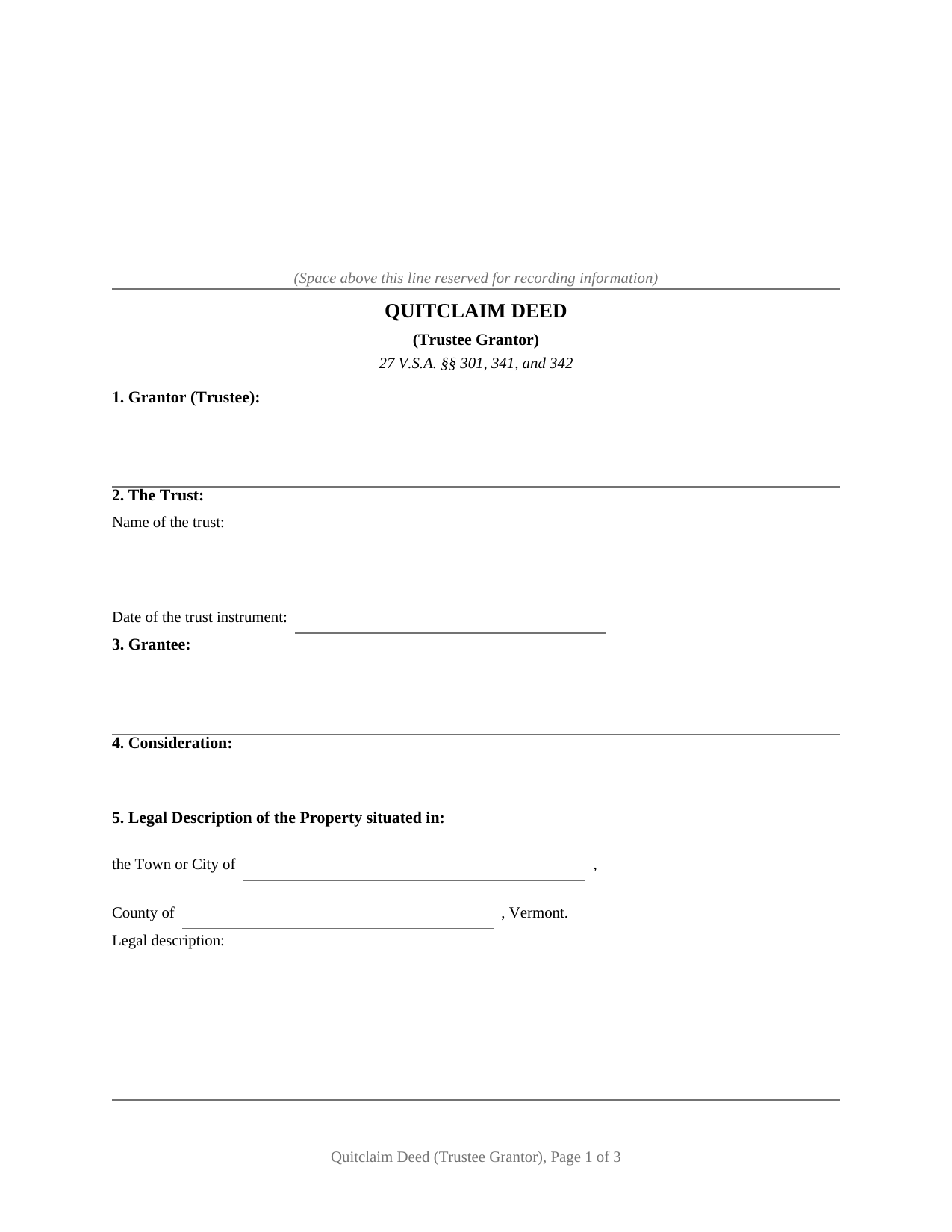
On this deed, the signature line does not belong to an individual owner in the usual sense: it belongs to a trustee, signing for a trust that holds title to Vermont real estate. This Vermont quitclaim deed is set up for the trustee grantor pattern, a deed that identifies the trust by name and date, recites that the grantor acts solely as trustee and not individually, and passes whatever interest the trust holds, without warranty of title.
A deed signed in a trustee's capacity
The grantor section names the trustee, and a dedicated trust section recites the name of the trust and the date of the trust instrument. The operative clause then remises, releases, and forever quitclaims all right, title, and interest the grantor holds as trustee, citing the trustee's power to sell and convey trust property under the trust instrument and 14A V.S.A. §§ 815 and 816, and binding the trust property rather than the trustee personally. Trusts move Vermont real estate in a handful of recurring patterns: a trustee distributing a home to a beneficiary after the settlor's death, a trustee of a revocable trust deeding property back to the settlor, and a trustee delivering a no-warranty conveyance to resolve a title question. Those transfers present the recitals this deed carries.
The form recites exactly one trustee grantor and one trust. A deed from an individual record owner, or from co-trustees whose trust instrument requires joint action, follows a different signing pattern than the single signature block and single certificate this form carries.
What a quitclaim conveys in Vermont
Vermont has no statutory quitclaim form and no statute that implies covenants of title from a deed's operative words, so the instrument's own language controls. This deed states that it conveys without covenant or warranty of title and passes only the interest, if any, the trustee holds at delivery; the grantee takes subject to whatever then affects title. That is the familiar trade of every quitclaim deed, sometimes searched as a quit claim deed or non-warranty deed: simplicity in exchange for no title promises, the reason the form appears so often in transfers between related parties and in conveyances into and out of trusts, where the parties already know the title.
The representative-capacity acknowledgment
Because the signer acts for a trust, the notary certificate on this form follows the representative-capacity short form of 26 V.S.A. § 5368(2): the record is acknowledged by the named individual as trustee of the named trust. The certificate carries the commission number element that 26 V.S.A. § 5367 lists for tangible records, and 27 V.S.A. § 341(a) makes the acknowledgment valid even without an official stamp affixed to the notary's signature. Vermont's deed statutes state no witness requirement, so one trustee signature and one certificate complete execution.
Authority is the other half of a trustee conveyance. A certification of trust under 14A V.S.A. § 1013, a sworn certificate prepared and recorded separately and not included in this package, documents the trust's existence, the trustee's identity, and the trustee's powers in the same municipal land records, and serves as conclusive proof of the matters it certifies, subject to the exceptions stated in that section.
Recording with the town clerk, not a county
Vermont keeps its land records with town and city clerks rather than county recorders, so the completed deed records in the municipality where the land lies, at the statewide fee of $15 per page. Under 32 V.S.A. § 9608, the clerk cannot record a deed unless a completed Vermont Property Transfer Tax Return, Form PTT-172, accompanies it, together with the required Act 250 certificate. The return carries its own $15 filing fee, and an exemption claim, including the exemptions for certain no-consideration trust transfers under 32 V.S.A. § 9603, is documented on that same return.
What the download contains
The download contains the blank Vermont quitclaim deed as a fillable PDF, a completed example showing the deed filled in for a Chittenden County fact pattern from the trust identification through the representative-capacity acknowledgment, and a plain-language guide that walks through every section of the form, the signing formalities, and the recording steps at the town clerk's office. The materials describe Vermont law in general terms and are not legal advice.
Important: County-Specific Forms
Our quitclaim deed (trustee grantor) forms are specifically formatted for each of the 14 counties in Vermont.
After selecting your county, you'll receive forms that meet all local recording requirements, ensuring your documents will be accepted without delays or rejection fees.