Vermont Quitclaim Deed (Interspousal)
County Specific Legal Forms Validated as recently as September 28, 2026 by our Forms Development Team
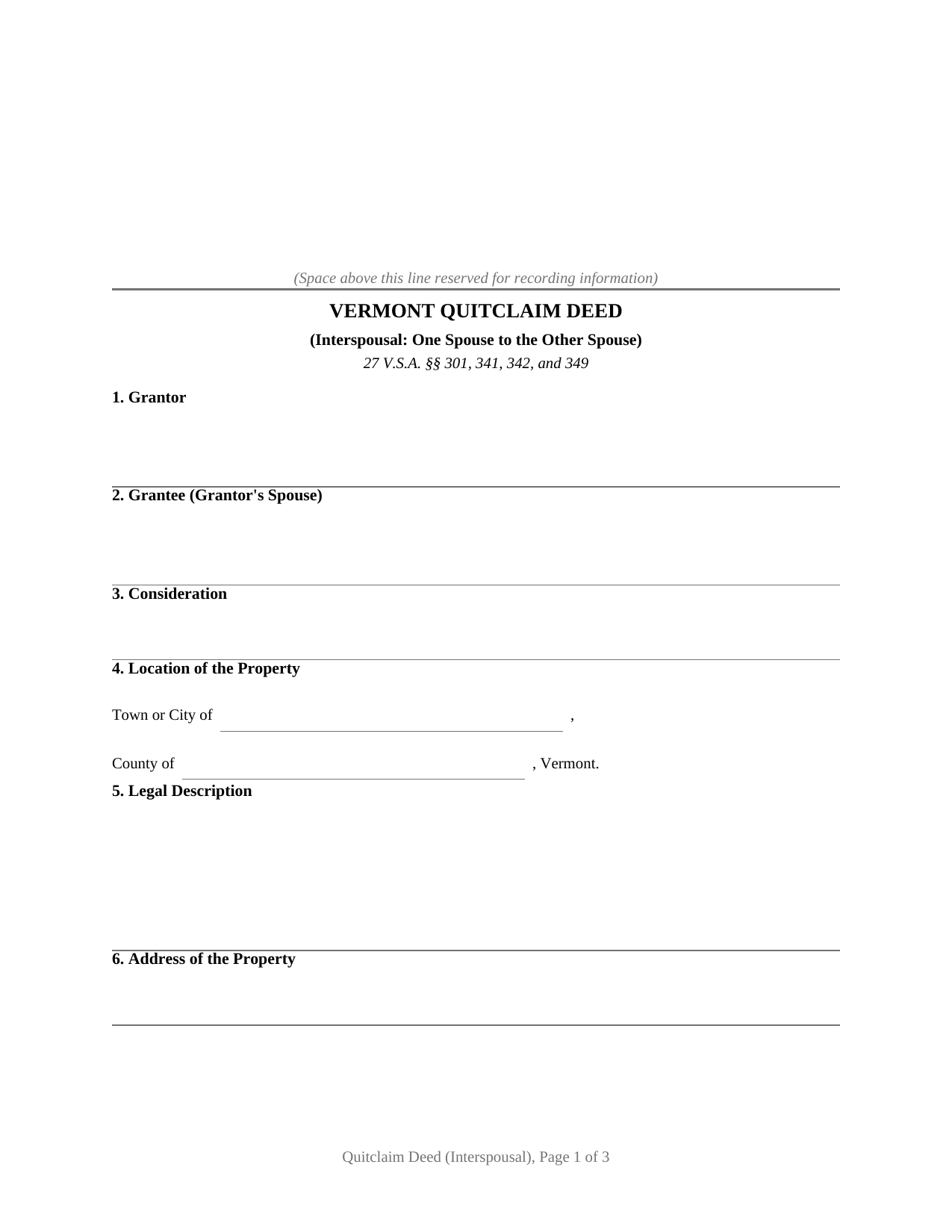
About the Vermont Quitclaim Deed (Interspousal)
How to Use This Form
- Select your county from the list
- Download the county-specific form
- Fill in the required information
- Have the document notarized if required
- Record with your county recorder's office
What Others Like You Are Saying
"Thank you very much for all your help its always a pleasure to continue working with you thanks agai…"
"excellent and simple to use. Great price for this."
"Document was easy to use and edit. It was accurate in referring to the appropriate statutes. Would u…"
"I was blown away by all the information I received for just $19.00!! I am still reading through it. …"
"I thought the forms were good but expensive, Spending almost 30 dollars for a 3 page form was a stif…"
4.8/5 from 4,830 reviews. Read all
On this deed, the work that a second signature performs on other married-owner conveyances in Vermont is done by the grantee line itself: the grantee is the grantor's spouse, so the conveyance never leaves the marriage and no joinder signature exists to collect. This is a Vermont quitclaim deed in its interspousal configuration, one spouse conveying directly to the other, the version of the quit claim deed, or quick claim deed, that searchers often reach under the name interspousal transfer deed.
Why a spouse on the grantee line changes the statutes that apply
Vermont law places two guards around a married owner's deed, and both stand down when the conveyance runs to the spouse. 27 V.S.A. section 349 bars conveying an interest in tenancy by the entirety property or homestead property to any person except the person's spouse unless the spouse joins, and the same section lets a person convey Vermont real estate directly to that person's spouse with no straw-man intermediary. 27 V.S.A. section 141(d) covers the homestead in as many words: a spouse may convey that spouse's homestead interest to the other spouse, divesting the grantor of it. This deed recites the marriage in its operative section and cites both statutes, so the record itself shows why a single signature carries a married grantor's homestead conveyance.
A bare release, inside a marriage that already knows the title
Vermont prescribes no statutory quitclaim form and implies no covenants into an ordinary deed, so the instrument speaks in its own words: the grantor remises, releases, and forever quitclaims all right, title, and interest held at delivery, if any, with no covenant or warranty of title. Between spouses that bare release is ordinarily the whole point, because the deed changes whose name carries the title rather than what the title contains. The deed binds the grantor and heirs from the moment of delivery; what recording adds, under 27 V.S.A. section 342, is effect against everyone beyond them.
One grantor, one spouse receiving, one certificate
The form recites exactly one grantor and exactly one grantee and states in the operative text that the two are married to each other. Ten numbered sections run from the parties and consideration through the description, source of title, and matters of record to the conveyance, a single grantor signature block, and one acknowledgment certificate in Vermont's statutory short form wording, with lines for the notary's printed name, commission number, and commission expiration. The grantee spouse takes sole title and signs nothing, and the form holds no signature block in reserve. A spouse who took title alone before the wedding and now places the property in the other spouse's name, an entireties couple ending the marital co-ownership so title stands in a single name, and spouses rebalancing separately held Vermont land as an estate plan changes shape all present the pattern this deed recites. The form does not recite two grantors, and it does not describe a grantee outside the marriage; each of those patterns arrives with joinder or co-grantor architecture this deed deliberately lacks.
Exempt from the tax is not excused from the return
The finished deed records with the clerk of the town or city where the land lies, Vermont keeping its land records municipally, at $15 per page. A Property Transfer Tax Return, Form PTT-172, rides with it, because 32 V.S.A. section 9608 forbids a clerk to record a deed evidencing a transfer without the completed return and the required Act 250 certificate. On this configuration the return commonly shows zero tax: 32 V.S.A. section 9603(5) exempts transfers between two spouses without actual consideration, the exemption is claimed by entering its number on the return, and the return is filed even when nothing is owed. Where value does change hands between the spouses, the general rate of 1.25 percent plus the 0.22 percent clean water surcharge applies, and the guide reaches the return, the exemption entry, and the fees as each arises.
The package
The download contains the interspousal quitclaim deed as a fillable PDF opening with a non-recorded instructions page, a completed example filled in for a Middlebury, Addison County fact pattern in which a wife conveys the home she brought into the marriage to her husband, and a plain language guide walking each numbered section, the ways a Vermont grantee may hold title, the interspousal statutes, the notary block, and the path through the transfer tax return to recording. The materials describe Vermont law in general terms and are not legal advice.
Important: County-Specific Forms
Our quitclaim deed (interspousal) forms are specifically formatted for each of the 14 counties in Vermont.
After selecting your county, you'll receive forms that meet all local recording requirements, ensuring your documents will be accepted without delays or rejection fees.