Vermont Quitclaim Deed (Reserving Life Estate)
County Specific Legal Forms Validated as recently as October 5, 2026 by our Forms Development Team
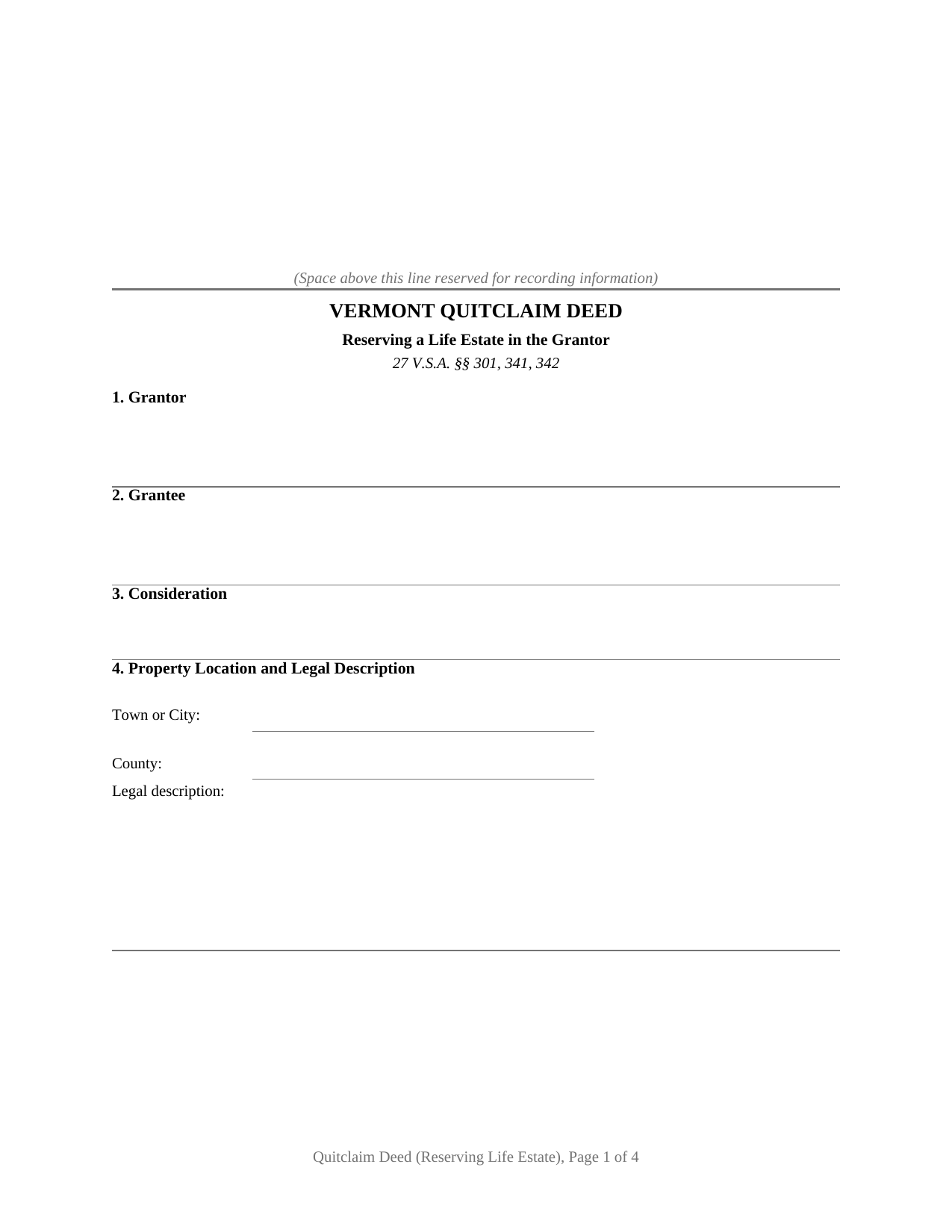
About the Vermont Quitclaim Deed (Reserving Life Estate)
How to Use This Form
- Select your county from the list
- Download the county-specific form
- Fill in the required information
- Have the document notarized if required
- Record with your county recorder's office
What Others Like You Are Saying
"This site was perfect in a time when travel is almost impossible. They asked a few questions to make…"
"I was quite pleased with Deeds.com. I got the information I requested instantly."
"Very easy to use - the completed sample was super useful"
"Great so Far!"
"Excellent service, knowledgeable and helpful representatives via the messaging service. Reliable inf…"
4.8/5 from 4,830 reviews. Read all
Two estates leave this deed, and both stand on the record the day it is filed: a life estate the grantor keeps, and a vested remainder the grantee owns from delivery. This is a Vermont quitclaim deed reserving a life estate in the grantor: one owner conveys the property without warranty while keeping the right to live on it, use it, and collect its income for life, and at the grantor's death the right to possession passes to the grantee without probate and without a second deed.
A conveyance and a reservation in the same operative clause
The deed's operative section performs both halves of the arrangement. First the conveyance: the grantor remises, releases, and forever quitclaims all right, title, and interest to the grantee, carrying no covenant or warranty of title; no Vermont statute prescribes a quitclaim form or reads covenants into a deed, so the express words are the deed's entire effect. Then the reservation: the grantor keeps a life estate, with exclusive possession, use, rents, and income for life. Recording in the town's land records under 27 V.S.A. section 342 makes the arrangement effectual against everyone beyond the grantor and the grantor's heirs.
A vested remainder, not a revocable designation
The reservation covers possession only: the deed states that the grantor retains no right or power to sell, convey, mortgage, revise, or revoke the remainder, and that it is not an enhanced life estate deed under 27 V.S.A. chapter 6, the 2020 statute governing deeds that reserve lifetime powers and leave the grantee a contingent interest. The remainder under this deed vests at delivery. The grantee's interest cannot be redirected by a later recorded revision, and a sale or mortgage of the whole property now takes the life tenant and every remainder holder signing together. Searches reach this configuration as a life estate deed, a quitclaim deed with reserved life estate, and under the quit claim deed and quick claim deed spellings.
One grantor, one reservation, a joinder block that waits
The form recites exactly one grantor. Ten numbered sections run from the parties, consideration, and property description through the source of title and matters of record to the operative conveyance and reservation, a signature block for the grantor, and a single acknowledgment certificate in Vermont's short form wording. A conditional joinder section stands ready for the married grantor: under 27 V.S.A. section 141 a homestead conveyance by a married owner is inoperative as to the homestead unless the spouse joins in executing and acknowledging it, so the form carries a joining spouse entry, signature block, and second certificate, completed only in that case. A parent deeding the farmhouse to a daughter while continuing to live in it, and an owner passing the camp to the next generation with lifetime use reserved, present the pattern this deed recites. A release of the entire title with nothing held back, co-owner grantors signing together, and trustee or entity signers each follow a different signing architecture this form does not carry.
Fifteen dollars a page, and a return that reports a life estate
Vermont keeps its land records municipally, so the deed records with the clerk of the town or city where the property lies, at the statewide $15 per page. Under 32 V.S.A. section 9608 the clerk cannot take a transfer deed of record until a completed Vermont Property Transfer Tax Return, Form PTT-172, and its required certificate accompany it. The return identifies the kind of interest the deed moves, and the Department of Taxes materials for the return list a life estate among the interest categories it reports. Many deeds in this pattern are family gifts, and 32 V.S.A. section 9603(5) exempts transfers between parent and child, grandparent and grandchild, or spouses without actual consideration, claimed by number on the return; where tax is due, the general rate is 1.25 percent of value plus the 0.22 percent clean water surcharge.
What the download holds
The package holds the deed as a fillable PDF opening with a non-recorded instructions page, a completed example worked through for a Bennington, Bennington County fact pattern in which a mother conveys her home to her son and reserves a life estate for herself, and a plain language guide treating each numbered section, the ways grantees may hold the remainder under Vermont law, the reservation and homestead statutes, notarization, and the transfer tax return. The materials describe Vermont law in general terms; they are not legal advice.
Important: County-Specific Forms
Our quitclaim deed (reserving life estate) forms are specifically formatted for each of the 14 counties in Vermont.
After selecting your county, you'll receive forms that meet all local recording requirements, ensuring your documents will be accepted without delays or rejection fees.