Vermont Quitclaim Deed (Married Grantor with Non-Owner Spouse Joinder)
County Specific Legal Forms Validated as recently as October 14, 2026 by our Forms Development Team
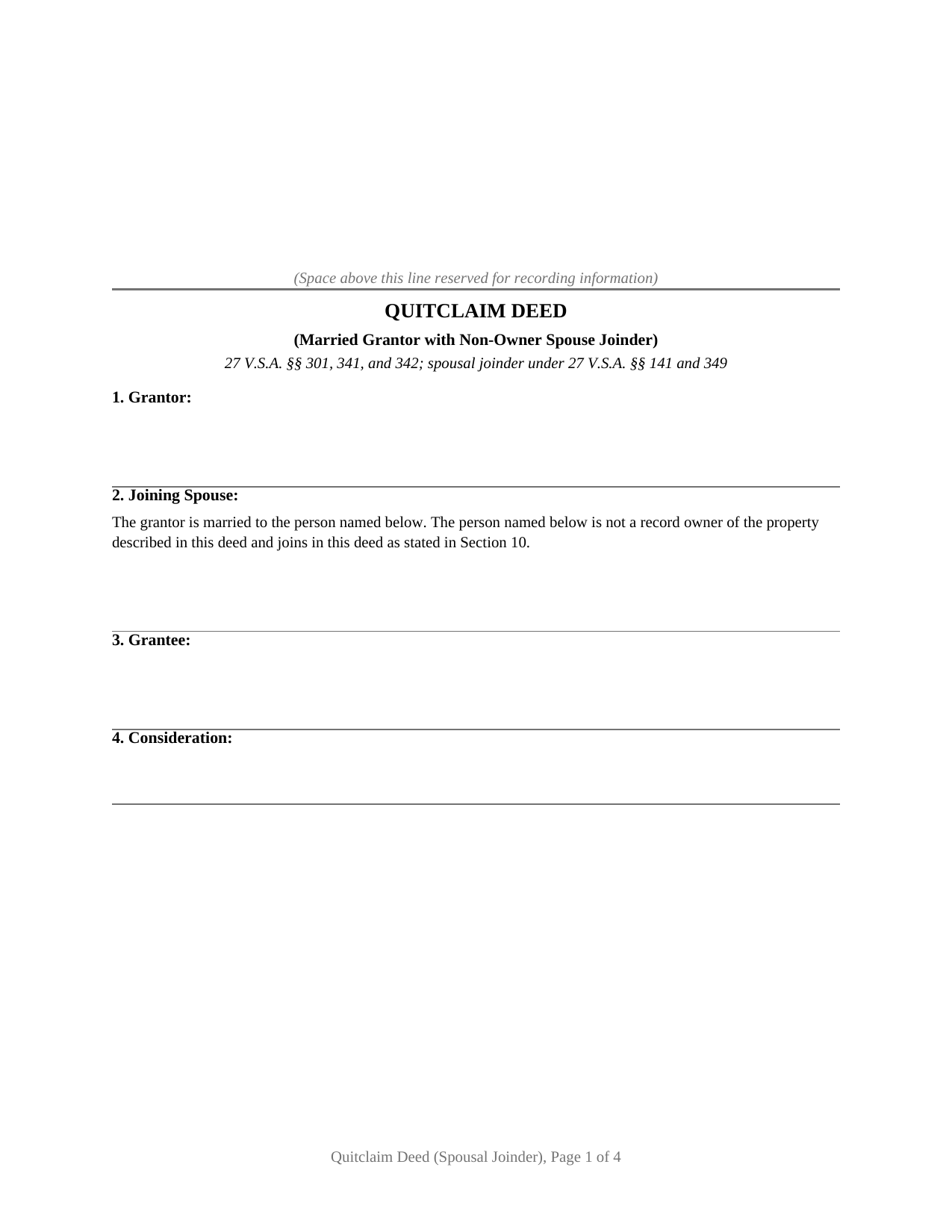
About the Vermont Quitclaim Deed (Married Grantor with Non-Owner Spouse Joinder)
How to Use This Form
- Select your county from the list
- Download the county-specific form
- Fill in the required information
- Have the document notarized if required
- Record with your county recorder's office
What Others Like You Are Saying
"The process was a little confusing to understand at first for someone like me with no experience doi…"
"It was actually very easy to use and not very expensive. I'm glad I tried it out"
"Great response and painless. Very easy to use"
"Easy to understand and work with Very pleased with the information I Received"
"My document got recorded right away. Thank you! Will use again in the future when needed."
4.8/5 from 4,836 reviews. Read all
The second signature on this deed conveys nothing, and without it the deed could quietly fail as to the family home. This Vermont quitclaim deed is drawn for a married grantor who holds record title alone, with the grantor's non-owner spouse joining in the execution and acknowledgment of the conveyance; searchers reach this configuration of the quit claim deed, or quick claim deed, while looking for the version with the spousal consent built in.
Why Vermont asks for a signature from someone who is not on the title
Under 27 V.S.A. section 141, a homestead or an interest in one shall not be conveyed by a married owner, outside a purchase money mortgage given at purchase, unless the owner's spouse joins in the execution and acknowledgment of the conveyance, and a conveyance made without that joinder is inoperative as far as the homestead reaches. A companion statute, 27 V.S.A. section 349, keeps homestead property and tenancy by the entirety interests from passing to a nonspouse without the spouse joining. Neither statute cares whose name the vesting deed carries: title taken before the marriage, or received by gift or inheritance in one name alone, still sits under the joinder rule once the property serves as the couple's home. The sole-signed deed from a grantor the record later shows to have been married is a recurring Vermont title defect, and it tends to surface years afterward, in someone else's closing.
One owner of record, two names before the notary
The form recites exactly one grantor, and directly after the grantor a numbered section identifies the joining spouse, reciting the marriage and stating that the person named holds no record ownership. The operative section carries the grantor's release alone: the grantor remises, releases, and forever quitclaims whatever right, title, and interest the grantor holds at delivery, if any, with no covenant or warranty of title, Vermont having no statutory quitclaim form and no statute implying covenants into an ordinary deed. The joinder section then does the statutory work, reciting that the spouse joins in the execution and acknowledgment under sections 141 and 349 and releases all homestead rights without becoming a grantor of any recorded interest. Two signature blocks and two acknowledgment certificates in the statutory short form wording follow, and every one of them is completed at every signing; nothing on this form waits in reserve. A grantor who took title in one name before the wedding and now deeds the home place to an adult child presents the pattern this deed recites; so does a sole-titled owner whose conveyance a title examiner would question the moment the record reveals the marriage. The form is not set up as a deed for two record owners, and it does not describe an unmarried grantor; each of those patterns carries a different signing architecture.
Two certificates, one trip to the clerk
Section 141 requires the spouse to join in the acknowledgment as well as the execution, so the joining spouse's notarized certificate is not a courtesy. The form carries a separate certificate for each signer, in the wording of Vermont's statutory short form, and the two acknowledgments can happen together or on different days before different notaries. The finished deed records with the clerk of the town or city where the land lies, Vermont keeping no county deed records, at $15 per page, and 32 V.S.A. section 1405 lets the recording official require each signer's name typed or printed under the signature, a $2 add-on the form's printed name lines head off. One completed Property Transfer Tax Return, Form PTT-172, accompanies the deed, since 32 V.S.A. section 9608 stops a clerk from recording a transfer document without the completed return and the required Act 250 certificate; the guide reaches the return, the current rates, and the family-transfer exemptions at the step where each arises.
What comes in the download
The download contains the deed as a fillable PDF with a non-recorded instructions page at the front, a completed example worked through for a Rutland, Rutland County fact pattern in which a father deeds a pre-marriage home to his daughter with his wife joining, and a plain language guide that walks the numbered sections, the forms of Vermont co-ownership a grantee entry can carry, the joinder statutes, the notarization details, and the recording and transfer tax steps. The materials describe Vermont law in general terms and are not legal advice.
Important: County-Specific Forms
Our quitclaim deed (married grantor with non-owner spouse joinder) forms are specifically formatted for each of the 14 counties in Vermont.
After selecting your county, you'll receive forms that meet all local recording requirements, ensuring your documents will be accepted without delays or rejection fees.