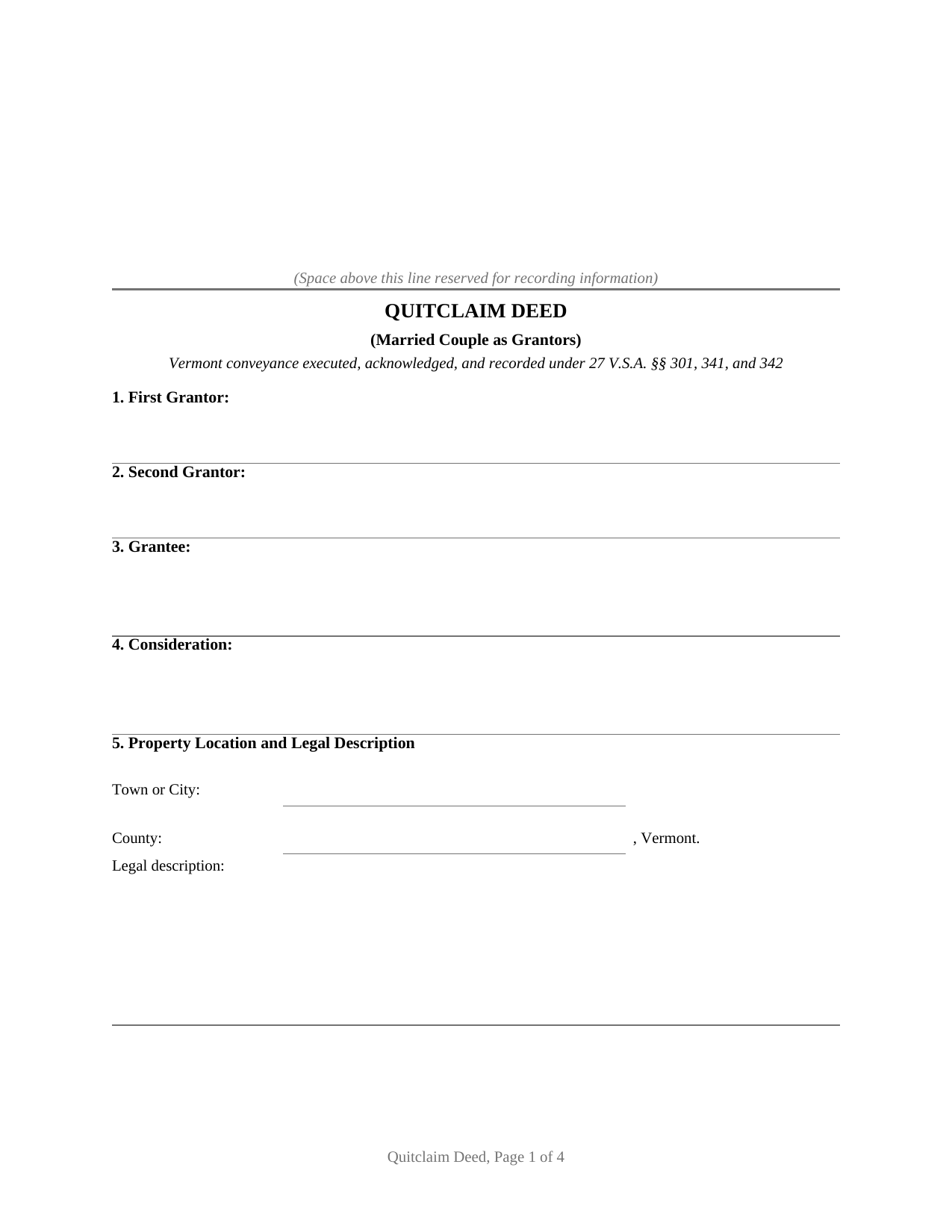
Vermont Quitclaim Deed (Married Couple as Grantors)
County Specific Legal Forms Validated as recently as September 18, 2026 by our Forms Development Team
About the Vermont Quitclaim Deed (Married Couple as Grantors)
How to Use This Form
- Select your county from the list
- Download the county-specific form
- Fill in the required information
- Have the document notarized if required
- Record with your county recorder's office
What Others Like You Are Saying
"Forms were not to hard to fill out, Will go to Douglas County Oregon Recorders office in a few weeks…"
"Outstanding service. The quit claim Deed form was great. Very easy to use and explained very clearly…"
"Fast, honest company Worth every penny! DO IT YOURSELF SAVE THOUSANDS"
"I was able to get the documents I wanted, and very quickly. Good service."
"I was searching information about my boyfriend family home and received the results in a timely mann…"
4.8/5 from 4,823 reviews. Read all
The operative section of this deed carries a recital most quitclaim forms never print: the two grantors are married to each other, and each of them executes and acknowledges the conveyance. This is a Vermont quitclaim deed built for a married couple signing together as grantors, the husband-and-wife configuration of the instrument that searchers also reach as a quit claim deed or quick claim deed.
The recital that retires the homestead question
Vermont statute makes a married owner's conveyance of the homestead inoperative as to that homestead unless the owner's spouse joins in both the execution and the acknowledgment, 27 V.S.A. section 141, and a companion statute, 27 V.S.A. section 349, keeps an interest in tenancy by the entirety property or homestead property from passing to a nonspouse without the spouse joining. On this deed those requirements never wait in a conditional block near the signature lines, because the joinder is the deed's own signing architecture: both spouses are grantors, both execute, both acknowledge, and the marriage recital in the operative section places that joinder on the face of the record. Ten numbered sections, and not one of them is a spare. Every signature line on this form is used at every signing, the quiet difference between the married-couple build and forms that hold joinder machinery in reserve for a spouse who is not a grantor.
What each spouse releases
Vermont implies no covenants into an ordinary deed and prescribes no quitclaim form, so the instrument speaks entirely through its stated terms: each spouse remises, releases, and forever quitclaims that spouse's own right, title, and interest, whatever it turns out to be at delivery, with no warranty of title. For property held by the entirety, where the Vermont Supreme Court has said neither spouse holds a separate share that can be disposed of without the other, the two releases in a single instrument pass the whole marital estate in one recording. And under 27 V.S.A. section 342, it is recording with the municipal clerk that makes the conveyance effectual against anyone beyond the grantors and their heirs.
Two spouses, two certificates, one marital estate
The form recites exactly two grantors who are married to each other, each with an identity section of that grantor's own, followed by a single grantee entry that accepts one or more grantees with any vesting words Vermont recognizes under 27 V.S.A. section 2. Each spouse signs a separate block, and each signature feeds a certificate of its own in the statutory short form wording; a couple can acknowledge together on one visit, as the completed example shows, or separately, before different notaries. Spouses deeding the marital homestead to the trustees of their revocable trust, and a married couple releasing entireties land to a neighbor in a boundary line adjustment, present the pattern this deed recites. The form does not recite a sole owner's release, and it does not describe co-owners who are unmarried or married to third parties; those patterns carry conditional joinder blocks this deed deliberately omits.
At the clerk's counter
The finished deed records with the clerk of the town or city where the land lies, Vermont keeping municipal rather than county land records, at $15 per page. A married couple's conveyance changes none of the tax mechanics: one Property Transfer Tax Return, Form PTT-172, travels with the deed, and 32 V.S.A. section 9608 stops the clerk from recording without the completed return and the required Act 250 certificate. Where the conveyance moves title without consideration, a deed into the couple's own revocable trust being a common instance, the exemptions of 32 V.S.A. section 9603 are claimed on that return, and a return is filed even when no tax is due.
Inside the package
The download holds the deed as a fillable PDF opening with a non-recorded instructions page, a completed example filled in for a Montpelier, Washington County couple deeding their home to themselves as trustees of a revocable trust, and a plain language guide covering each numbered section, the ways grantees may hold Vermont title, the joinder statutes, and the path through recording and the transfer tax. The materials describe Vermont law in general terms and are not legal advice.
Important: County-Specific Forms
Our quitclaim deed (married couple as grantors) forms are specifically formatted for each of the 14 counties in Vermont.
After selecting your county, you'll receive forms that meet all local recording requirements, ensuring your documents will be accepted without delays or rejection fees.