Vermont Quitclaim Deed (Trustee Grantee)
County Specific Legal Forms Validated as recently as October 16, 2026 by our Forms Development Team
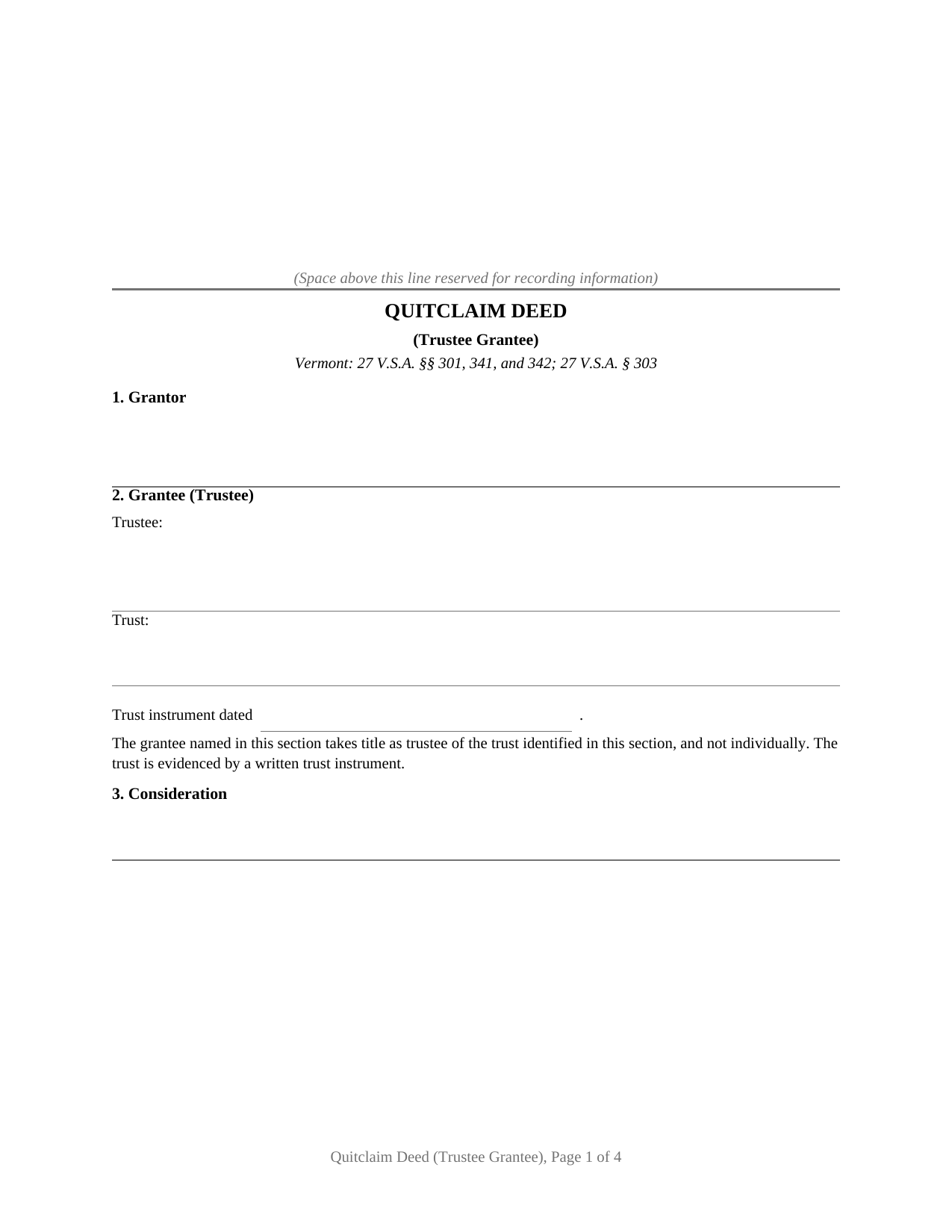
About the Vermont Quitclaim Deed (Trustee Grantee)
How to Use This Form
- Select your county from the list
- Download the county-specific form
- Fill in the required information
- Have the document notarized if required
- Record with your county recorder's office
What Others Like You Are Saying
"Death of JT form was excellent. You have the best documents out there. I wish I could have read the …"
"Very user friendly website and service."
"This is perfect! Thank you!"
"To set the service was incredibly easy and the results came back very fast. Very reasonable price."
"I planned to use an attorney for this process but deeds.com made it so easy I was able to do it myse…"
4.8/5 from 4,831 reviews. Read all
The grantee entry on this deed names a person and an office at once: title passes to the named trustee, as trustee of an identified trust and not individually, so the land answers to the trust instrument, not to the trustee's personal affairs. This is a Vermont quitclaim deed configured for a trustee grantee, the deed-into-trust build of the instrument that searchers also reach as a quit claim deed, a quick claim deed, or simply a deed to a trust.
A capacity recital that changes what the grantee line means
A Vermont deed to an individual makes that individual the owner; a deed to a trustee makes the trust instrument the rulebook. The capacity recital in the grantee section states that the grantee takes as trustee and not individually, and the conveyance runs to the trustee's successors in trust, so title follows the office when trustees change. Vermont statute stands behind both halves: 27 V.S.A. section 303 requires an express trust concerning lands to rest on a signed written trust instrument, and 27 V.S.A. section 2 excludes conveyances to trusts from its tenancy in common default for co-owner deeds.
No straw man, and no warranty either
The most common trustee grantee deed in Vermont runs from an owner to that same owner in a different capacity, which 27 V.S.A. section 349 permits directly, with no intermediary party. The instrument stays a true quitclaim: the grantor remises, releases, and forever quitclaims whatever right, title, and interest exists at delivery, if any, with no covenant or warranty of title, a bare release customary in trust funding because the deed changes the capacity in which title is held, not the title itself. Recording with the municipal clerk under 27 V.S.A. section 342 is what makes the conveyance good against everyone beyond the grantor and the grantor's heirs.
The configuration: one grantor, a three-part grantee entry
The form recites exactly one grantor. Its grantee section collects three entries, the trustee's name and mailing address, the trust's name as the trust instrument states it, and the instrument's date, followed by the capacity recital. Eleven numbered sections run through consideration, location, legal description, source of title, and matters of record to the operative conveyance, one grantor signature block, and an acknowledgment certificate in Vermont's statutory short form wording; a conditional homestead joinder under 27 V.S.A. section 141 sits ahead of the signature blocks for the married grantor case and stays blank at every other signing. An unmarried owner placing her home in her revocable living trust, and an owner retitling a woodlot in the name of the trustee of a family trust, present the pattern this deed recites. The form is not set up as a deed from a trustee, which is signed in a representative capacity under a different recital, and it does not recite co-owner grantors or spouses conveying together; those patterns arrive with a different signing architecture.
A tax exemption written with trusts in mind
The deed records with the clerk of the town or city where the land lies, at Vermont's statewide $15 per page, and a completed Property Transfer Tax Return, Form PTT-172, accompanies it; 32 V.S.A. section 9608 forbids the clerk to accept a transfer deed without the return and the required Act 250 certificate. Trust funding has its own lines in that paperwork: 32 V.S.A. section 9603(5) exempts a transfer in trust without actual consideration to the extent the benefit runs to the donor or listed relatives, section 9603(6) exempts a mere change in ownership form with no change in beneficial ownership, and the return asks whether the transferee is the grantor's revocable trust. Where tax is due, the general rate is 1.25 percent plus the 0.22 percent clean water surcharge. A companion instrument serves the years after recording: the certificate of trust under 14A V.S.A. section 1013, sworn by the trustee, documents the trustee's authority in the land records without exposing the trust's dispositive terms; it is prepared and recorded separately and is not included in this package.
What downloads
The package contains the deed as a fillable PDF, its first page a non-recorded instructions sheet, a completed example showing a Woodstock, Windsor County owner conveying her home to herself as trustee of her revocable trust, and a plain language guide covering each numbered section, the ways a Vermont grantee may hold title, the trust and joinder statutes, notarization, and the recording and tax steps. The materials describe Vermont law in general terms and are not legal advice.
Important: County-Specific Forms
Our quitclaim deed (trustee grantee) forms are specifically formatted for each of the 14 counties in Vermont.
After selecting your county, you'll receive forms that meet all local recording requirements, ensuring your documents will be accepted without delays or rejection fees.